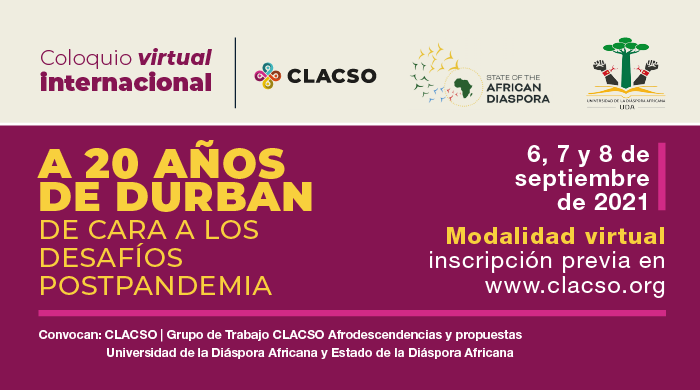
Virtual international colloquium: 20 years after Durban facing post-pandemic challenges
Virtual format – September 6, 7 and 8, 2021
Second circular
The Latin American Council of Social Sciences , the Working Group on Afro-descendants and counter-hegemonic proposals and the University of the African Diaspora , together with the State of the African Diaspora , convene the International Colloquium “20 years after Durban facing the challenges of the post-pandemic”.
Twenty years have passed since the World Conference against Racism, Xenophobia and Related Intolerance, held in 2001 in Durban, South Africa. This event systematized a process capable of providing humanity with the most powerful anti-racist program to date, the result of a broad and diverse international consensus and Afro-descendant leadership.
Today, the midpoint of the International Decade for People of African Descent (2015-2024) has passed. However, the Decade's founding goals—recognition, justice, and development—show limited progress and continue to define an enormous racialized and feminized social debt. The impacts of the COVID-19 pandemic and other endemic pandemics are being faced within a context of reconfiguration and intensification of racism, marked by necropolitics (Mbembe, 2018).
In Latin America and around the world, it is becoming increasingly clear that achieving sustainable development without dismantling the matrix of inequality and the culture of privilege is impossible. This reinforces the significance of Afro-descendant issues as a field of study and political action.
“It is not possible to overcome the great challenges facing the region, deeply exacerbated in the context of the Pandemic, and to move towards equality on the path of inclusive development as a fundamental pillar of a new model of sustainable development without undertaking decisive actions to advance in the recognition, protection and guarantee of the rights of the Afro-descendant population (Economic Commission for Latin America and the Caribbean, 2020).
Meanwhile, the Afro-descendant movement continues to grow, expand, diversify, and renew itself by promoting new forms of struggle, new avenues for political influence, new actors involved, and new strategic alliances. The development of networks, Afro-feminist leadership, and the influence of new generations of Afro-descendants on political platforms at the national, local, and global levels, among other trends, demonstrate this.
OBJECTIVES
To take stock of the situation of Afro-descendant populations in Latin America and the Caribbean 20 years after the Durban Declaration and Plan of Action.
To make visible the thought and political and organizational action of Afro-descendants and their contributions to the anti-racist struggle.
To build joint actions of research, training, dissemination and political action as part of the anti-racist struggle to face the post-pandemic context.
Coordinators: Jhon Antón Sánchez (Ecuador), Julio Pereyra (Uruguay) and Gloria E. Amézquita Puntiel (Dominican Republic)
Confronting racism and its impact on the lives of racialized people is a monumental challenge. Atomization and division have been key instruments of the dominant system to prevent othered, marginalized, excluded, impoverished, and exploited people from organizing to subvert the prevailing order. From contexts of oppression and dehumanization, Afro-descendant people have resisted and re-existed with one of the most evident expressions of humanity, emancipation, emotional intelligence, and strategic thinking: the capacity to organize ourselves in networks. These networks have guaranteed everything from biological and cultural survival to the development of revolutions. Given this transcendent role that networks have played in our struggles, we invite you to join us in this thread by sharing: – The history of our networks and their role in history; critical and decolonial analysis of the theoretical and methodological approaches developed for the study of networks; reflections on solidarity, revisiting the concept and its practical manifestations from the perspective of Afro-experience; Mapping and characterization of our networks, their scope, objectives, forms of organization, activities, results and impacts; analysis of the relationships between the networks and public policies, programs and development projects focused on Afro-descendant populations; assessments of network work, based on good practices and lessons learned from ancestral and current experiences; and proposals to strengthen our networks and their political influence.
Coordinators: Geydi Fundora (Cuba), Shari García (Colombia) and Melvin Brow (Panama)
This call for papers analyzes the scope and impact of the International Decade for People of African Descent and the 2030 Agenda on the realities and development of Afro-descendant communities in Latin America and the Caribbean. These communities await urgent action from States to promote recognition, justice, and development—three actions closely linked to the initiatives championed by the 2030 Agenda. Papers are expected to examine the effects of racism, racial discrimination, xenophobia, and related forms of intolerance on the lives of Afro-descendants, and to analyze and evaluate the Decade's impact on the development of public policies that address the challenges faced by Afro-descendants.
Coordinators: Ayrlín Pérez (Colombia), Yoania Pulgarón (Cuba) and Esther Falcão de Jesus (Brazil)
How are the identity experiences of Black and Afro-descendant children and youth reconstructed amidst structural racism, systematic state violence, and the criminalization of their bodies? The Black and Afro-descendant Children and Youth axis opens spaces for building pathways for debate and critical analysis of the current situation of Afro-descendant children and youth in the region; attempting to explore, through the articulation of knowledge, experiences, and understanding, new paths of epistemic re-existence, social mobilization, and political advocacy to contribute to justice and respect for the dignity of this population group as a historical and ancestral debt.
Coordinators: Carlos Álvarez Nazareno (Argentina), Oswaldo Bilbao (Peru), and Catherine Mckinley (Costa Rica)
Historically, people of African descent have migrated to develop new strategies to improve their quality of life and development. While Europe increases its barriers with racist and xenophobic rhetoric, separatist and neoconservative political groups and parties have managed to establish themselves institutionally and in positions of power within various spheres of European governments, explicitly exacerbating racism and xenophobia. Latin America has become a “new” destination and migration hub for hundreds of thousands of African and Afro-descendant migrants and asylum seekers. In this context, there are numerous challenges to promoting the integration of migrants and refugees, particularly those of African descent. State responses through social policies in a post-pandemic scenario require the active participation of these groups, which have been particularly affected. The racialized pandemic highlighted the differentiated impacts on Afro communities and migrant groups, particularly in Latin America. The objective of this section is to analyze the migratory patterns and mobility of people of African descent and Africans, examining these flows in various countries, their processes and challenges for integration, and the specific policies implemented by states. It also aims to propose and promote anti-xenophobic and anti-racist practices, along with their challenges and implications.
Coordinators: Helena Veloso (Angola), Jacques Bertrand Mengue Moli (Cameroon) and Collins Nnabugwu (Nigeria)
The African continent, known as the cradle of humanity, is also, as Mallence Bart-Williams demonstrates almost effortlessly, the richest in the world. Africa has withstood the turmoil that has marked its history, a greed for its natural wealth that led to the expropriation of its lands and resources and the abduction of its people. These same riches and its young population are also the factors identified by a variety of theorists as potentially making Africa the land of the future. But what paths should be followed to build that future for Africa? How can history be rewritten to achieve this outcome? Following these paths means answering the question: how to resist the appropriation and subjugation of Black power (its aesthetics, its knowledge, its culture, its very being, its currency, its identity, its value, among other infinite riches) perpetuated by neocolonialism. Children of Africa, come and build that answer by accepting the invitation to participate in this forum, which we hope will be an exciting event.
Coordinators: Santiago Arboleda (Ecuador), Jorge García (Colombia) and Jackeline Romio (Brazil)
The notion of ecogenoethnocide is an interpretive perspective on the reality of Black peoples and other “subaltern” groups in Latin America and the Caribbean. It refers fundamentally to the ways in which states and their military apparatuses, in alliance with global industrial capital, engage to dismantle, violate, and exterminate populations that keep alive the wounds of colonialism in the fields and territories of the Americas. Indeed, the violence of extermination against racialized territories, cultures, and epistemologies can be understood historically as a reproduction of the racist colonial model. This violence of extermination has resulted in massacres, land dispossession, forced disappearances, forced migration, femicides, and exacerbated sexual violence against Black and Indigenous women, among other atrocious crimes and acts of victimization. This reproduction of seemingly endless colonial racist practices has, in recent times, at least in the cases of Colombia and Brazil, and without prejudice to what is happening in other countries of the Americas, intensified into epistemicidal, genocidal, and femicidal violence. Although the politics of death employed by states and defenders of the global economy savagely affect Afro-descendant communities in general, it is the thinkers within these communities who bear the brunt of the violence, both in rural and urban areas. The recurring assassination and persecution of social leaders, which various Black feminist thinkers have termed political epistemicides and femicides, is part of the agenda of patriarchal racial capitalism. Faced with these events, several questions arise: What are the factors historically, religiously, politically, and epistemologically associated with a supposed historical immunity from racial and gender-based violence against Afro-descendant populations in the Americas? Is a transformation of the state model and cultural model possible in countries that favors the African diaspora? What influence do Black intellectual collectives and movements in the Americas have on state policies regarding Afro-descendant populations? What are the advantages and limitations of the notion of ecogenoethnocide as an analytical and interpretive perspective on the complexities of Afro-descendant peoples? What alternatives have Afro-descendant communities developed to address racism and state violence? How can we interrelate the connections between the notions of ecogenoethnocide, epistemicide, and femicide to analyze the situation of extreme human rights violations against Afro-descendant populations in Latin America?
Coordinators: José Antonio Caicedo (Colombia), Teresa Mojica (Mexico) and Natividad Guerrero (Cuba)
As a result of the demands of Afro-descendant organizations in Latin America during the second half of the 20th century, the various peoples of the African diaspora achieved significant gains in their fundamental rights. Particularly in the field of education, the demand for projects aligned with the historical, territorial, and cultural realities of Black communities became one of the most important issues for transforming hegemonic education and its practices of deculturation. In Colombia, this process was called Afro-Colombian ethno-education, and in Brazil, quilombola education. Ethnically relevant education has been one of the fundamental achievements of the peoples of the African diaspora in the Americas, demonstrating diverse processes, methods, and approaches to decolonizing education. After almost thirty years of implementing these processes in various Latin American countries, it is necessary to examine their achievements, progress, and, above all, the challenges of ethno-education in the current continental context. In this regard, this theme invites submissions that characterize the processes leading to the development of these policies, their main achievements and scope, as well as the various actors involved. Particular interest lies in the development of comparative analyses at the national or international level, their potential for integration, and the challenges at the national and transcontinental levels.
Coordinators: Santiago Arboleda (Ecuador), Jorge García (Colombia) and Jackeline Romio (Brazil)
The notion of ecogenoethnocide is an interpretive perspective on the reality of Black peoples and other “subaltern” groups in Latin America and the Caribbean. It refers fundamentally to the ways in which states and their military apparatuses, in alliance with global industrial capital, engage to dismantle, violate, and exterminate populations that keep alive the wounds of colonialism in the fields and territories of the Americas. Indeed, the violence of extermination against racialized territories, cultures, and epistemologies can be understood historically as a reproduction of the racist colonial model. This violence of extermination has resulted in massacres, land dispossession, forced disappearances, forced migration, femicides, and exacerbated sexual violence against Black and Indigenous women, among other atrocious crimes and acts of victimization. This reproduction of seemingly endless colonial racist practices has, in recent times, at least in the cases of Colombia and Brazil, and without prejudice to what is happening in other countries of the Americas, intensified into epistemicidal, genocidal, and femicidal violence. Although the politics of death employed by states and defenders of the global economy savagely affect Afro-descendant communities in general, it is the thinkers within these communities who bear the brunt of the violence, both in rural and urban areas. The recurring assassination and persecution of social leaders, which various Black feminist thinkers have termed political epistemicides and femicides, is part of the agenda of patriarchal racial capitalism. Faced with these events, several questions arise: What are the factors historically, religiously, politically, and epistemologically associated with a supposed historical immunity from racial and gender-based violence against Afro-descendant populations in the Americas? Is a transformation of the state model and cultural model possible in countries that favors the African diaspora? What influence do Black intellectual collectives and movements in the Americas have on state policies regarding Afro-descendant populations? What are the advantages and limitations of the notion of ecogenoethnocide as an analytical and interpretive perspective on the complexities of Afro-descendant peoples? What alternatives have Afro-descendant communities developed to address racism and state violence? How can we interrelate the connections between the notions of ecogenoethnocide, epistemicide, and femicide to analyze the situation of extreme human rights violations against Afro-descendant populations in Latin America?
Coordinators: Claudia Miranda (Brazil), Bernd Reiter (United States) and Aquiles Castro (Dominican Republic)
Understanding historical Afro-existence and Afro-descendant resistance is fundamental for new, more radical paths, ones that run counter to “necropower.” Recovering interpretive links and expanding the provocations included in the agenda of the International Decade for People of African Descent (2015-2024) are objectives that form part of our collective and Afro-diasporic challenges. To pursue an inclusive perspective, capable of incorporating social rights and anti-racist agendas, in our region (Latin America and the Caribbean), historiographical revision gains centrality, as does highlighting successful initiatives involving our community-based institutions. This requires movements to reconnect with the cartographies that have been colonially suppressed. We also situate the debate on our other strategies based on the evidence of the important path already forged. Through all of this, we learn about anticolonial pedagogies and decolonizing sociopolitical practices. In this section, we invite individuals and groups aligned with a revitalizing approach to engage with us, offering a fresh perspective on the Global South. We encourage them to present their critiques to guide alternative approaches, while continuing to raise fundamental questions for interpreting the challenging wave we face with the global health crisis and the multiple political crises.
Coordinated by: Anny Ocoró Loango (Colombia), Joselina Da Silva (Brazil) and Lourdes Adriana Martínez Betervide (Uruguay)
As we know, the effects of the pandemic are far more dramatic for the most disadvantaged sectors, as they suffer from historical economic and gender inequalities, as well as racism and discrimination. This is the reality for a large part of the Afro-descendant, Indigenous, and African migrant population in the region, especially women. Given this context, this theme invites submissions that analyze the impact of the pandemic on racialized women, paying particular attention to the actions, agency, and strategies they have implemented to resist the effects of the current health and economic crisis. It is also expected that submissions will analyze the reconfigurations of racism during the pandemic and its impact on racialized women.
Coordinators: Karina Bidaseca (Argentina), Roberto Borges (Brazil) and Glodel Mezilas (Haiti)
The theme of Art and Marronage translates the power of the imagination against all forms of subjugation or domination. In the colonial context, songs, dances, and pictorial figures represented strategies of aesthetic, symbolic, metaphysical, and even ethical rebellion against the hegemony of Christian symbolism and structural racism. In the current postcolonial context, Art and Marronage refers to the imagery of marronage, escapes, and bodies in motion, which imprint their mark on artistic and performative productions understood as a transfer of vital energies and as the construction and strengthening of Black identities in different media contexts. These are practices that escape closed compartments, that value marronage, that make escape into revolt and the possibility of an alternative world. Funk, rap, and Black cinema as weapons of war against racism. Visual and sound artists are invited to send us their contributions.
Coordinators: Elizabeth Castillo Guzmán (Colombia), Paulo Vinicius (Brazil) and María del Carmen Zabala (Cuba)
As a result of the struggles of Afro-descendant populations, in conjunction with the impetus provided by the Durban Declaration and the will of some progressive governments, various affirmative action initiatives in higher education have taken place in the region over the last fifteen years, primarily in Brazil. These policies have generated significant transformations and efforts to combat racism within higher education institutions, but they also face serious limitations and threats from the resurgence of neoliberal discourses in some countries of the region. Within this context, this theme invites submissions that characterize the processes that led to their development, their main achievements and scope, as well as the various actors involved in the development of these policies. Comparative analyses at the national or international level are of particular interest.
MODALITY The colloquium will be held virtually and will include various sections:
Master lectures lectures given by prominent Afro-descendant academic figures.
Presentation of papers: Send by email the summary of up to 250 words indicating: authorship (name, surname, country of residence, institutional affiliation and email address); thematic axis of the event in which it is inserted; summary of the content (objectives, main theses that are defended) and up to five keywords.
Boards Panels of up to 6 members (one coordinator and up to five speakers) should be submitted via email. The general panel summary (up to 100 words) and the abstracts for each presentation should also be included. The document must also indicate: authorship (names, surnames, country of residence, institutional affiliation, and email address of each panel member); the thematic focus of the event; a summary of the content (objectives, main arguments presented); and up to five keywords.
Exhibitions and presentations ofAudiovisual productions, books, and performances. Please send an email with the following information: authorship (names, surnames, country of residence, institutional affiliation, and email address); the thematic focus of the event in which it is included; and a description of up to 100 words.
Meeting of: Afro-descendant organizations, CLACSO Working Groups, collectives, academic entities and public policy leaders.
Those interested in participating in the event must complete their online registration and send the requested documentation by email.
Inquiries and submission of abstracts. Please include the theme under which the proposal falls in the subject line: [email protected] m
New deadline for registration and abstract submission: August 15th, XNUMX out of 2021
COORDINATOR
Rosa Campoalegre Septien (Cuba) CLACSO Working Group on Afro-descendants and counter-hegemonic proposals / State University of the African Diaspora
ACADEMIC COMMITTEE
Karina Batthyány (Uruguay), CLACSO
Pablo Vommaro (Argentina), CLACSO
Santiago Arboleda Quiñonez(Ecuador), Working Group on Afro-descendants and Counter-Hegemonic Proposals / Association of Black Researchers of Latin America and the Caribbean / State University of the African Diaspora
Anny Ocoró (Argentina), Working Group on Afro-descendants and Counter-Hegemonic Proposals / Association of Black Researchers of Latin America and the Caribbean / State University of the African Diaspora
Karina Bidaseca(Argentina), Working Group on Afro-descendants and counter-hegemonic proposals / State University of the African Diaspora
Claudia miranda(Brazil), GT Afrodescendants and counter-hegemonic proposals / State University of the African Diaspora
Quince Duncan(Costa Rica), National University of Costa Rica
Jenny Torres(Dominican Republic), CLACSO
Shari Garcia (Costa Rica), Afro-descendant Institute for Study, Research and Development
Nilma Lino Gomes(Brazil), Federal University of Minas Gerais
Helena Veloso(Angola), Interdisciplinary Research Center
Luis Martelo (Colombia), Student of the Specialization in Afro-Latin American and Caribbean Studies of CLACSO
ORGANIZING COMMITTEE
Carlos Alvarez (Argentina), Working Group on Afro-descendants and counter-hegemonic proposals / University of the African Diaspora / Afro-descendant Institute for Study, Research and Development
Lourdes Martinez Betervide (Uruguay), GT Afrodescendants and counter-hegemonic proposals / University of the African Diaspora
Airlin Pérez Carrascal(Colombia), GT Afro-descendants and counter-hegemonic proposals
Melvin Brown(Panama), State of the African Diaspora
Felicitas Regla López Sotolongo(Cuba), Center for Psychological and Sociological Research
Gloria Amézquita Puntiel (Dominican Republic), GT Crisis alternatives and responses in the Greater Caribbean
SUPPORTING INSTITUTIONS:
Nelson Mandela Chair, Cuba
CLACSO South-South Programme
Association of Afro-Latin American and Caribbean Researchers – AINALC
Network of Afro-Latin American, Afro-Caribbean and Diaspora Women, Nicaragua
NUSUR. Decolonizing art and feminism. South-South Center for Postcolonial, Performative, Afro-Diasporic and Feminist Studies (IDAES/UNSAM), Argentina
Post-Graduation Program in Ethnic-Racial Relations (PPRER), Centro Federal de Educaçao Tecnológica Celso Suckow da Fonseca (CEFET/RJ), Brazil
Carioca Network of Black Ethnoeducators, Brazil
Xangô Group for inclusion and social justice, Argentina
Afro-Latin American Studies Collective, Uruguay
University Program on Cultural Diversity and Interculturality, UNAM, Mexico
TeMA, Roundtable of Afro-Latin American Women, Argentina
Institute of Psychology, University of Sao Paulo, Brazil
Petra Morga Afro-Mexican Foundation, Mexico
Center for Ethnic Memories, University of Cauca, Colombia