
"We need to strengthen CLACSO and NOLAN to think of solutions to global problems."
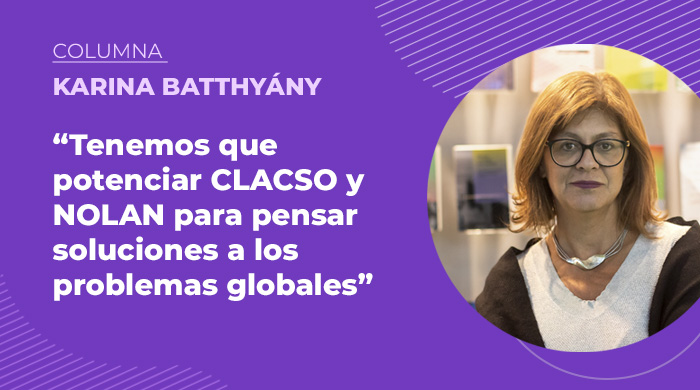
Transcript of Karina Batthyány's column
in InfoCLACSO – May 22, 2024
We are in Copenhagen, Denmark, participating on behalf of CLACSO in the Nordic Network for Latin American Research (NOLAN) conference. Two years ago, immediately after our #CLACSO2022 Conference in Mexico, we held a meeting in Finland and then another in Denmark.
CLACSO is present to participate in one of the key conferences on the topic of inequalities, specifically the Challenges to Gender Equality in Latin America within the context of the democratic challenges posed by these new ultraconservative right-wing governments. In addition, we will participate in two roundtables, where we will share experiences of collaborative work between the Nordic countries and Latin America.
We must remember that Sweden is one of the Nordic countries. At CLACSO, we collaborate with the Swedish International Development Cooperation Agency (SIDA) on our Platforms for Social Dialogue (PDS) project, and previously on various projects that contribute to our institution's long history.
At the NOLAN Conference, we will be analyzing common themes related to working collaboratively and horizontally with these institutions and governments of the Nordic countries to address challenges that are ultimately shared. These include democracy, gender equality, environmental issues, migration and human mobility, as well as topics related to economic challenges, poverty, and inequality.
– In that sense, what is the common concern about the virulence of the inequalities that are being experienced in the world?
The shared concern is how to rebuild democratic and egalitarian social pacts, how to contribute to the well-being of everyone in different regions and territories, not only in Latin America and the Caribbean and the Nordic countries, but throughout the world. One of the key questions is what the central issues are that will allow for coexistence in the various territories that make up our world, under conditions of democracy, justice, equality, and peace.
– We know the journey continues; CLACSO has many meetings, news from other important panels, and topics related to Our America…
– Yes, absolutely. Today, we're at the meetings within the framework of NOLAN. Afterwards, we'll go to The Hague, Netherlands, to work with one of our CLACSO Member Centers there on how to articulate and share concerns in the field of social sciences and humanities in Latin America and Europe. We'll also exchange ideas on topics related to our PDS (Programs for the Development of Science) regarding evaluation, open science, and open access to knowledge, highlighting the experience of the Latin American Forum on Scientific Evaluation (FOLEC), which originated in Latin America but is for the whole world.
– What are the central themes to address when analyzing Our America?
There are people in the Nordic countries who work with Latin America, and the countries of the Latin American region are their fields of study—in many cases, areas of influence—for building collaborative work. When we began exchanging experiences on certain issues currently being questioned in the Nordic countries, we saw that they are the same: climate change, migration, challenges to democracies, successes or attempts from a quantitative perspective, and how to rebuild alternatives based on knowledge from the social sciences, movements, organizations, and social actors in the broadest sense, along with the field of public policy implementation. We also discussed how to further strengthen the networks of CLACSO, NOLAN, and other specific knowledge networks, enabling us to think together about solutions to these global problems.
– There are certain governments that distrust democracy, climate change, the women's struggle, and feminist movements…
– I was speaking precisely about these topics at the Nolan Conference: feminisms and how they have been the prime target of attacks from all these conservative movements that are trying to undermine the democratic foundations in our countries. Why? Because the feminist movement has transformative, not conservative, potential in the face of neoliberal governments and the new right wing. Therefore, there is a line of work to be done, both for analyzing knowledge and for developing strategies and articulating mechanisms of resistance against denialist discourses.

CLACSO at NOLAN
If you would like to receive more information about CLACSO's training programs:
[widget id=”custom_html-57″]
to our email lists.

