
X Call for the formation of Working Groups 2023-2025
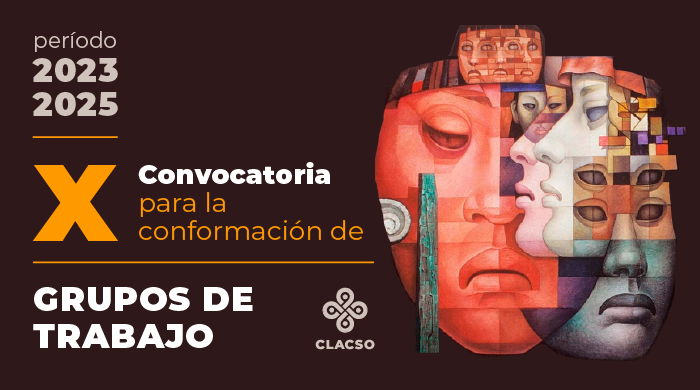
The Latin American Council of Social Sciences (CLACSO) opens the X Call for proposals for the creation of Working Groups (WGs) for the period 2023-2025.
The main objective of the CLACSO Working Groups is to support the creation of interdisciplinary networks of researchers, linked with public policy decision-makers and representatives of social organizations, grouped around social issues and problems relevant to Latin America and the Caribbean and capable of developing relevant and rigorous comparative social research with a regional perspective.
Thus, the Working Groups (WGs) constitute spaces for research, training, exchange, and cooperation among researchers from diverse fields within the social sciences, humanities, and arts, and those responsible for or managing public policies, social and labor organizations, community and territorial initiatives, and researchers from other disciplines and fields. They are areas of academic cooperation, as well as platforms for the production and management of evidence-based, critical, situated knowledge with a high impact on policymaking and public opinion formation. Through the WGs and the platforms they promote or integrate, it is hoped that critical dialogue will be broadened among the social sciences, humanities, and arts, and the various collective spaces that work to promote public accountability and diverse forms of social intervention in the region.
Working Groups are selected through public competitions where specific thematic proposals are submitted along with a three-year work plan. The proposals are evaluated by an international academic committee with recognized expertise in various thematic fields.
The teams that make up the Working Groups must consist of a minimum of fifteen (15) people from at least six (6) countries, all of whom are affiliated with member centers or institutions associated with the CLACSO institutional network. Once this number is reached, other external members may be added. In their formation, it is necessary to consider that their members should represent a diversity of countries and regions, include the participation of members from countries with less developed social sciences and humanities, ensure gender parity, encourage the active participation of researchers in training, foster intergenerational dialogue in the action plan outlined for the proposed period (2023-2025), and promote the active participation of diverse social, political, and cultural sectors relevant to the Group's activities and the dialogues it seeks to foster. In this way, the work of the Working Groups also aims to promote and strengthen exchanges among social movements, academics, and public policy leaders focused on developing joint action programs.
Within the framework of this Call for Proposals, special consideration will be given to the convergence and integration of various existing Working Groups that share thematic fields, concerns, or perspectives, strengthening and fostering dialogue among their work to plan future collaborations. Recent experiences of collaborative work among Working Groups at the CLACSO 2022 Conference can serve as a reference for these collaborations. The spaces organized at the Conference (such as Forums, panels, and various meetings) demonstrated the power of the convergence and integration of existing Working Groups to promote diverse proposals, generate dialogue, give rise to emerging themes, agendas, and epistemic perspectives, propose innovative approaches to overcoming various social problems, and make better use of the resources, outputs, and initiatives achieved.
This Call for Proposals will allow the selection of the set of teams that will make up the CLACSO Working Groups from among the February 1, 2023 and December 31, 2025.
The Call for Proposals is open to all themes.
The main objectives that the CLACSO Working Groups Area aims to achieve are:
- To produce knowledge and promote critical, relevant, rigorous, collaborative and situated social research, with a regional perspective.
- To stimulate the formation and consolidation of research networks at the regional and international level, seeking to influence the social agenda and to build bridges between academia and public policies based on the dialogue of knowledge.
- To promote dialogue between scientific fields and disciplines and the recognition of diverse knowledge and forms of understanding.
- Promote regional and comparative research with innovative approaches on topics of relevance to Latin American and Caribbean societies linked to the global agenda.
- Facilitate connections with public policy decision-makers at the local, national, and regional levels, stimulating horizontal dialogue among researchers and incorporating social organizations as key actors in research processes and in the dialogues that are generated.
- To disseminate the knowledge produced and the results achieved through different formats and languages (printed, digital, audiovisual), guaranteeing open access to the knowledge produced and allowing its more active use and appropriation by public policy managers, social and citizen organizations, the press and the education system.
The basic criteria for evaluating and selecting the Working Groups will be the following:
- Relevance, scientific quality and feasibility of the proposal.
- Regional diversity, especially the inclusion of researchers from countries with less relative development of the social sciences and humanities (Central America, the insular Caribbean, Bolivia and Paraguay) as well as from other regions and continents.
- Gender parity and diversity.
- Incorporation of researchers in training (postgraduate students, recent graduates) to integrate younger generations and promote intergenerational dialogues.
- Confluence and integration between current Working Groups, selected within the framework of the IX Call (2019-2022).
- Addressing topics of regional and global relevance, paying special attention to significant problems for Central America and the Caribbean, incorporating South-South and North-South academic dialogue.
- Promotion of dialogues and exchanges with networks and other regional and international spaces.
- Articulation with public policies in a broad sense, including social movements and organizations.
Application of the Working Group
The application of the Groups will be made through the presentation of a Workplan projected for a total duration of 36 monthswhich will be organized in three annual periods (12 months old).
El Workplan It may contain research, training, advocacy, or intervention activities and initiatives.
Proposals may include initiatives to ensure that the knowledge produced within the Group has an impact on public opinion through communication, training and publishing activities, and contributes to improving the living conditions of communities and territories.
The Work Plan will include a audiovisual organized in a similar way (generally for 36 months and three annual periods).
This budget will detail the resources provided by institutional partnerships or complementary sources.
The inclusion of institutional alliances that allow the acquisition of complementary resources to those provided by CLACSO for the development of the GTs' work plans through open calls to which the Groups can apply will be positively valued.
Each GT will be able to have up to three coordinatorsThey must be members of one of the CLACSO member or associated centers, a status they will demonstrate through a letter of support. Member centers must be up to date on their 2021 annual membership dues.
If there is more than one coordinator, the coordination team must represent different genders, countries, and institutions.
The coordinators must also attach their complete Curriculum Vitae.
Each proposal must have a minimum of fifteen (15) members of at least six (6) countries, all of them linked to member centers or associated with the CLACSO institutional network. For the purposes of this call, the country of the member center to which each member is linked will be considered as the reference country. Once this number is reached, other external members may be incorporated.
The team must consider in its composition geographical and regional diversity, institutional and gender diversity, as well as the participation of members from countries with less relative development of the social sciences and humanities, the participation of researchers in training and of public policy decision-makers and members of social organizations.
Each member may be a member of up to a maximum of two (2) Working Groups in this Call, and may collaborate or establish links with other Working Groups once approved.
Each member may only participate as coordinator in one proposal.
Working Groups currently in force that wish to remain linked to the Council must apply to this Call for Proposals.
The presentation of proposals articulated between various Working Groups that they find diverse affinities or that they are interested in the integration and confluence of projects.
See the list of the 90 GTs 2019-2023 organized into 30 thematic fields
Registration procedure
- Registration must be completed through the online system provided by CLACSO. Specifications regarding the Work Plan and team composition will be included in the form.
- Printed or emailed submissions will not be accepted. Applications that do not comply with the established guidelines will be rejected. It is recommended to access the online system to review the registration form.
- All data entered in the registration form constitutes a sworn statement for the purposes of this Call for Applications.
- The information uploaded to the form cannot be modified once it has been submitted.
- The online registration form will be available starting Tuesday, August 16, 2022.
- Access the online registration system available from Tuesday, August 16, 2022.
- In order to complete the registration, the person designated to upload data must register in the system by creating their username and password.
This information will be requested each time you wish to log in to view, modify, add, or send information. - Complete the registration form for submitting proposals for new Working Groups. It includes the following points:
- critical placement of the topic in the Latin American and Caribbean context;
- justification and analysis of its theoretical relevance;
- three-year work plan broken down by year;
- three-year budget broken down annually;
- bibliography;
- List of members of the GT - Select the proposed members as coordinators of the Working Group (up to three).
Each coordinator must attach a letter of endorsement signed by the Director of the institution affiliated with the CLACSO network. Access the list of member and associate centers.
Each coordinator must also include their curriculum vitae. - Only those proposals submitted through the registration system by the closing date will participate in the evaluation process of the Call for Proposals.
Selection process
- The evaluation of the proposals will be carried out by a Academic Committee made up of researchers and specialists from different countries in the region and diverse backgrounds and trajectories, appointed by the Executive Secretariat of CLACSO.
- His decision will be irrevocable and unappealable.
- The results will be published on the CLACSO website and social media.
- The coordinators of the selected Working Groups will be contacted by email.
The selection of a proposal signifies CLACSO's endorsement for its development, thus becoming part of the set of Working Groups that the Council promotes in all its areas of intervention and dissemination.
The Working Groups will receive full operational and logistical support from the CLACSO Executive Secretariat for the development of the activities outlined in their submitted Work Plan. Selected Working Groups will be eligible to participate in open calls for proposals, through which funds will be distributed to support the development of their work plans. These applications will be evaluated by a committee appointed by the CLACSO Executive Secretariat.
CLACSO will collaborate in the search for financial resources to carry out the activities of the Working Groups and to promote their mutual cooperation and exchange.
In addition to the direct funds that may be distributed in the calls for proposals, CLACSO will support the Working Groups with:
- publication of digital books in co-edition within the Working Groups Collection;
- dissemination and communication of the GTs' activities and initiatives in various formats and platforms;
- Preparation and distribution of a monthly activity schedule;
- assistance in the editing of newsletters, workbooks and books within the Working Groups Collection of the Latin American and Caribbean Social Sciences Library of CLACSO and other publications;
- open calls aimed at prioritizing the participation in the GTs of researchers in training or from certain regions;
- audiovisual and radio productions;
- collaboration for submitting applications to calls for proposals that allow obtaining other funds;
- logistical monitoring of activities;
- virtual work modalities;
- articulations with other areas and programs of CLACSO (Postgraduate Network, Virtual Library, Communication, FOLEC);
- links with other networks and platforms;
- Promotion of publication spaces in scientific journals and dossiers in CLACSO Journals; among other support and assistance.
Other activities and initiatives will also be carried out with the aim of strengthening the Working Groups Programme and the resources of the Working Groups.
The selected Working Groups must submit periodic reports detailing their activities, outputs, and progress toward the proposed Work Plan. They must also submit a final report upon completion of 36 months of operation.
Registration closing: October 3, 2022 (23:59 GMT-3)
Publication of results: December 2022
Start of activities: February 2023
Inquiries will be answered only via email.
List of proposals for new Working Groups
[+] Publish on the billboard | [+] See showtimes
FAQ
Each proposal must include a minimum of fifteen (15) members of at least six (6) countries, All of them are linked to member centers or centers associated with the CLACSO institutional network. For the purposes of this call, the country of reference for each member will be the country of the member center to which they are linked. Once this number is reached, other external members may be added.
Once this number is reached, other external members may be added. The maximum number of members is open.
Its composition must take into account geographical and regional diversity, institutional and gender diversity, as well as the participation of members from countries with less relative development of the social sciences and humanities, the participation of researchers in training and of public policy decision-makers and members of social organizations.
Each person may be part of up to a maximum of two (2) Working Groups in this Call, and may collaborate or establish links with other Working Groups once approved.
The letter of support must be attached to the registration system. Only letters in PDF format with institutional letterhead and the signature of the Director of the CLACSO Member Center will be accepted.
No. It is not necessary to re-upload the information for each member. The registration system allows you to retrieve the information currently in the database.
Yes. Individuals without an institutional affiliation with a CLACSO network member center can participate as members of the Working Groups. In that case, a team of 15 members affiliated with member centers must first be formed, and once that number is reached, other external participants can be added.
No. It is not possible to modify the presentation once it has been submitted.
OPINION – Working Groups 2023-2025

CLACSO announces the results of the evaluation and selection process for the new Work groups who will carry out their activities during the next three years, between February 1, 2023 and December 31, 2025.
Within the framework of this Xa The call for proposals received 147 submissions from 6.980 participants in 46 countries. The majority of proposals were of high quality, relevance, and consistency, and aligned with the terms and objectives of the call. Therefore, the selection process was complex. After the technical and formal review, all submissions proceeded to the qualitative and content evaluation process and the final selection stage.
The Executive Director of CLACSO, Karina BatthyányHe welcomed the quality of the proposals received and emphasized that “The results reaffirm once again the importance of the Working Groups for our network. Their importance lies in their role as a space where research, knowledge production, diverse forms of knowledge are combined with social organizations and advocacy work in public policy, as interdisciplinary and intergenerational networks that address the main themes and problems of the social sciences, humanities, and arts.”
Pablo VommaroThe Director of Research also highlighted the relevance of the proposals of the new Working Groups in the institutional life of CLACSO.
The evaluation process for the submitted proposals was carried out in four consecutive stages:
1. First, compliance with the technical requirements established in the Call for Proposals was considered.
2. Secondly, a International Evaluation Committee The quality, relevance, and soundness of the proposals were evaluated through a double peer review process. International Evaluation Committee It was made up of 165 specialists (83 women and 82 men) from 26 countries.
3. The evaluation carried out constituted the input for the work of International Selection Committee which developed a proposal for selecting the new Working Groups based on the evaluations and the institutional guidelines and priorities. International Selection Committee It took into account the incorporation of new Working Groups, while also maintaining the continuity of existing proposals that had a good evaluation and good performance.
4. Finally, the CLACSO Executive Secretariat systematized the final selection based on the recommendation prepared by the International Selection Committee and the CLACSO Steering Committee took note of it.
The Working Groups constitute the core of research and knowledge management in the CLACSO network, while also promoting social dialogues to address the most relevant problems in the region and the world.
With immense joy and also with a sense of responsibility, we present to you the 87 new CLACSO Working Groups 2023-2025 made up of 4.584 members from 44 countries.
|
WORKGROUP |
COORDINATORS |
MEMBER CENTER |
COUNTRY |
|
|
1 |
Afro-descendants and counter-hegemonic proposals |
Rosa Campoalegre Septien |
Center for Psychological and Sociological Research – CIPS |
Cuba |
|
2 |
Political agroecology |
María Inés Gazzano Santos |
Latin American Faculty of Social Sciences – FLACSO |
Uruguay |
|
Narciso Barrera Bassols |
Faculty of Political and Social Sciences. Autonomous University of Querétaro – UAQ |
Mexico |
||
|
3 |
Anti-capitalisms and emerging sociability |
Dmitri Pietro Samsonov |
Cuban Institute of Cultural Research – ICIC |
Cuba |
|
María Maneiro |
Gino Germani Research Institute – IIGG/UBA |
Argentina |
||
|
4 |
Appropriation of digital technologies and intersectionalities |
Leonor Graciela Natansohn |
Center for Multidisciplinary Studies in Culture – CULT/UFBA |
Brazil |
|
Marta Pilar Bianchi |
Faculty of Humanities and Social Sciences – FHCS-UNPSJB |
Argentina |
||
|
Roberto Canales Reyes |
Center for Regional Development Studies and Public Policies – CEDER |
Chile |
||
|
5 |
Arts and politics |
Andrea Forero Hurtado |
Faculty of Human and Social Sciences – FCHS-UNIMINUTO |
Colombia |
|
Hans Stange |
Center for Communication Studies – CECOM/UCHILE |
Chile |
||
|
Natalia Aguerre |
Faculty of Journalism and Social Communication – FPyCS/UNLP |
Argentina |
||
|
6 |
Arts, education and cross-cutting knowledge production |
Hugo Damian Del Valle |
Secretariat of Development and Institutional Relations – UNA |
Argentina |
|
Sandra Daniela Torlucci |
Secretariat of Development and Institutional Relations – UNA |
Argentina |
||
|
7 |
Street-level bureaucracy and inequalities |
Gabriela Lotta |
Fundação Getulio Vargas – FGV |
Brazil |
|
Gianinna Muñoz Arce |
Department of Social Work – DTS |
Chile |
||
|
Rik Peeters |
Center for Economic Research and Teaching AC – CIDE |
Mexico |
||
|
8 |
Digital capitalism, educational policy and critical pedagogy |
Geo Saura |
May 25 Institute for Democracy – I25M |
Spain |
|
Luis Bonilla-Molina |
International Research Centre “Other Voices in Education” – CII-OVE |
Venezuela |
||
|
Marisa Bolaña |
School of Humanities – EHU/UNSAM |
Argentina |
||
|
9 |
China and the map of world power |
Gabriel Esteban Merino |
Institute for Research in Humanities and Social Sciences – IdIHCS/UNLP-CONICET |
Argentina |
|
Lourdes Regueiro Bello |
Center for International Policy Research – CIPI |
Cuba |
||
|
Wagner Tadeu Iglesias |
Post-Graduation Program in Integration of Latin America – PROLAM/USP |
Brazil |
||
|
10 |
Open science as a common good |
Arianna Becerril García |
Center for Research and Advanced Studies in Political Science and Public Administration – CIPAP/UAEM |
Mexico |
|
Saray Córdoba González |
Institute for Educational Research – INIE/UCR |
Costa Rica |
||
|
11 |
Mobile and politicized social science |
Guido Riccono |
Department of Political and Social Sciences – DCPS/UNCOMA |
Argentina |
|
Ricardo Pérez Mora |
University Center for Economic and Administrative Sciences – CUCEA |
Mexico |
||
|
12 |
Communication, cultures and politics |
Daiana Bruzzone |
Faculty of Journalism and Social Communication – FPyCS/UNLP |
Argentina |
|
Omar Rincón |
Interdisciplinary Center for Development Studies – CIDER/UNIANDES |
Colombia |
||
|
Paola Ricaurte Quijano |
Departments of Social Sciences and Humanities – UCA – DCSH-UCA |
El Salvador |
||
|
13 |
Civilizational crisis, reconfigurations of racism, Afro-Latin American social movements |
Diogenes Diaz Campos |
PhD in Social Sciences with a specialization in Cultural Studies – UEC |
Venezuela |
|
Federico Fernando Pita |
Workers' Innovation Center – CITRA |
Argentina |
||
|
Yulexis Almeida Junco |
Department of Sociology, University of Havana – Sociology Dept |
Cuba |
||
|
14 |
Crisis and the global economy |
Adriana Gabriela Roffinelli Maya |
Foundation for Social and Political Research – FISyP |
Argentina |
|
Alejandro César López Bolaños |
Institute of Economic Research – IIEc/UNAM |
Mexico |
||
|
15 |
Crisis, responses and alternatives in the Greater Caribbean |
Glory Hope c |
Miuca Multi-Thematic School – MIUCA |
Dominican Republic |
|
Jacqueline Laguardia Martinez |
Institute of International Relations – IIR |
Trinidad and Tobago |
||
|
16 |
Bodies, territories and feminisms |
Alida Dagnino Contini |
Institute for Research in Humanities and Social Sciences – IdIHCS/UNLP-CONICET |
Argentina |
|
Delmy Tania Cruz Hernández |
Center for Higher Studies of Mexico and Central America – CESMECA/UNICACH |
Mexico |
||
|
Joana Emmerick Seabra |
Institute of Social and Political Studies – IESP/UERJ |
Brazil |
||
|
17 |
Bodies, territories, resistances |
Xochitl Leyva Solano |
Center for Research and Higher Studies in Social Anthropology – CIESAS |
Mexico |
|
18 |
Care and gender |
Amparo Hernández-Bello |
PENSAR Institute of Social and Cultural Studies – PENSAR/PUJ |
Colombia |
|
Valentina Perrotta |
Department of Sociology – DS/UDELAR |
Uruguay |
||
|
19 |
Culture and cultural policies |
Antonio Albino Canelas Rubim |
Center for Multidisciplinary Studies in Culture – CULT/UFBA |
Brazil |
|
Eduardo Nivón Bolán |
Division of Social Sciences and Humanities – DCSH/UAM-I |
Mexico |
||
|
Susana Dominzain |
Faculty of Humanities and Education Sciences – FHCE/UDELAR |
Uruguay |
||
|
20 |
Sport, culture and society |
Alejo Levoratti |
Institute for Research in Humanities and Social Sciences – IdIHCS/UNLP-CONICET |
Argentina |
|
Verónica Moreira |
Gino Germani Research Institute – IIGG/UBA |
Argentina |
||
|
21 |
Contemporary Right-Wing Movements: Dictatorship and Democracy |
Gabriela Gomes |
Institute for Human Development – IDH/UNGS |
Argentina |
|
22 |
Development and territorial inequalities: critical perspectives |
Jorge Leal |
Department of Social Sciences – DCS/CenUR Litoral Norte/UDELAR |
Uruguay |
|
Raúl Hernández Mar |
Lerma Unit – LERMA UAM |
Mexico |
||
|
Roxana María Viruez Valverde |
Center for Higher University Studies – CESU-UMSS |
Bolivia |
||
|
23 |
Decentralizing international relations |
Daniela Perrotta |
Secretariat of Research and Postgraduate Studies – SIPFyL/UBA |
Argentina |
|
Gerardo Caetano Hargain |
Institute of Political Science – ICP/UDELAR |
Uruguay |
||
|
24 |
Comparative social inequalities: social class, gender and ethnicity |
Mirlena Rojas Piedrahita |
Center for Psychological and Sociological Research – CIPS |
Cuba |
|
Paula Boniolo |
Gino Germani Research Institute – IIGG/UBA |
Argentina |
||
|
25 |
Inequalities, social structure and policies |
Iliana Yaschine Arroyo |
University Program of Development Studies – PUED/UNAM |
Mexico |
|
Jesica Lorena Pla |
Gino Germani Research Institute – IIGG/UBA |
Argentina |
||
|
Tabaré Fernández Aguerre |
Department of Sociology – DS/UDELAR |
Uruguay |
||
|
26 |
Political ecologies from the South/Abya-Yala |
Aida Luz López Gómez |
Autonomous University of Mexico City – UACM |
Mexico |
|
Lucrecia Soledad Wagner |
STAND Research Group (South Training Action Network of Decoloniality) – STAND |
Spain |
||
|
Melissa Moreano Venegas |
Latin American Studies Program – PEL/UASB |
Ecuador |
||
|
27 |
Emancipatory feminist economics |
Amaranta Cornejo Hernández |
Latin American Studies Program – PEL/UASB |
Mexico |
|
Natalia Quiroga Díaz |
Institute of the Conurbation – ICO/UNGS |
Argentina |
||
|
Patricio Dobrée |
Documentation and Studies Center – CDE |
Paraguay |
||
|
28 |
Political economy of information, communication and culture |
Cesar Bolaño |
Graduate Program in Geography – PPGEO/UFS |
Brazil |
|
Daniela Inés Monje |
Center for Advanced Studies – FCS/UNC |
Argentina |
||
|
Elizabeth Ramos |
Latin American Faculty of Social Sciences – FLACSO |
Ecuador |
||
|
29 |
Popular economies. Theoretical and practical mapping |
Martha Lucía Bernal Suárez |
Interdisciplinary School of Advanced Social Studies – IDAES School |
Argentina |
|
Maria Cristina Cielo |
Latin American Faculty of Social Sciences – FLACSO |
Ecuador |
||
|
Veronica Gago |
Interdisciplinary School of Advanced Social Studies – IDAES School |
Argentina |
||
|
30 |
Education and interculturality |
Ana Carolina Hecht |
Secretariat of Research and Postgraduate Studies – SIPFyL/UBA |
Argentina |
|
Gabriela Czarny |
National Pedagogical University of Hidalgo – UPN-Hidalgo |
Mexico |
||
|
Patricia Ames |
Center for Sociological, Economic, Political and Anthropological Research – CISEPA/PUCP |
Peru |
||
|
31 |
Popular education and critical pedagogies |
Gerónimo Fernando Santana |
Institute of Thought and Culture in Latin America, Civil Association – IPECAL AC |
Mexico |
|
María Mercedes Palumbo |
Secretariat of Research and Postgraduate Studies – SIPFyL/UBA |
Argentina |
||
|
Victor Adrian Diaz Esteves |
Department of Social Work – UCTEMUCO |
Chile |
||
|
32 |
The State as a contradiction |
Josefina Torres Jiménez |
Institute of Ecuadorian Studies – IEE |
Ecuador |
|
Mabel Thwaites Rey |
Institute of Latin American and Caribbean Studies – IEALC/UBA |
Argentina |
||
|
Sandra Carolina Bautista Bautista |
School of Social Sciences, Arts and Humanities – ECSAH-UNAD |
Colombia |
||
|
33 |
The Central American isthmus: peripheral epistemological perspectives |
Aleksander Aguilar Antunes |
Post-Graduation Program in Social Policy and Human Rights – PPGPSDH – UCPEL |
Brazil |
|
Briseida Barrantes |
Center for Latin American Studies "Justo Arosemena" – CELA |
Panama |
||
|
Melissa Salgado |
Departments of Social Sciences and Humanities – UCA – DCSH-UCA |
El Salvador |
||
|
34 |
Work in contemporary capitalism |
Hernán M. Palermo |
Center for Labor Research Studies – CEIL/CONICET |
Argentina |
|
Patricia Torres Mejía |
Center for Research and Higher Studies in Social Anthropology – CIESAS |
Mexico |
||
|
35 |
Economic elites, the state, and inequality |
Florence Luci |
Gino Germani Research Institute – IIGG/UBA |
Argentina |
|
Francisco Robles-Rivera |
Institute of Social Research – IIS/UCR |
Costa Rica |
||
|
miguel serna |
Department of Sociology – DS/UDELAR |
Uruguay |
||
|
36 |
Energy and sustainable development |
Esteban Serrani |
Interdisciplinary School of Advanced Social Studies – IDAES School |
Argentina |
|
Nora Estela Fernández Mora |
Faculty of Human Sciences, Pontifical Catholic University of Ecuador – FCH-PUCE |
Ecuador |
||
|
37 |
Epistemologies of the South |
Karina Andrea Bidaseca |
Interdisciplinary School of Advanced Social Studies – IDAES School |
Argentina |
|
Maria Paula Gutierrez Meneses |
Center for Social Studies – CES/UC |
Portugal |
||
|
38 |
Critical studies of rural development |
Alhelí González Cáceres |
Center for Interdisciplinary Rural Studies – CERI |
Paraguay |
|
Natalia Espinosa Rincón |
Faculty of Environmental and Rural Studies – FEAR/PUJ |
Colombia |
||
|
Pablo Leandro Díaz Estévez |
Faculty of Humanities and Education Sciences – FHCE/UDELAR |
Uruguay |
||
|
39 |
Critical studies in disability |
Brenda Araceli Bustos García |
Institute of Social Research – IINSO |
Mexico |
|
Cristina Pereyra |
Faculty of Humanities and Social Sciences – FHCS-UNPSJB |
Argentina |
||
|
Diana Carolina Vallejo Ortega |
Autonomous University of Mexico City – UACM |
Mexico |
||
|
40 |
Critical studies on motherhood and fatherhood |
Ana Cecilia Vergara del Solar |
School of Psychology – USACH |
Chile |
|
Ana Cecilia Marotta |
Faculty of Psychology – Faculty of Psychology-UdelaR |
Uruguay |
||
|
Catalina Arteaga Aguirre |
Department of Sociology – DS/UCHILE |
Chile |
||
|
41 |
Latin American studies: national, regional and transnational perspectives |
Gabriela Pulido Llano |
Research Coordination of the FFyL – UNAM |
Mexico |
|
Martin Lopez |
The College of Michoacán – COLMICH |
Mexico |
||
|
Mario Hugo Ayala |
Institute of Culture, Society and State – ICSE |
Argentina |
||
|
42 |
Studies on time and temporalities |
Guadalupe Valencia García |
Center for Interdisciplinary Research in Sciences and Humanities – CEIICH/UNAM |
Mexico |
|
Raúl Hernán Contreras Román |
Center for Interdisciplinary Research in Sciences and Humanities – CEIICH/UNAM |
Mexico |
||
|
René Ramírez |
Latin American Strategic Center for Geopolitics – CELAG |
Ecuador |
||
|
43 |
Studies on the United States |
Leandro Ariel Morgenfeld |
Institute of Latin American and Caribbean Studies – IEALC/UBA |
Argentina |
|
Loreta Tellería Escobar |
JAINA Study Community – JAINA |
Bolivia |
||
|
Mariana Aparicio Ramírez |
Faculty of Political and Social Sciences – FCPyS/UNAM |
Mexico |
||
|
44 |
Social studies for health |
Carolina Andrea Julieta Tetelboin Henrion |
Master's Degree in Social Medicine/Doctorate in Public Health Sciences – MMS-DCSC |
Mexico |
|
Daisy del Rosario Iturrieta Henriquez |
Alejandro Lipschutz Institute of Sciences – ICAL |
Chile |
||
|
José Carvalho de Noronha |
Oswaldo Cruz Foundation – Fiocruz |
Brazil |
||
|
45 |
Exodus of cultural matrices |
Amaurys Giordano Perez |
University Center for Political and Social Studies – CUEPS/PUCMM |
Dominican Republic |
|
Margarita Mercedes Moll Marte |
Latin American Faculty of Social Sciences – FLACSO |
Dominican Republic |
||
|
46 |
Feminisms, resistance and emancipation |
Claudia María García Muñoz |
Center for Advanced Studies in Childhood and Youth of CINDE and the University of Manizales – CEANJ |
Colombia |
|
Joana of Flowers Duarte |
Post-Graduation Program in Latin American Integration – PROLAM/USP |
Brazil |
||
|
Raquel Irene Drovetta |
Academic Pedagogical Institute of Social Sciences – IAPCS/UNVM |
Argentina |
||
|
47 |
Political Philosophy – Undisciplined Humanities: cosmos, body and utopia |
Augusto José Castro |
Institute of Natural Sciences, Territory and Renewable Energies – INTE/PUCP |
Peru |
|
Aurea Mota |
Institute of Ecuadorian Studies – IEE |
Ecuador |
||
|
48 |
Borders, regionalization and globalization |
Alejandro Fabián Schweitzer |
Permanent Seminar on Chicano and Border Studies, Directorate of Ethnology and Social Anthropology, National Institute of Anthropology and History – SPEChF |
Mexico |
|
Juan Manuel Sandoval Palacios |
Permanent Seminar on Chicano and Border Studies, Directorate of Ethnology and Social Anthropology, National Institute of Anthropology and History – SPEChF |
Mexico |
||
|
Luis Manuel Martínez Estrada |
Directorate of Scientific Research – DICIHT/UNAH |
Honduras |
||
|
49 |
Security forces, control agencies and illicit markets |
Sabina Andrea Frederic |
Department of Social Sciences – DCS/UNQ |
Argentina |
|
Juan Andrés Antillano Isaac |
Institute of Criminal Sciences – ICP/UCV |
Venezuela | ||
|
50 |
Gender, (in)equalities and rights in tension |
Andrea Daverio |
Institute of Justice and Human Rights – IJDH/UNLA |
Argentina |
|
Gisela Zaremberg |
Latin American Faculty of Social Sciences – FLACSO |
Mexico |
||
|
Lilian Soto |
Documentation and Studies Center – CDE |
Paraguay |
||
|
51 |
Geopolitics, regional integration and the world system |
andres arauz |
University Program of Studies on Asia and Africa – PUEAA |
Mexico |
|
Jaime Fernando Estenssoro Saavedra |
Institute for Advanced Studies – IDEA |
Chile |
||
|
Rebeca Peralta Mariñelarena |
Postgraduate Program in Latin American Studies – PPEL/UNAM |
Mexico |
||
|
52 |
History and current situation: Marxist perspectives |
Marcelo Starcenbaum |
Institute for Research in Humanities and Social Sciences – IdIHCS/UNLP-CONICET |
Argentina |
|
María Elvira Concheiro Bórquez |
Center for Interdisciplinary Research in Sciences and Humanities – CEIICH/UNAM |
Mexico |
||
|
Patricia Flor de Lourdes González San Martín |
Observatory of Social Participation and Territory – OPSYT-UPLA |
Chile |
||
|
53 |
Childhoods and youth |
Daniel Gustavo Llanos Erazo |
Center for Research in Social Sciences, Humanities and Education – CICSHE/UPS |
Ecuador |
|
María Camila Ospina Alvarado |
Center for Advanced Studies in Childhood and Youth of CINDE and the University of Manizales – CEANJ |
Colombia |
||
|
Melina Vázquez |
Gino Germani Research Institute – IIGG/UBA |
Argentina |
||
|
54 |
Intellectuals, ideas and politics |
Dalila Concepción Sosa Marín |
Faculty of Social Sciences-UNA – FACSO-UNA |
Paraguay |
|
Ezequiel Saferstein |
Interdisciplinary School of Advanced Social Studies – IDAES School |
Argentina |
||
|
José Carlos Reyes Pérez |
Center for Economic Research and Teaching AC – CIDE |
Mexico |
||
|
55 |
Leftist movements and social struggles in Latin America |
Pablo Pozzi |
Secretariat of Research and Postgraduate Studies – SIPFyL/UBA |
Argentina |
|
Viviana Bravo Vargas |
Department of Research and Postgraduate Studies – DIP/UAHC |
Chile |
||
|
Mauricio Archila |
Foundation Center for Research and Popular Education – CINEP |
Colombia |
||
|
56 |
Lex mercatoria, corporate power and human rights |
Luciana Ghiotto |
School of Politics and Government – EPyG/UNSAM |
Argentina |
|
57 |
Anti-patriarchal struggles, families, genders, diversities and citizenships |
Germán Darío Herrera Saray |
Faculty of Legal and Social Sciences – JURIDICASYSOC/UCALDAS |
Colombia |
|
Gisela Elizabeth Spasiuk |
Faculty of Humanities and Social Sciences. National University of Misiones – FHyCS UNAM |
Argentina |
||
|
Marlene Rosario Choque Aldana |
Center for Social Research of the Vice Presidency – CIS |
Bolivia |
||
|
58 |
Marxisms and resistances of the global south |
Nayar López Castellanos |
Faculty of Political and Social Sciences – FCPyS/UNAM |
Mexico |
|
Nestor Kohan |
Institute of Latin American and Caribbean Studies – IEALC/UBA |
Argentina |
||
|
59 |
Collective memories and resistance practices |
Ana María Cacopardo |
Institute for Research in Humanities and Social Sciences – IdIHCS/UNLP-CONICET |
Argentina |
|
Isabel Piper Shafir |
Department of Psychology – DP/UCHILE |
Chile |
||
|
Pilar Calveiro |
Autonomous University of Mexico City – UACM |
Mexico |
||
|
60 |
Social metabolism/Environmental justice |
Antonio De Lisio |
Center for Development Studies – CENDES/UCV |
Venezuela |
|
Maritza Islas Vargas |
Faculty of Political and Social Sciences – FCPyS/UNAM |
Mexico |
||
|
Urphy Vasquez Baca |
Center for Sociological, Economic, Political and Anthropological Research – CISEPA/PUCP |
Peru |
||
|
61 |
Migration and South-South borders |
Ana Inés Mallimaci |
Institute of Social Sciences and Administration – ICSyA/UNAJ |
Argentina |
|
Fernanda Stang |
Center for Research in Social Sciences and Youth – CISJU/UCSH |
Chile |
||
|
Handerson Joseph |
Post-Graduation Program in Sociology – PPGS/UFRGS |
Brazil |
||
|
62 |
Socio-territorial movements in critical and comparative perspective |
Emiliano Ignacio Díaz Carnero |
College of the Northern Border – COLEF |
Mexico |
|
Fernanda Valeria Torres |
Institute for Research in Humanities and Social Sciences – IdIHCS/UNLP-CONICET |
Argentina |
||
|
Juan Luis Corporán |
Alternative City Association – CA |
Dominican Republic |
||
|
63 |
Latin American and Caribbean critical geographical thought |
Daniel G. Pérez-Torres |
Center for Social Research, Puerto Rico – CIS/UPR |
Puerto Rico |
|
Juan Manuel Delgado Estrada |
Center for Studies and Promotion of Development – DESCO |
Peru |
||
|
Maria de Estrada |
Faculty of Social Work – FTS-UNLP |
Argentina |
||
|
64 |
Critical legal thinking and sociopolitical conflicts |
Aleida Hernández Cervantes |
Center for Interdisciplinary Research in Sciences and Humanities – CEIICH/UNAM |
Mexico |
|
Diana Isabel Molina Rodríguez |
Center for Latin American Studies and Research – CEILAT |
Colombia |
||
|
Sonia Boueiri Bassil |
Center for Political and Social Studies of Latin America – CEPSAL |
Venezuela |
||
|
65 |
Poverty and social policies |
Alicia Ziccardi |
Institute of Social Research – IIS/UNAM |
Mexico |
|
Carlos Hugo Fidel |
Department of Social Sciences – DCS/UNQ |
Argentina |
||
|
María del Carmen Midaglia |
Institute of Political Science – ICP/UDELAR |
Uruguay |
||
|
66 |
Educational policies and the right to education |
Fernanda Saforcada |
Secretariat of Research and Postgraduate Studies – SIPFyL/UBA |
Argentina |
|
María Gabriela Walder Encina |
Faculty of Social Sciences-UNA – FACSO-UNA |
Paraguay |
||
|
Pablo Martinis |
Faculty of Humanities and Education Sciences – FHCE/UDELAR |
Uruguay |
||
|
67 |
Emancipatory practices, common goods, and decolonial alter-global methodologies |
Alicia Itatí Palermo |
Master's Degree in Society and Institutions – MSeI/UNSL |
Argentina |
|
Jorge Rojas Hernández |
Department of Sociology – UdeC |
Chile |
||
|
Martha Nélida Ruiz Uribe |
International University Institute of Toluca – IUIT |
Mexico |
||
|
68 |
Latin American urban processes: (in)justices and (in)equalities |
Paulina Cepeda |
Latin American Faculty of Social Sciences – FLACSO |
Ecuador |
|
Ramiro Segura |
Interdisciplinary School of Advanced Social Studies – IDAES School |
Argentina |
||
|
69 |
Participatory processes and methodologies |
Mariano Suárez Elías |
Department of Social Sciences – DCS/CenUR Litoral Norte/UDELAR |
Uruguay |
|
Romina Rébola |
Department of Education, Culture and Knowledge – UNRaf |
Argentina |
||
|
70 |
Proposal for regional integration |
Alberto Rocha Valencia |
University Center for Social Sciences and Humanities – CUCSH/UDG |
Mexico |
|
Jorge Marchini |
Center for Research and Management of the Solidarity Economy – CIGES |
Argentina |
||
|
71 |
Indigenous Peoples and Epistemic-Territorial Disputes |
Ana Catarina Zema |
ELA – Department of Latin American Studies – ELA |
Brazil |
|
Gonzalo Eugenio Bustamante Rivera |
Center for Social Sciences and Humanities – CISOH |
Chile |
||
|
Taira Edilma Stanley Icaza |
Institute of National Studies – IDEN/UP |
Panama |
||
|
72 |
Indigenous peoples, autonomies and collective rights |
Fatima Teresa Monastery Market |
Planning and Management Center – CEPLAG/UMSS |
Bolivia |
|
Luciana García Guerreiro |
Gino Germani Research Institute – IIGG/UBA |
Argentina |
||
|
Waldo Lao Fuentes Sánchez |
Post-Graduation Program in Latin American Integration – PROLAM/USP |
Brazil |
||
|
73 |
What development? Multi-stakeholder and multi-level dialogues |
Alejandro López Evangelista |
Latin American Faculty of Social Sciences – FLACSO |
Dominican Republic |
|
Irene Palma Calderón |
Central American Institute for Social Studies and Development – INCEDES |
Guatemala |
||
|
María del Carmen Zabala Argüelles |
Latin American Faculty of Social Sciences – FLACSO |
Cuba |
||
|
74 |
What job for what future? |
Adoration Guaman Hernandez |
Observatory of Economic, Social and Cultural Rights – DESC Observatory |
Spain |
|
Nora Goren |
Institute of Social Studies in Contexts of Inequalities – UNPAZ |
Argentina |
||
|
75 |
Network of gender, feminisms and memories |
Mariela Peller |
Institute of Latin American and Caribbean Studies – IEALC/UBA |
Argentina |
|
Melody Fonseca |
Center for Social Research, Puerto Rico – CIS/UPR |
Puerto Rico |
||
|
Rosario del Pilar Fernández Ossandón |
Institute for Advanced Studies – IDEA |
Chile |
||
|
76 |
Religions and society: Tensions, diversities, and mobilizations under debate |
Erick Adrián Paz González |
Autonomous University of Mexico City – UACM |
Mexico |
|
Monica Ulloa Gomez |
Faculty of Social Sciences – UNA |
Costa Rica |
||
|
77 |
Ruralities and political transitions in Central America and Colombia |
Helene Roux |
Research Institute for Development – IRD |
France |
|
Luis Antonio Ramírez Zuluaga |
Institute of Regional Studies – INER/UdeA |
Colombia |
||
|
Ursula Roldán |
Institute for Research in Socio-Humanistic Sciences – ICESH |
Guatemala |
||
|
78 |
International health and health sovereignty |
Gonzalo Basile |
Latin American Faculty of Social Sciences – FLACSO |
Dominican Republic |
|
Leny Trad |
Latin American Faculty of Social Sciences – FLACSO |
Brazil |
||
|
Marinitda Rivera Díaz |
Department of Social Sciences, Graduate School of Public Health – UPR |
Puerto Rico |
||
|
79 |
Social security and pension systems |
Berenice Patricia Ramírez López |
Institute of Economic Research – IIEc/UNAM |
Mexico |
|
Sergio Carpenter |
Argentine Institute for Economic Development – IADE |
Argentina |
||
|
80 |
Territorialities, spiritualities and bodies |
Claudia Luz Piedrahita Echandía |
PhD in Social Studies – DES/UDistrital |
Colombia |
|
81 |
Agricultural work, inequalities and rural life |
Hubert C. de Grammont |
Institute of Social Research – IIS/UNAM |
Mexico |
|
Paola Mascheroni |
Department of Sociology – DS/UDELAR |
Uruguay |
||
|
82 |
Work, production and service configurations, new labor subjects |
Marcela Hernández |
Division of Social Sciences and Humanities – DCSH/UAM-I |
Mexico |
|
Maria Aparecida da Cruz Bridi |
Postgraduate Program in Sociology – UFPR/PPGSOCIO |
Brazil |
||
|
83 |
Just transitions and care for our common home |
Diego Álvarez Newman |
Program of Cultural Studies – PEC/UNAJ |
Argentina |
|
María Isabel Gil Espinosa |
Institute of Bioethics |
Colombia |
||
|
84 |
Universities and depatriarchalization |
Margarita Millán |
Faculty of Political and Social Sciences – FCPyS/UNAM |
Mexico |
|
85 |
Vigilantism, collective violence, and security governance |
Antonio Fuentes Díaz |
Postgraduate Program in Sociology – PPS/BUAP |
Mexico |
|
Leandro Gamallo |
Gino Germani Research Institute – IIGG/UBA |
Argentina |
||
|
Loreto Francisca Quiroz Rojas |
Center for Conflict and Social Cohesion Studies – COES/UCHILE |
Chile |
||
|
86 |
Violence in Central America |
Ana Silvia Monzón |
Latin American Faculty of Social Sciences, Guatemala – FLACSO |
Guatemala |
|
Carlos Figueroa Ibarra |
Postgraduate Program in Sociology – PPS/BUAP |
Mexico |
||
|
Laura Yanina Sala |
Institute of Social Studies in Contexts of Inequalities – UNPAZ |
Argentina |
||
|
87 |
Violence, governments and democracy |
Carolina Duque |
Faculty of Legal and Social Sciences – JURIDICASYSOC/UCALDAS |
Colombia |
|
Luciana Noelia Ginga |
Secretariat of Research and Postgraduate Studies – SIP/UNR |
Argentina |
||
|
Rochele Fellini Fachinetto |
Post-Graduation Program in Sociology – PPGS/UFRGS |
Brazil |
The following integrations and convergences between GTs are also recommended, with the intention of producing synergies that recover the contributions and potential expressed in these proposals:
- That the proposal “Juvenicide(s): violence and social resistance”, coordinated by Germán Muñoz González, José Manuel Valenzuela Arce and Marisa Feffermann be integrated with the approved Working Group “Childhoods and youth” coordinated by Daniel Gustavo Llanos Erazo, María Camila Ospina Alvarado and Melina Vázquez.
- That the proposal “Urban informality, territorial transformations and political subjectivity”, coordinated by Maria Cristina Cravino and Rafael Soares Gonçalves, be integrated with the approved Working Group “Latin American urban processes: (in)justices and (dis)equalities” coordinated by Paulina Cepeda and Ramiro Segura.
- That the proposal “Worlds of Work, legislation and policies in Latin America”, coordinated by Héctor Palomino and Magda Biavaschi, be integrated with the approved Working Group “Work, productive and service configurations, new labor subjects” coordinated by Marcela Hernández and Maria Aparecida da Cruz Bridi.
- That the proposal “Religion, public sphere and human rights”, coordinated by Ileana de las Mercedes Hodge Limonta, Joanildo Albuquerque Burity and Marcos Andrés Carbonelli be integrated with the approved Working Group “Religions and society. Tensions, diversities and mobilizations in debate” coordinated by Erick Adrián Paz González and Mónica Ulloa Gómez.
Finally, the following proposals submitted in this call continue to work as Special Groups:
- “José Martí. Thought and action” coordinated by Gladys González Martínez.
- “Education, work and development: trade union and academic perspectives for the design of public policies in the post-pandemic context” coordinated by Irma Briasco, Juan Cruz Esquivel and Jusmary Gómez Arencibia.
If you would like to receive more information about CLACSO's training programs:
[widget id=”custom_html-57″]
to our email lists.

