
“Making visible the Afro-Latin American, Afro-Caribbean and Diaspora woman”
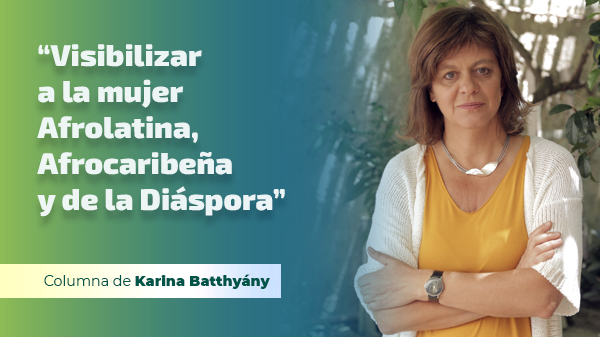
(Transcription of Karina Batthyány's Column)
(In InfoCLACSO – August 3, 2022)
In this journey we have been taking through the themes of inequalities in Latin America and the Caribbean, on the occasion of July 25, International Day of Afro-Latin American, Afro-Caribbean and Diaspora Women, I want to dedicate this column briefly to the topic on this date that has been commemorated since 1992.
The purpose of designating July 25th as International Women's Day is to raise awareness of Afro-descendant women, contribute to promoting public policies that improve their quality of life, and eradicate racism and discrimination. This initiative arose from a meeting held in the Dominican Republic, where Black women from 32 Latin American and Caribbean countries decided to highlight their struggles and define political strategies to confront racism from a gender perspective. Since 92, this day has been commemorated.
And what is happening with this issue in Latin America? There is a minimum estimate from ECLAC (Economic Commission for Latin America and the Caribbean), based on data from the latest census round in 16 Latin American countries, which suggests an approximate figure of 134 million people of African descent. The Afro-descendant population of Latin America and the Caribbean represents 21% of the total population of our region. This translates to more than 108 million people in Brazil, where they represent 51% of the population; more than 10 million people in Haiti, where they make up more than 95% of the population; and between 7% and 10% of the population in five other Latin American countries: Colombia, Costa Rica, Ecuador, Panama, and the Dominican Republic.
Not all countries have quality data and analysis disaggregated by race, ethnicity, and sex. There is a certain statistical silence or invisibility that hinders access to a more accurate (not just approximate) picture of the Afro-descendant population. However, the data we do have clearly show that Afro-descendant people—and especially women—disproportionately suffer from poverty, violence, child labor, and other dimensions of inequality.
Throughout Latin America, racialized groups are more likely to live in poverty than the rest of the population. For example, ECLAC's latest social panorama of Latin America, published this year, reveals that 48% of the Afro-descendant population in Colombia and 44% of the Afro-descendant population in Ecuador have incomes below the poverty line.
Furthermore, the multiple inequalities that Afro-descendant women in Latin America and the Caribbean have historically experienced are part of a complex system of structural discrimination that was clearly a legacy of the colonial slave past, where we see how multiple dimensions of inequality of ethnic, racial, class and gender origin cross and intersect.
If we also look at UN Women reports, we find that Afro-descendant women face significant inequality compared to non-Afro-descendant women. For example, the average total income of Afro-descendant women barely exceeds the poverty vulnerability line defined internationally by ECLAC.
For example, poverty rates in single-parent households headed by Afro-descendant women are nearly double those of households headed by non-Afro-descendant women. In Brazil, Ecuador, Peru, and Uruguay—my country—this situation is three times higher; that is, poverty rates in households headed by women are significantly higher than those in households headed by non-Afro-descendant women.
In Latin America, labor markets are also characterized by ethnic, racial, and gender gaps in terms of access to employment and job quality. There are also significant gaps in rights and social protection, among other factors, which hinder efforts to escape poverty and reduce inequality in the region.
In five of the countries that currently have data—Argentina, Brazil, Ecuador, Panama, and Uruguay—Afro-descendant women represent the population group most affected by unemployment in the labor market. And in three of these countries—Argentina, Brazil, and Uruguay—the unemployment rate is double (or even more than double) that of non-Afro-descendant men.
Furthermore, let us also remember paid domestic work, where Afro-descendant people and Afro-descendant women are overrepresented. This work is also closely linked to caregiving, and these individuals are often the ones who work for pay in households and in this type of occupation. Paid domestic work is among the lowest-paid in Latin America, and, moreover, not all countries have followed the path of formalization, which would allow, among other things, access to social protection.
If we look at some examples, in Brazil, around 7 million people work in paid domestic work, with approximately 4,5 million being Afro-descendant, about 63%. In Ecuador, one in five Afro-descendant women is employed in paid domestic work. In Costa Rica, Brazil, Nicaragua, and Honduras, these figures exceed 10% for the cases I'm describing.
So, we need to effectively show, to make visible, how these inequalities are embodied in the case of Afro-descendant women, how we need to look at it with an intersectional approach and how different dimensions of inequalities such as economic, social, political, cultural, subjective intersect in these specific historical contexts, generating forms of exclusion, hierarchy and inequality that are effectively and very significantly affecting the Afro-descendant population, and in particular the collective of Afro-descendant women.
Given the possibility of July 25th, and given what will happen this weekend in Colombia, where for the first time a progressive government will assume power and in that presidential ticket we find a feminist woman who has also dedicated her life to working for the rights of Afro-descendant people and she is an Afro-descendant woman (and her name is Francia Márquez), I thought it was important to dedicate this column to the topic.
-Absolutely, Karina. Three months ago, the census was conducted in Argentina, and for the first time, on a massive scale, the self-identification of the Afro-descendant and Indigenous communities was included. In 2010, it had been incorporated in Argentina only as a sample, in some of the questionnaires used by census takers; now it was done on a massive scale. It's 2022, and now it's included in a census—if that isn't making them invisible, what is?
Absolutely. That's why I mentioned statistical invisibility and the difficulty we face when preparing reports or columns on this topic, which addresses the specific situation of the Afro-descendant population. We encounter a primary problem: this invisibility. That is, the lack of questions about ethnic origin, race, and the difficulties this creates. If we add to that the invisibility often associated with sex—the identification of men, women, and, of course, sexual or gender diversity—then we have two forms of invisibility. The reports and figures I'm presenting represent minimal scenarios in terms of identifying the problem. We know that the reality is much larger, and we must make an effort—a responsibility of those of us in the social sciences—to make these phenomena visible from every perspective, including statistically.
If you would like to receive more information about CLACSO's training programs:
[widget id=”custom_html-57″]
to our email lists.

