
“School violence”: from safe classroom to ideological indoctrination
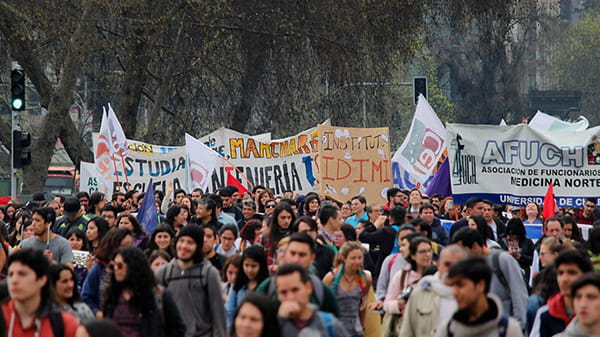
The announcement made by the Minister of Education on Monday, November 25th, regarding the drafting of a bill to address “ideological indoctrination” in the country's educational establishments, cannot leave us indifferent nor should we analyze it lightly, because once again, and just as they did from the moment they initiated the discussion on safe classrooms, the government is invoking the problem of “school violence”.
From our perspective, it is relevant to point out from the outset that Marcela Cubillos' announcements regarding the bill against "ideological indoctrination" must be linked to two trajectories of continuity in educational policies, one developed at the national level and the other at the Latin American level.
Firstly, and in terms of a trajectory of continuity at the national level, the recently announced project reaffirms the right-wing political and ideological positions regarding educational policies, as it is completely linked to the Safe Classroom Law (approved on December 27, 2018), which proposes, in general terms: a strengthening of the powers of school and high school principals regarding expulsion and cancellation of enrollment in cases of physical or psychological violence against any member of the community; the incorporation of new grounds for expulsion and cancellation of enrollment, such as the possession, carrying, use, or activation of weapons, explosive devices, damage to infrastructure, among others; and it accelerates the timeframes for expulsions, establishing the "preventive separation" of the student while the facts are investigated (guaranteeing "due process").
The arguments put forward by the Ministry of Education to enact the controversial Safe Classroom Law were based, on the one hand, on the slowness of the processes for expelling students according to what was stipulated in DFL No. 2/1998, the Law on School Violence (2011) and the Law of Inclusion (2012); and on the other hand, on showing itself as an effective solution against the problem of insecurity in schools, since it allowed curbing physical and psychological violence towards teachers and education workers.
Each of the arguments presented was refuted by specialists in school violence and coexistence, as well as by student and teacher organizations. On the one hand, it was argued that legal precedents and tools already existed to address school violence, and on the other, that no studies or research demonstrated that laws like this one, known as "zero tolerance" laws, could reduce school violence. The law was thus criticized as purely punitive, with little connection to the educational and ethical goals of a public, inclusive, and democratic education, as it also failed to establish any pedagogical or psychosocial prevention policies.
For the reasons stated above, the Safe Classroom Law was, in the eyes of specialists and student organizations, a legal initiative that should be inscribed within a mercantile, neoliberal model of education that privileged segregation and exclusion; it should be understood as a policy directly focused on the dismantling and criminalization of the secondary school student movement who, as all Chileans know, have been, during the 21st century, the driving force behind social movements and transformative forces in this country.
The implementation of the Safe Classroom Law since March of this year has yielded only shameful and scandalous results. The brutality of the actions of the Carabineros special forces in prestigious high schools, the "random" searches of backpacks, and the brutal attacks on secondary school students and educational communities, along with the daily violence experienced by the educational community of the Instituto Nacional, cannot be easily forgotten by civil society. This is all without mentioning that the annual report from the Superintendency of Education, which will inform all of society about the real repercussions of the Law's implementation, has not yet been published.
Secondly, we must note that the bill against “ideological indoctrination”, presented in the media by the Minister of Education, has a clear line of continuity and evident influence from conservative sectors in Brazil, specifically from organizations such as “all for education” and “schools without party,” which in turn demonstrates a concerted political agenda on the part of right-wing governments in Latin America and a Bolsonaro-ization of the Piñera government.
As numerous researchers, social organizations, and unions in the Brazilian educational field have denounced, the initiatives promoted by "all for education" and "schools without political parties" must be understood as political responses from the elites to the threat of curbing profit and ending their class privileges. These are political proposals that advance the criminalization of the pedagogical subject (teachers, students, and educational communities). They are projects that attempt to persecute politically active subjects in the struggles against neoliberalism and capital, even promoting denunciation among members of educational communities. These political initiatives, by denying the ethical-political character of the act of educating, emphasize the "technical," "neutral," and "universal" character of school knowledge, thus opposing the development of critical thinking and the construction of democratic schools. In short, these are political signs of a "rabid conservatism," as Gaudencio Frigotto called it, of an educational and pedagogical conception that vindicates market education intertwined with religious fundamentalism.
Additionally, it is relevant to note that the "schools without political parties" movement declared open war on Freirean pedagogical thought, accusing the Brazilian educator and his legacy of promoting political and ideological indoctrination in educational settings. This criticism was justified by a twisted and distorted reading of his postulates regarding the inherently political nature of all educational processes. The animosity directed toward Freirean thought extended to any expression accused of being linked to "cultural Marxism" and "gender ideology." Crucially, these types of political, pedagogical, and media strategies have emphasized the "ideological" character of leftist perspectives, crudely denying or obscuring the ideological nature of neoliberalism and its educational policies. Or are freedom of teaching, management policies, voucher funding, standardized assessment, the discourse of competencies, the emphasis on individualism and meritocracy, human capital theory, and many other expressions of market education not profoundly political and ideological?
Consistent with the above, Minister Cubillos' announcement of a bill against "ideological indoctrination," linked to the Safe Classroom Law, reveals—once again—a political and social force that abhors the possibility of democratizing socially produced wealth and building a state that guarantees and promotes social rights (education, health, housing, etc.). These are elites who despise the possibility of a public, secular, free, relevant, democratic, plurinational, non-sexist education, and so on. These are power groups that, faced with social demands to democratize education and school culture, respond with authoritarian, exclusionary, and profoundly violent logic.
Just to conclude this column, we would like to point out two things. First, it seems worth reminding the minister that the government of which she is a part has exercised the de facto state violence The most brutal the country has seen in these post-dictatorship years. From October 18, 2019, to the present, tens of thousands have been detained, thousands injured by the repression of the "forces of order," more than two hundred comrades have suffered serious eye and vision damage from pellet gun fire aimed directly at the face, there are dozens of accusations of sexual abuse and rape, cases of torture, and more than twenty Chileans have been murdered. Minister Marcela Cubillos, before lecturing us on school violence, remind your colleagues in the government that they will be judged politically, criminally, and by the people. We will not allow the cloak of impunity to protect them once again. The banners demanding all the truth and all the justicecia, will be present in every day of mobilization, in every organizational and fighting space that arises in this long and narrow strip of land.
And finally, it seems important to highlight that we, the social, student, union, professional, and grassroots organizations that work and fight to transform the education system based on profit, exclusion, and the fetishization of academic freedom, have approached the problem of school violence in a way that is completely contrary to the government's proposals. That is, we have embraced the challenge of the radical democratization of classrooms and schools. In this sense, for decades we have been developing various ideas and experiences that advocate for the collective construction of classroom rules, the promotion of dialogical and horizontal relationships, the equitable participation of all children and young people, the practice of active listening to encourage the collective construction of ideas, the practice of ongoing, constructive, and assertive feedback, the promotion of care in the classroom, curbing aggression of all kinds, developing educational practices of cooperation and mutual support, experimenting with forms of collective and community-based evaluation, and building spaces for community deliberation on issues relevant to schools, among many others. Others. That is to say, for decades we have been prefiguring - as an Italian political and intellectual figure said - in the here and now, some forms of the education of the future.
If you would like to receive more information about CLACSO's training programs:
[widget id=”custom_html-57″]
to our email lists.

