
VIII International Postgraduate School: Critical Paradigms of Emancipation in the Caribbean and Latin America
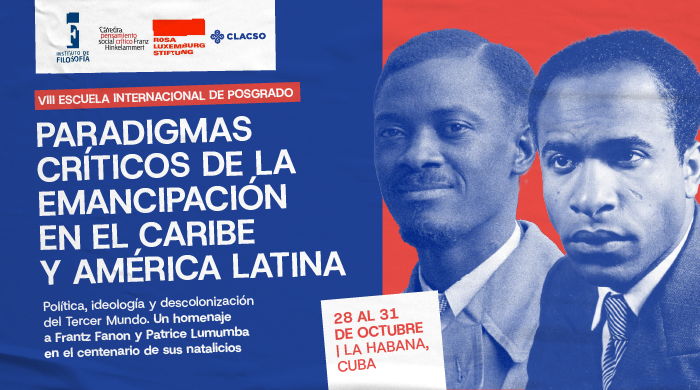
Politics, ideology and decolonization of the Third World. A tribute to Frantz Fanon and Patrice Lumumba on the centenary of their births
Havana, October 28-31, 2025
The Latin American Council of Social Sciences (CLACSO), the Rosa Luxemburg Foundation's (RLS) Office for Mexico, Central America, and Cuba, and the Franz Hinkelammert Chair of Critical Thought (Cuba) of the Institute of Philosophy, invite master's and doctoral students—preferably in the first half of their programs and in the initial stages of formulating their thesis projects—as well as established public policy officials and activists from civil society organizations in Latin America and the Caribbean interested in the topic, to submit their applications to participate in the VIII International Postgraduate School: Critical Paradigms of Emancipation in the Caribbean and Latin America, to be held from October 28 to 31 in Havana, Cuba.
Venue: Institute of Philosophy (Havana, Cuba)
Up to 40 scholarships will be awarded to students from Latin America and the Caribbean.
ORGANIZING INSTITUTIONS:
- Latin American Council of Social Sciences (CLACSO)
- Office for work in Mexico, Central America and Cuba of the Rosa Luxemburg Stiftung (RLS)
- Institute of Philosophy. Chair of Critical Thinking “Franz Hinkelammert” (Cuba)
ORGANIZING COMMITTEE:
- Magdalena Rauch (Latin American Council of Social Sciences)
- Patricia Zapata Alamilla (Rosa-Luxemburg-Stiftung, Mexico)
- Felix Valdés García (Institute of Philosophy, Havana)
- Georgina Alfonso González (Institute of Philosophy, Havana)
- Yohanka León del Río (Institute of Philosophy, Havana)
On the occasion of the centenaries of the births of the intellectuals and revolutionaries Frantz Fanon of Martinique and Patrice Lumumba of the Congo, the Latin American Council of Social Sciences (CLACSO), the Rosa Luxemburg Foundation's (RLS) Office for Mexico, Central America, and Cuba, and the Franz Hinkelammert Chair of Critical Social Thought at the Institute of Philosophy invite advanced master's and doctoral students, researchers and scholars of thought, and social actors committed to the study of thought processes and transformation in Our America to submit applications to participate in the VIII International School of Postgraduate and Theoretical-Political Training, "Critical Paradigms of Emancipation in the Caribbean and Latin America," which has been held in Havana, Cuba, since 2017. This school will take place at the Institute of Philosophy from Tuesday, October 28, to Friday, October 31, 2025.
The eighth edition of the School “Critical Paradigms of Emancipation in the Caribbean and Latin America” aims to promote debate surrounding the political and ideological realities of the 1960s, a period marked by processes of human emancipation and decolonization in the Third World. However, the reality of a bipolar world, the idea of socialism as a possible horizon, the existence of “real socialism,” and the Cold War “that led nowhere”—as Frantz Fanon would say—made these years a time of arduous debates with relevance to our own time. The result of that era is a body of critical work, both in practice and in print, that deserves to be revisited.
During this period, threats arose concerning the ideological definition of the processes, the crisis and impossibility of neocolonialism and dependence on the former metropolises, and the assimilation of Western models. Equally significant was the debate surrounding possible paths forward: the unchecked acceptance of armed struggle, revolutionary violence, or pacifism in times of adherence to the policy of peaceful coexistence promoted by the USSR and the countries of the Global North.
Today, these dialogues surrounding the work of the two anti-colonial fighters, African revolutionaries who confronted the brutal racism of colonialism, are of vital urgency in a world experiencing racist genocide, an atrocious colonialism perpetrated by Israeli Zionism with the complicity of European and North American colonialisms, which seeks to erase Gaza and the Palestinians from the face of the earth.
In school, students will study texts by Frantz Fanon such as * The Wretched of the Earth * (1961), * Year V of the Algerian Revolution * (1959), * For the African Revolution *, Patrice Lumumba's inaugural address as Prime Minister (June 30, 1960), and works by Ernesto Guevara such as "Notes for the Study of the Ideology of the Cuban Revolution" and * Guerrilla Warfare *, among others. Given that the focus is on Cuba, the 1959 triumph of the Cuban Revolution becomes unavoidable as an event that marked the 1960s and the complex African processes, along with the war in Algeria and the situation in the Congo. Students will study critical political and intellectual figures such as Frantz Fanon, Che Guevara, Fidel Castro, Patrice Lumumba, Kwame Nkruma, Amílcar Cabral, and Thomas Sankara, among others.
- To provide a space for learning and dialogue about human emancipation based on reflections on the decolonization processes in the 1960s, using critical works by intellectuals such as Frantz Fanon, Patrice Lumumba, and Ernesto Che Guevara.
- To exchange knowledge among participants on theoretical and ideological issues debated during the years of the decolonization of the Third World and their transcendence and importance for current times.
- To advance in the construction of networks of scholars and social activists interested in the knowledge and dissemination of forms of critical thinking and critical paradigms of emancipation, sponsored by CLACSO and the centers that convene this school.
The School is an intensive, in-person, postgraduate-level training program that aims to deepen understanding of the realities of Our America, critical forms of thought, and paradigms of emancipation. The main focus of this edition will be the global impact of critical thought on the decolonization of the Third World, the adaptation of Marxism to the realities of the Global South, socialism as an alternative amidst the Cold War, revolutionary action, armed struggle and revolutionary violence, as well as the ideology committed to total human emancipation. Cross-cutting themes include the continued relevance of critiques of colonialism and its theory of supposed human races, the role of women, and the relationship between gender, race, and class in the anticolonial and emancipatory struggle.
The working methodology includes participation in conferences and panels, a workshop for reading and discussing selected texts, and a documentary screening (film discussion). The presentation of research projects is also planned, upon request from participants.
The proposed activities will be led by specialists with experience in the study of the culture, thought and history of the region, articulating in their activities the academic dimension and the political commitment to transformation.
Certificates of participation will be given to all students of the School who participate in all the planned activities.
The call for applications is aimed at:
Master's or doctoral students with thesis projects related to the study of critical thinking, Marxist thought, history and current reality of the region, particularly Cuba, the Caribbean, Africa and Latin America.
Public policy officials, social activists, student leaders and social movement leaders interested in the study of the emancipatory critical tradition, whether or not linked to regular academic life.
Participation in the School is free for all selected applicants.
Latin American and Caribbean participants who do not reside in Cuba will have their accommodation in shared rooms covered from October 27th to October 31st (4 nights).
The institutions organizing the school do not assume or cover air or land transport costs, nor any other lodging or food beyond what is mentioned in this call for applications.
An international jury, made up of members of the academic committee and other designated evaluators, will select the participants.
The evaluation will take into account academic, geographic, and institutional criteria to ensure the participation of students from diverse countries and institutions. The decision will be final and cannot be appealed.
A total of up to 40 participants will be selected.
The result will be announced on the CLACSO websites.
Those interested should register on the CLACSO website. To do so, they must complete the following requirements:
- Online form with personal data
- Summary of your research project (graduate students) / territorial intervention plan project (representatives of civil society organizations and public policy officials). The document should be a maximum of 5 pages.
- Curriculum vitae or summary resume
- Letter of intent
- Letter of endorsement (mandatory requirement for representatives of civil society organizations and public policy officials)
Applications open until:
- el 21 September 2025 for interested parties that do not reside in Cuba
- el October 5, 2025 for interested parties reside in Cuba
Publication of results:
- September 28, 2025: selected do not reside in Cuba
- October 12, 2025: selected reside in Cuba
Certificates of participation will be given to all students of the School who participate in all the planned activities.
Inquiries: [mail protected]

