
VI International Postgraduate School: Beyond the International Decade for People of African Descent
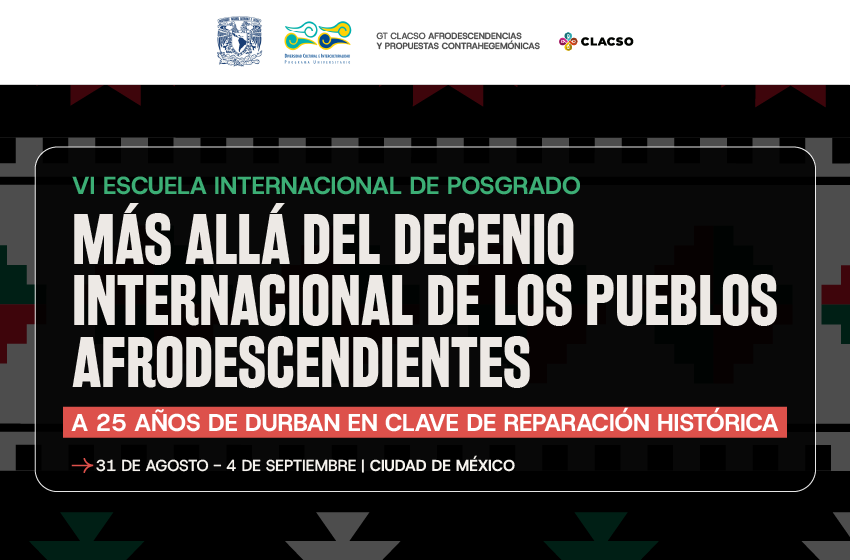
25 years after Durban, in the context of historical reparations
Mexico City | August 31 to September 4, 2026
The Latin American Council of Social Sciences (CLACSO), the CLACSO Working Group (GT) on Afro-descendants and counter-hegemonic proposals, and the University Program of Studies on Cultural Diversity and Interculturality of the National Autonomous University of Mexico (PUIC-UNAM), invite advanced master's and doctoral students, public policy officials, as well as leaders and activists from organizations of the Afro-descendant movement in Latin America and the Caribbean interested in the topic, to submit their applications to participate in the VI International Postgraduate School “Beyond the International Decade for People of African Descent. 25 Years After Durban in the Key of Historical Reparation”, which will take place from August 31 to September 4, 2026 in Mexico City.
Venue: University Program of Studies on Cultural Diversity and Interculturality of the National Autonomous University of Mexico (Mexico City)
Up to 50 scholarships will be awarded to students from Latin America and the Caribbean and Africa
ORGANIZING INSTITUTIONS:
- Latin American Council of Social Sciences (CLACSO)
- CLACSO Working Group (WG) Afro-descendants and counter-hegemonic proposals.
- University Program of Studies of Cultural Diversity and Interculturality of the National Autonomous University of Mexico.
COLLABORATING INSTITUTIONS:
- Center for Interdisciplinary Research in Sciences and Humanities (CEIICH-UNAM).
- Postgraduate Program in Gender Studies, UNAM Mexico
- University Program on Studies of Asia, Africa and Oceania (PUEAAO UNAM).
- Simone de Beauvoir Leadership Institute (ILSB)
- Nelson Mandela Chair of Studies on Afro-descendants, Cuba.
- International Association for Afro-Feminist Development (AIDAF), Colombia.
- Association of Afro-Latin American and Caribbean Researchers (AINALC).
- CLACSO Working Group on International Health and Health Sovereignty, Argentina.
- Research Group on Social Theory, Decolonial Studies and Critical Thinking (G-TEP). University of Mar del Plata, Argentina.
- CIESAS South Pacific
- Rosario Ibarra de Piedra National Human Rights Center, Mexico.
- National Human Rights Commission, Mexico (CNDH)
- Department of Social Work, Catholic University of Temuco, Chile.
- PhD in Communication. University of La Frontera-Austral University of Chile.
- International Network of Afrofeminist Voices.
- Global Anti-Racist Afro-Indo-American Network
- Helping Hand of the Costa Chica AC
- Timba laye Project
- AFROPODEROSAS, Mexico
ACADEMIC COMMITTEE
- Rosa Campoalegre Septien – PUIC UNAM; GT Afrodescendencias y propuestas contrahegemónicas (CLACSO); Cátedra Nelson Mandela, Cuba.
- Pablo Vommaro – CLACSO, Argentina.
- Carolina Sánchez García. PUIC-UNAM. GT Afrodescendencias y propuestas contrahegemónicas (CLACSO), Mexico.
- Anny Ocoró-Loango – AINALC; GT Afrodescendencias y propuestas contrahegemónicas (CLACSO); Universidad Nacional de Tres de Febrero (UNTREF) and CONICET, Argentina.
- Pastor Elias Murillo. Permanent Forum of Afro-descendants. United Nations, Colombia.
- Karina Bidaseca – GT. Epistemologies of the South and GT Afrodescendants and counter-hegemonic proposals (CLACSO). UNSAM, Argentina.
- Nilma Lino Gómes – Federal University of Minas Gerais (UFMG, Brazil) and GT Afrodescendencias y propuestas contrahegemónicas (CLACSO), Brazil.
- Santiago Arboleda Quiñones – Universidad Andina Simón Bolívar (UASB, Ecuador) and GT Afrodescendencias y propuestas contrahegemónicas (CLACSO), Ecuador.
- Felicitas López Sotolongo – GT Afrodescendencias y propuestas contrahegemónicas (CLACSO) and Centro de Investigaciones Psicológicas y Sociológicas (CIPS), Cuba.
- Carlos Álvarez Nazareno– GT Afrodescendencias y propuestas contrahegemónicas (CLACSO), Argentina.
- Odeth Santos – GT International Health and Health Sovereignty (CLACSO) and GT Afro-descendants and counter-hegemonic proposals (CLACSO), Mexico.
- Nathalie Cook Reyes. AfroLeaders Research Institute on Technology, Artificial Intelligence and Racial Equity, Costa Rica.
- Helena Cosma da Graça Fonseca Veloso – Centro Interdisciplinar de Estudos e Investigação da Universidade Católica de Angola.
- Elia Avendaño Villafuerte. PUIC-UNAM and GT Afrodescendencias y propuestas contrahegemónicas (CLACSO), Mexico
- Jorge García Rincón. Association of Afro-Latin American and Caribbean Researchers (AINALC) and GT Afrodescendants and counter-hegemonic proposals (CLACSO), Colombia.
- Arbey Bustamante – AINALC and GT Afrodescendencias y propuestas contrahegemónicas (CLACSO), Colombia.
RESULTS
We thank all master's and doctoral thesis students, public policy officials, and representatives of social organizations for the positive response to this call.
We received 43 applications that were evaluated by an international jury made up of members of the organizing committee. This entire team was responsible for considering the quality, relevance and coherence of the applications according to the terms of the call for applications.
In accordance with the above, the selected participants in the School are:
| Name and Surname | Country of residence |
| Abigail de los Ángeles Bravo Campos | Mexico |
| Alejandra Arteaga García | Mexico |
| Ana Lara Carbajal | Mexico |
| Anabel Herrera Soriano | Mexico |
| Angelica Moreno Calderon | Colombia |
| Auris Camila Murillo Jiménez | Colombia |
| Beatriz Carvalho Pimentel | Brazil |
| Bertha Maribel Pech Polanco | Mexico |
| Bruna Nélio | Brazil |
| Byron Ivan Lara Borja | Spain |
| Claudia Lucia Garduño Barrita | Mexico |
| Diana Karen Pinacho Lopez | United States |
| Dyadha Zuleima Herrera Morga | Mexico |
| Emerson Caetano Silva Junior | Brazil |
| Evelyn Perez Brito | Mexico |
| Federico Frontán | Uruguay |
| Fernel M-Valenzuela | Ecuador |
| Geise Barros Queiroz | Brazil |
| Henry Steven Rebolledo Cortes | Colombia |
| Iraneide Soares Da Silva | Brazil |
| Ivette Salinas Carranza | Mexico |
| Jose Manuel López Medel | Mexico |
| Juan Pablo Betancur Herrera | Colombia |
| Karla Mylena Faillace Delgado | Mexico |
| Laura Murillo | Colombia |
| Lois Nwadiaru | Ecuador |
| Luciana Oliver Barragán | Mexico |
| Maria Luiza Freitas Marques do Nascimento | Brazil |
| Marina Crespo | Argentina |
| Neyda Aracelly Neri Pat | Mexico |
| Patrick Suhe da Rosa | Brazil |
| Pavel Pupo Campoalegre | Cuba |
| Raúl Hernando Cortés Landázury | Colombia |
| Sara vargas | Brazil |
| Sergio Aramis Figueroa Pierce | Mexico |
| Sofia Fernanda Ju | Mexico |
| Thaynara Floriano Batista da Silva | Brazil |
| Veronica Abigail Hesiquio Bernal | Mexico |
| Victor Luis Benitez Pimentel | Cuba |
| Viviana Leticia Parody | Argentina |
| Yira Lizet Perea Osorno | Colombia |
This ruling is final and irrevocable.
The VI CLACSO International Postgraduate School “Beyond the International Decade for People of African Descent”, hereinafter “the School”, continues the tradition of the anti-racist struggle, based on the paradigm of Historical Reparation, viewed from the perspective of ancestrality and renewed maroonage, highlighting its integral, symbolic, material, intersectional and emancipatory character.
The School takes place within an exceptionally complex international context, characterized by global polycrisis and the reconfiguration of systemic and structural racism, as it enters the Second International Decade for People of African Descent (2024-2034). During this period, the slave trade and enslavement have been recognized as the most serious crime against humanity in history, one that does not have a statute of limitations and is not limited to mere compensation. This new phase of struggle begins with the main goals of the First Decade still unfulfilled, necessitating a deconstruction of the anti-racist agenda, incorporating current emergencies and perspectives, and emphasizing that people of African descent are collective subjects of rights, not merely isolated individuals.
The School takes place on the tenth anniversary of the founding of the Working Group “Afro-descendants: Counter-hegemonic Proposals,” which created this academic and political initiative in alliance with the Afro-descendant movement. This in itself constitutes an act of historical reparation in the face of epistemic racism.
Despite some progress in international initiatives and the momentum of the Afro-descendant movement, the pillars of Recognition, Justice, and Development remain central objectives and, simultaneously, sources of tension. A key point of contention in today's debate revolves around the "International Declaration for the Promotion, Guarantee, and Full Respect of the Rights of People of African Descent." This refers to the tension between individual rights and collective rights as a people, and the erosion of the latter as part of the global polycrisis.
Given this panorama, new scenarios are emerging that demand the deconstruction of the anti-racist agenda and rigorous preparation to sustain it. Nelson Mandela's warning, "The old methods are suicidal today," remains relevant. Within this context, the School focuses its attention on three structuring lines:
- Anti-racist postgraduate training, from the articulation of the academies and the Afro-descendant movement, with the protagonism of their voices.
- The agenda of situated knowledge, anchored in Amefricanity (Gonzáles, 1998) and in the contributions of intellectuals from the field of Afro-diasporic and African studies.
- The influence on public policies, based on the third generation of rights of Afro-descendant peoples, towards the historical reparation of Afro-descendant and African peoples.
Within the CLACSO training system, our School is a powerful, consolidated counter-hegemonic space, constantly evolving, and whose international relevance reaffirms the decisive role that education plays in the fight against racism (Mandela, 2012). We embrace this thesis from the perspective of restorative social and racial justice, environmental justice, and digital justice, from an anti-racist standpoint and from the perspective of the people.
- To consolidate a space for postgraduate training and anti-racist action with an impact on public policies for the promotion, guarantee and full respect of the rights of Afro-descendant peoples, from the emerging paradigm of Historical Reparation and the validity of the legacy of the Durban Conference.
- To make visible the thought and political action of references, academics, activist leaders of the Afro-descendant movement.
- To contribute to the construction and consolidation of the anti-racist agenda, as a premise for the successful realization of the Second International Decade for People of African Descent.
- Promote the strengthening of Afro-diasporic networks focused on combating systemic and structural racism, and the development of emancipatory proposals.
It is an intensive postgraduate training program that integrates critical Afrocentric, Afrofeminist, decolonial, and intersectional perspectives. Held since 2017, it is currently in its sixth edition. It is aimed at activists and leaders of Afro-descendant movement organizations, master's and doctoral students, and professionals responsible for the formulation, management, and evaluation of public policies. Its distinctive feature is the connection between academia and the Afro-descendant movement in Latin America, the Caribbean, and Africa.
The central theme of the School is "25 years after Durban in terms of historical reparation."
The main thematic areas of the School are the following:
- Afroepistemologies and the production of counter-hegemonic knowledge.
- The challenges of the Second International Decade for People of African Descent, in the context of historical reparation.
- Black decolonial feminisms: bodies, territories and struggles.
- Ethnoeducation, anti-racist education and curricular justice.
- Racialization and human mobility: tensions and alternatives.
- Africa and the Afro-descendant diaspora: memories, articulations and perspectives.
- Haiti and historical reparations.
- Racial justice and digital technologies: what to do in the face of Artificial Intelligence?
- Racism, health and structural inequalities.
- Afro-descendant youth: participation, resistance and contested futures.
- Art, culture and contemporary maroonage.
The school will be offered in person as part of the program for the International Convention “25 Years After Durban.” It will feature keynote lectures, panels, thematic workshops for collective discussion, book presentations, an Afrocentric fair, and cultural activities. This postgraduate program combines academic excellence, the production of situated knowledge, and the development of an anti-racist advocacy agenda. Since the school will be based in Mexico, it will analyze the experience of the Afro-Mexican movement from an intersectional perspective, using comparative and proactive analysis with Afro-descendant and African experiences.
The call for applications is aimed at:
- Young Afro-descendant graduate students, researchers, and educators who have addressed the topic.
- Activists and leaders of Afro-descendant organizations, with an emphasis on women and youth.
- Master's or doctoral students with thesis projects related to the School's theme.
- Representatives of public policy, NGOs and cooperation agencies involved and interested in the topic.
Selection includes both participation in the School and accreditation . The organizing institutions of the school will not cover air or ground transportation costs or accommodation.
An international jury, comprised of members of the academic committee and other designated evaluators, will be responsible for selecting participants. The evaluation will consider academic criteria, gender, Afro-descendant heritage, geographic and institutional affiliation, and social activism, in order to guarantee the participation of students from diverse countries and institutions. The jury's decision will be final and cannot be appealed.
A total of 50 participants will be selected.
The result will be announced on the CLACSO websites.
Interested parties must register on the CLACSO website, completing the online form and attaching documentation that proves compliance with the following requirements :
- Curriculum Vitae (CV).
- Letter of intent, in which the reasons that drive participation in the VI International Postgraduate School “Beyond the International Decade for People of African Descent” are set out.
- Summary of the research project (in the case of postgraduate students).
- Letter of institutional endorsement (in the case of public policy representatives or social organizations).
Applications open until July 26, 2026
Certificates of participation will be given to all students who attend all the activities proposed by the School.
Email inquiries: [email protected]
WhatsApp inquiries: +54 9 11 3880 – 1388

