
VI Latin American and Caribbean Biennial on Early Childhood, Childhood and Youth
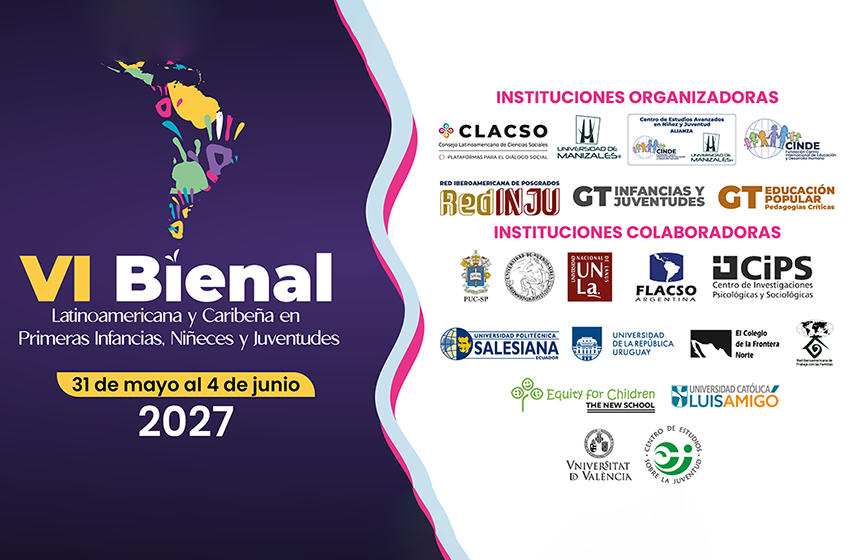
📅From May 31 to June 4, 2027 📍 Manizales, Caldas, Colombia
The call for applications for Working Groups is now open » Apply by September 11, 2026
A platform to share research, connect experiences, mobilize knowledge, and build proposals for regional transformation.
The 6th Latin American and Caribbean Biennial on Early Childhood, Childhood, and Youth (Manizales, May 31 – June 4, 2027) is the leading regional forum for collaboration among academia, governments, social organizations, the private sector, and multilateral organizations to influence public policy and transform the realities of children and youth. Supported by the RedINJU network and the CLACSO Working Group, the Biennial combines research, political dialogue, and participatory development, addressing strategic issues such as inequality, poverty, violence, social mobilization, diversity, and identities, with the aim of generating concrete alternatives and funding for local projects throughout Latin America and the Caribbean.
This Biennial was created in 2014 by the Ibero-American Network of Postgraduate Studies – RedINJU (CLACSO's postgraduate network) and the CLACSO Working Group on Childhoods and Youth. Currently, RedINJU comprises the Center for Advanced Studies of the University of Manizales and CINDE (Colombia), the Pontifical Catholic University of São Paulo (Brazil), the University of the Republic (Uruguay), FLACSO (Argentina), the University of Lanús (Argentina), COLEF (Mexico), the University of La Plata (Argentina), the Salesian Polytechnic University (Ecuador), Luis Amigó University (Colombia), and the University of Valencia (Spain). The Working Group on Childhoods and Youth currently consists of 130 researchers from various countries in Latin America and the Caribbean.
This sixth Biennial will focus on the following epistemic themes: Generational Inequalities, Childhoods and Youths: Politics, Resistance, Poverty and Hunger; Social-Collective Mobilization, Democratic Transformations, Agency and Violence; and Narratives of Life, Social Movements, Diversities and Identities. We present a brief rationale for each of these themes.

