
Window to the world
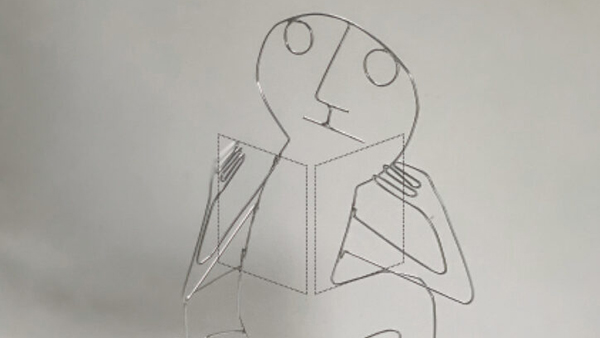
A pointless thing to celebrate: books, reading, and society


Window to the world
A book is not a work of art; it is the possibility of a work of art; it only comes to life when it is opened and breathes in the company of the reader.
Umberto Eco pointed out that this curious object was invented perfectly once and for all. Like scissors or a spoon, it cannot be improved. But even perfection has its history.
Reading technology has changed dramatically. According to Ivan Illich, in the 12th century, Scholastic scholars invented the page with lines resembling the furrows of a vineyard; hence, the word legere comes from "to harvest." Rural metaphors were used to help an agricultural society accept the surprising written language (similarly, today we find reassurance in finding a "desktop" on our computer screen).
In the 12th and 13th centuries, parchment scrolls and enormous tomes that had to be supported on a lectern were replaced by portable books, and this forever altered human behavior. Reading, which had traditionally been done aloud, began to be silent. A collective activity became personal, with no judge but the reader's own conscience. This transition was crucial in consolidating the notion of the "individual." With the invention of the printing press in the 15th century, the number of independent thinkers expanded enough to give rise to the Renaissance.
The history of modernity is inseparable from the book, which enjoyed a relatively stable existence until the arrival of television. In 1962, communication theorist Marshall McLuhan prophesied the end of print culture in *The Gutenberg Galaxy*. Ironically, the success of that work contradicted his prediction: the book's death certificate was a bestseller.
The next technological shift didn't come with audiovisual media, but with a device powered by letters: the personal computer. Since the 12th century, the way we read hadn't changed so much. Today we practice this task in fits and starts, jumping from one message to another and from paper to multiple screens. Reading has become atmospheric.
In its electronic form, the book contains encyclopedias, dictionaries, and entire libraries, and even allows the reader to be read by leaving traces of their habits and preferences. However, with a simple play on words, we can say that the printed book has a secure future. The reasons are obvious: its technology doesn't become obsolete, it engages the five senses, including touch and smell, and it is passed from hand to hand. As long as we have a need for other hands, there will be paper books.
In the 18th century, the German scientist Lichtenberg discovered the profound secret of this invention: “A book is like a mirror: if a monkey looks into it, it cannot see an apostle reflected.”
The book is a window to the world and the world is a mirror: the risky opportunity to know what we carry inside.
Juan Villoro
Listen to the story and look at the poster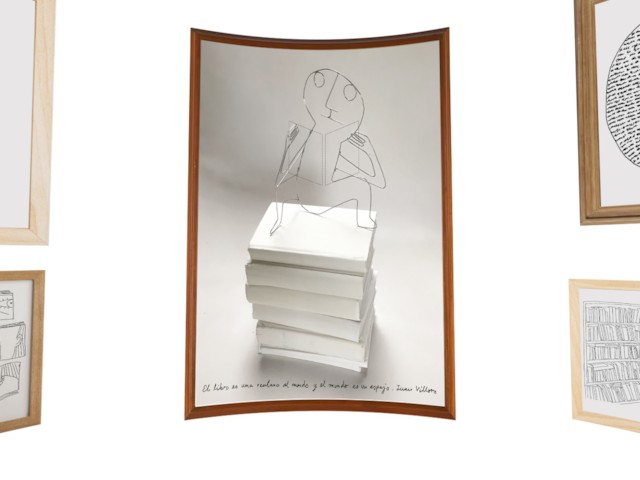

READING SOCIETIES
“All societies,” Michèle Petit tells us, “cast a net of words, stories, and cosmogonies across the starry night, fragments of which we appropriate from childhood.” For communities, reading is a way of presenting the world to their new members, of inscribing them within a history, a culture, and a genealogy. Societies, like individuals, are what they have read, and a community that reads cultivates its memory and its identity. Cultivating readers is also cultivating citizenship: reading and democracy go hand in hand.
The ideal space for reading is one of unwavering freedom and is also a space for encountering others. In this sense, the role of mediators (librarians, teachers, storytellers) is fundamental, as they contribute to the formation of reading communities by selecting texts, listening to what readers have to say, giving them a voice, discussing, asking questions, and rereading. To mediate is to share one's own experience with books, to bring it out of the private sphere so that it becomes part of the learning process for others.
THE PROTAGONISM OF READERS
A book does not exist without its readers. Just as it is often said that if a tree falls in a forest with no one to hear it, it makes no sound, we could similarly say that an unread book is not yet a book in the true sense. Reading, moreover, is not a passive activity: it involves developing a growing capacity to construct meaning and think critically.
Despite the many technological innovations and the fast pace of modern life, reading remains an unprofitable but necessary activity; it is, as Carlos Skliar expresses it, "a breath like a gulp of free time, free time without any utility, a uselessness worthy of celebration."
THE RIGHT TO READ
Reading is a right, and like all rights, it must be guaranteed for everyone by the State. This is a task that governments in Latin America, the Caribbean, and around the world must include in their public policy agendas. There are many ways in which States can and should contribute to fostering and developing reading societies: from creating national reading plans and distributing up-to-date reading materials in schools, libraries, and alternative spaces, to training, advising, and supporting teachers, librarians, and facilitators, creating digital repositories, and organizing countless activities in community spaces to generate conditions and policies related to reading and writing that impact diverse communities and populations.
Open access policies for knowledge dissemination are a powerful engine for democratization and the promotion of reading. Open access is the availability of texts on the public internet, allowing anyone to read, download, or copy them without financial, legal, or technical barriers beyond internet access. The only restriction should be to give authors the right to be properly acknowledged and cited.
Who to Follow?


Readings to Go Into Depth

Carlos Skliar. Reading and education: Between pedagogical and literary arguments

Gregorio Weinberg. Writings on books and publishing in Latin America

Graciela Montes. The great opportunity. The school as a reading society
Books to interpret the world. Books to transform it.
Collaborators:
CLACSO Coordination:
Karina Batthyány, María Fernanda Pampín and
Gustavo Lema
Executive Director (i) of the Valparaíso Cultural Park:
Erick Fuentes Góngora
Edition:
Lucas Sablich, Solange Victory and Marcela Alemandi
Illustration: Alexander Magellan
Design: Marcelo Giardino
Virtual reality and the web:
Sebastián Higa and Camila Pastor

