
Venezuelan women in the pandemic
Alba Carosio, Indhira Libertad Rodríguez and Tania Elíaz [1]
In Venezuela, women are the mainstays of life, not only within their families but also in their communities. The country is crisscrossed by solidarity networks for the distribution of food, goods, and services, which are primarily operated by women. Therefore, in addition to housework, they also undertake community work, which is essential for sustaining life in the context of the ongoing crisis the country is experiencing.
This is the context in which the pandemic found us. Even before the first case, it brought with it the voluntary quarantine, which the entire country has been observing since March 16th. Once again, it is women who sustain life, now confined to their homes. They are more active than ever: they are taking extreme hygiene precautions in difficult circumstances with unreliable electricity, water, and gas services. They continue to activate solidarity networks to sew homemade face masks from recycled fabrics. They are finding ways to obtain bleach and other disinfectants in scarce markets. They are supporting their children, now without schools or school lunches. Others continue working online, teaching classes or writing articles; they are happy to do so, even though they have to divide their time, now more demanding on domestic tasks.
Women also make up the majority of frontline healthcare workers. The same is true in other sectors, such as supermarkets and related businesses. A significant number of women are part of the police force, which is enforcing quarantine measures in all municipalities. Women also comprise the majority of doctors and nurses conducting door-to-door visits to people suspected of having the virus.
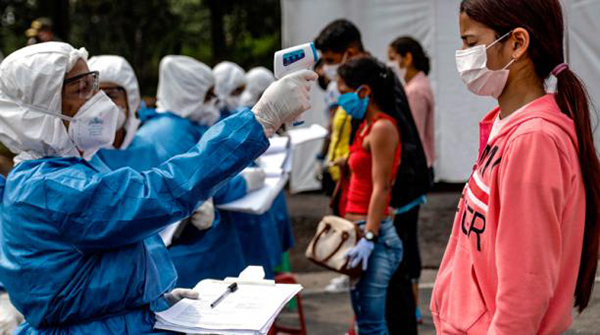
There are nearly two million Venezuelan women living in various Latin American countries. Mostly poor migrants who left the country on foot, they have integrated precariously into the economies of their host countries. Having made great sacrifices to send remittances to their families, they are now unemployed and unprotected, with little chance of returning. However, a wave of compatriots is arriving on foot at the Colombian-Venezuelan border, where they will receive healthcare, free screenings, and quarantine before being allowed to reach their families' homes. There, once again, these women are caring for their children under critical conditions.
Feminist groups have created telephone networks for emotional support and counseling for women who are forced to confine themselves in the same space as their abusers.
In Venezuela, there is experience and preparedness to face crises; Venezuelan women have acquired this through hard work in recent years. Women perform miracles to feed their families; many are informal workers who have lost their income, which, in the midst of this pandemic, exacerbates their precarious situation, forcing them to take risks to earn a living. The government has established social protection bonuses; they are not enough, but it's something, and we work miracles with them.
In short, the pandemic exacerbates the structural inequality faced by women. It increases and complicates their workload, already heavily burdening their bodies, spirits, and minds. It exponentially increases the different types of violence they experience. Ultimately, the pandemic does not affect them equally, neither within the same gender nor in comparison to men.
Venezuelan women facing gender-based violence during the pandemic
In Venezuela, there has been no official gender-based data since 2016. For this reason, social and feminist organizations have taken on the task of counting femicides. Anthropologist Aimee Zambrano has been conducting research based on Open Source Intelligence techniques, which she publishes monthly through the Utopix platform. In 2019, 167 femicides occurred in the country [2] . That is, approximately every two days a Venezuelan woman was killed simply for being a woman. However, Zambrano reports on her social media that so far this year there have been 73 femicides, which means there has been a considerable increase in the daily rate, approaching one femicide per day.
UN Women, in its publication “Gender and COVID-19 in Latin America and the Caribbean: Gender Dimensions in the Response,” warns that, within the context of health emergencies, the dangers of women, adolescents, and girls experiencing gender-based violence, specifically domestic violence, increase. The accumulated tensions of prolonged confinement at home generate friction, conflict, and disagreements, for which hegemonic masculinity finds no other means of conflict resolution than violence, which is directed at the most vulnerable: women and children. This can increase the isolation of women, which is already part of the cycle of violence.
There is an undeniable economic impact triggered by this pandemic, which adds barriers for a woman to leave an abusive partner, as well as a greater risk of sexual exploitation.
Furthermore, women survivors of gender-based violence face additional obstacles in escaping these situations, as mobility is restricted. Accessing protection measures and/or essential life-saving services is even more difficult, due in part to the same quarantine-related movement restrictions.
If in Venezuela, last year only 42,45% of femicide perpetrators were imprisoned, according to the aforementioned report [3] , it is no exaggeration to say that a veil of impunity surrounds these crimes, especially since many of them were preceded by complaints filed with the relevant authorities. This lamentable ineffectiveness on the part of the State raised alarms within the feminist movement amidst the pandemic, as we immediately anticipated an increase in gender-based violence in its various forms and the danger to the lives of women living with their abusers.
Faced with this situation, feminist organizations and individuals decided to take action to guarantee women's lives free from violence, forming a network that provides "loving support" by phone, as the feminist collective Tinta Violeta prefers to call it. A particularly interesting aspect of this effort is that the pandemic achieved—something that had not been possible after many years and attempts—uniting feminists and transcending the political polarization that characterizes our collective and social life.
Thus, they have established a logistical system that provides psychological support via telephone, involving the following organizations: Fundana, Plafam, S y D Salud, Fundamujer, 5ta Ola, and the Center for Women's Studies; case management, which includes providing legal advice, psychological support, and coordination with complaint-receiving agencies and organizations or institutions offering psychological services: Tinta Violeta, La Araña Feminista, Mujeres por la Vida, Colectivo Feminista Mujer Género Rebelde, and Cepaz; and addressing sexual violence through Doctors Without Borders, Avesa, and Ámbar. One of these organizations alone has handled 50 calls since the start of the quarantine in Venezuela.
This organizational achievement of the feminist movement is not being built behind the backs of the people, or rather, the people, given the feminine face of the prolific territorial organization that has been built from the grassroots and is so vital at this time. It is their reflection.
Venezuelan women and migration during the pandemic
The Covid-19 pandemic shows us the various flaws of capitalism, one of which is the notorious interest and priority given to protecting the interests of capital at the expense of the rights of those who reproduce it with their labor.
The situation of those who have opted for human mobility between different countries as a survival strategy shows us another side of this seam.
The lives of poor migrants are marked by inequality, with low wages, exclusion from formal employment and decent housing; precariousness characterizes their lives. Countries with openly neoliberal models have demonstrated their shortcomings regarding access to healthcare, protection, and social services in the face of the crisis generated by the pandemic. Discourses are constructed that discriminate against and exclude the migrant population from policies aimed at vulnerable sectors, policies that are largely unrepresentative of the magnitude of the problem.
Currently, the human mobility of Venezuelans is increasing and, according to IOM data, Colombia, as the first receiving country in South America, has the presence of approximately 1,8 million migrants from Venezuela.
Enduring the pandemic might only last a few days, as these are men and women who live hand to mouth, forced to choose between hunger, the risk of infection, and the consequences of evading quarantine, including temporary imprisonment, police repression, and exorbitant fines. In recent weeks in the neighboring country, entire families have been left homeless after being evicted for failing to pay rent and utilities, despite decrees prohibiting such payments.
Many of the evicted families are Venezuelan, left homeless and exposed to the elements. It is there that they decide to return to their country. A new category of migrants is emerging between Colombia and Venezuela: returnees. Some are lucky enough to reach the border by bus thanks to a designated humanitarian corridor, while others, less fortunate, undertake the journey back on foot. On the Venezuelan side, they are met with a 14-day quarantine in makeshift shelters such as schools in the border states, a period during which it can be determined whether the virus has incubated.
In the case of women, conditions of inequality and discrimination are exacerbated. A considerable number of migrant women live hand-to-mouth from their informal work, and losing access to their only source of income complicates their situation, as many have migrated with their children. Those who have not been evicted are also considering returning to their country of origin, since once the quarantine is lifted, they would face an insurmountable debt. This is especially true after losing jobs, for example, jobs without contracts or job security, or being unable to continue their economic activity within the informal economy. The experience of eviction, living outdoors, forced return, and improvised confinement puts women and girls at risk of violence, discrimination, and infection.
Will we be able to turn the tables?
The contributions of feminist economics are just under a century old. One of its main points lies in the urgent need to build an economy that recognizes care work, the work of reproducing life, with the ethics that this entails, permeating the social fabric, promoting its redistribution and shared community responsibility. This also includes overcoming the exploitative relationship with Mother Earth, with the oikos , imposed by this patriarchal, colonial, heteronormative capitalism.
Much has been said about the powerful opportunity this pandemic presents, highlighting the unsustainability of the civilizational order we have as humanity. We firmly believe that many of the keys to understanding and feeling this post-pandemic world have been not only reflected upon, but also built through their actions by women, dissident sexualities, and feminisms of the Global South. It is time to turn to their contributions and organizational experiences. We invite you to dream of the world to come. Will we be able to turn the tables?
[1] Co-coordinator and member of the CLACSO Working Group on Feminisms, Resistances and Emancipation.
[2]https://utopix.cc/pix/monitor-de-femicidios-2019-interactivo/
[3] ibid

If you would like to receive more information about CLACSO's training programs:
[widget id=”custom_html-57″]
to our email lists.

