
"Uruguay was the first country to advance in a Care System and what has been achieved is irreversible."
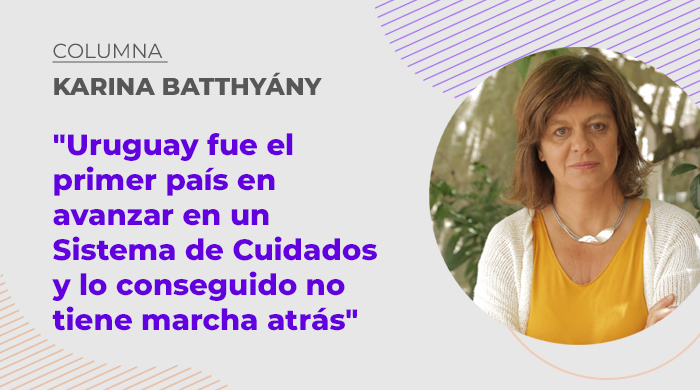
Transcript of Karina Batthyány's column
in InfoCLACSO – April 30, 2025
We are at the Faculty of Social Sciences of the University of the Republic of Uruguay to present a comparative report on the topic of care work. The report was prepared by the Gender Sociology research group, which I coordinate, and which has been working systematically on gender inequalities for over 30 years, with care work being one of the critical issues.
– The report poses the question “Gender mandates in transformation?” It refers to a very long period, since 2015 in relation to the Care Law. What was the social work done on the issue of care in the face of political decisions?
– Let's put this report into perspective. Indeed, the idea is to compare two moments. Initially, in 2011, when Uruguay was experiencing the debate prior to the creation of the Care System, a progressive government had won and proposed care as one of its main measures in terms of social transformation and the generation of social well-being.
In addition to supporting these discussions through the research team, providing various inputs, we established a baseline and essentially revealed what Uruguayans thought about caregiving issues: who should provide care, how they should provide it, who they wanted to care for them, and so on. The research conducted in 2011 served as the starting point for drafting what later became the Care Law and the beginning of the implementation of the National Integrated Care System.
Subsequently, in 2023, we decided to repeat the same measurement to effectively compare public care policies in terms of their impact on these representations. "Who do you want to care for you?" and "Where do you place the primary responsibility for your children's care?" are some of the questions we ask ourselves regarding the issue of care.
Today, we present comparative results that allow us to examine the gendered division of labor and the issue of care work. Furthermore, the report reveals some transformations, indicating greater social representation or a growing awareness of the need for public institutions to support the care work performed by women in the home. We therefore attribute this to the implementation of a policy that, while offering services, does so with limited scope and thus alters these perceptions.
In turn, we find some continuities in the sense of the disconnect between social representations and practices with slightly less conservative views, distinguishing between the two populations of children and dependent elderly people in relation to knowledge of public care policy. We know that one of the main demands in certain sectors of the Uruguayan population is how to care for children, beyond the care that can be provided at home in terms of work schedules. Beyond the results, I want to highlight some elements from the perspective of understanding the social sciences through critical sociology: the articulation between knowledge, public policy, and social movements and organizations with civil society and the pro-care network.
Moving beyond this study and looking at the bigger picture, the issue of care is on the public agenda, and pioneeringly so in Latin America and the Caribbean. Uruguay was the first country to place it there with its law, its integrated national care system, and the progress achieved is irreversible. Once care is on the public agenda, progress may be faster or slower, but the issue is there.
-Within the framework of CLACSO, care work has become a central theme for study, development, and research. How does the role of care work on the political agenda contribute to this debate at the regional level?
Of course, at CLACSO, the issue of care has gained significant importance in recent years, but this is because the social sciences are important, and we open doors or windows to emerging themes to transform some conceptual frameworks or traditional ways of thinking. Furthermore, there is a need at the societal level in different countries for the issue of care to be present in order to create a fairer and more equitable world, given one of the root causes of gender inequality. If we do not develop public policies to modify the aforementioned elements, we will hardly achieve the goal of equality within the new frameworks of social relations and in pursuit of building social well-being.
– Now we see the current Uruguayan government implementing a collaborative effort with academia to make progress on care issues…
– I want to clarify that the issue of care work isn't just being revisited; quite the contrary. We've already been working very actively with both the National Care Secretariat and the National Institute for Women, which is the governing body for gender policy in Uruguay. In fact, we were once again highlighting the difference between Uruguay and other Latin American countries regarding care work. Unfortunately, all of this progress was lost or dismantled in terms of the participation of groups working at the University of the Republic (UDELAR), where the logic of collaboratively producing knowledge useful for public policy and social transformation was abandoned. What I want is to influence changes in people's living conditions, and knowledge production must be integrated with politics, social movements, and organizations.
– The region is experiencing a period of retreat and dispute regarding the issues discussed. We're in Uruguay, next door is Argentina, and we also have Brazil, which recently passed a policy on care. How do you interpret this diverse regional landscape with so many contrasts?
– These are the diversity and contrasts to which our region has accustomed us. A unique and diverse Latin America, where we find countries embracing progressive movements but also others experiencing profound setbacks toward conservatism and the right wing, thus undermining the rights agenda—that is, the rights won so far this century. And within this context, rights associated with feminism, diversity, dissent, and women's rights occupy a privileged place.
So, we are at a particular moment, not only in Latin America but worldwide, facing regressive trends in law and the growing strength of conservatism and right-wing movements. This compels us to redouble our efforts with different types of research and to explore what we can contribute to building alternatives. We believe that placing care at the center of the discussion is one way to contribute to building such an alternative.
If you would like to receive more information about CLACSO's training programs:
[widget id=”custom_html-57″]
to our email lists.

