
“It is urgent to establish welfare and social protection systems in our region”
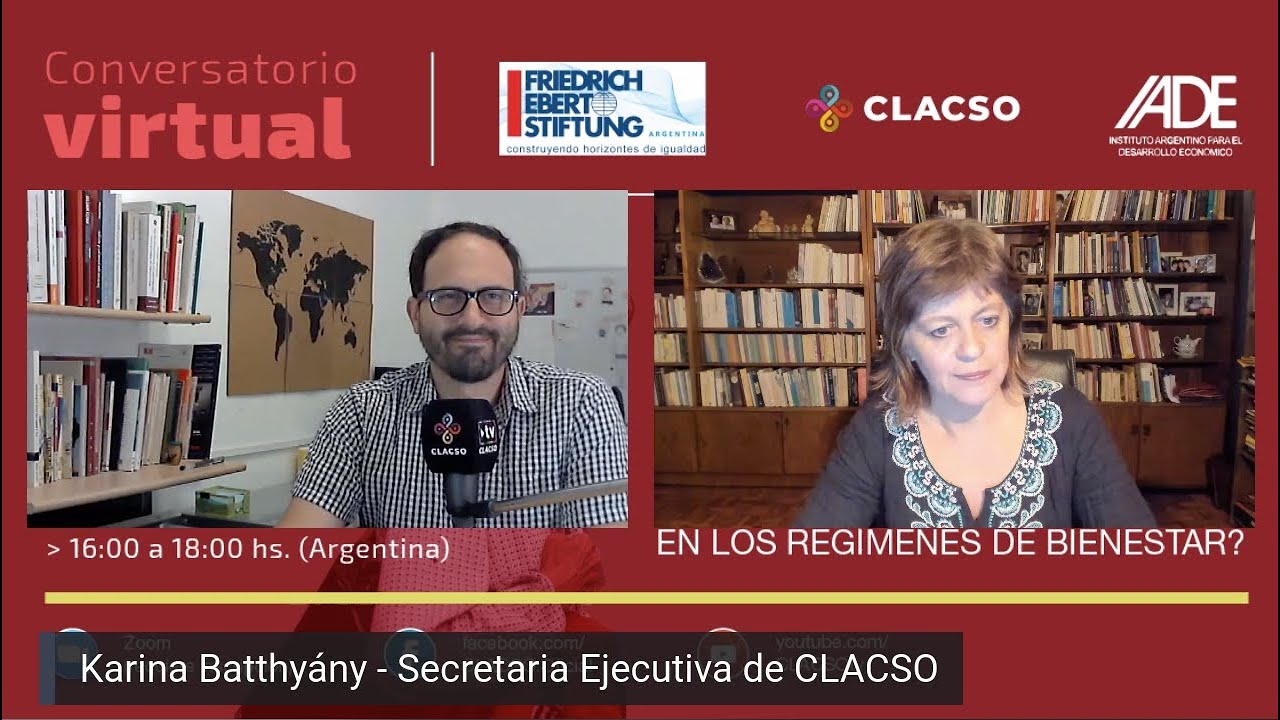
On August 4, the Latin American Council of Social Sciences (CLACSO), the Friedrich Ebert Foundation, IADE, and the CLACSO Working Group on Social Security and Pension Systems organized the Third Meeting: “The Social Challenge in Times of Pandemic: Structural Changes in Welfare Regimes?” The speakers were: Fernanda Raverta, Executive Director of ANSES (Argentina's social security administration); Simone Cecchini, Officer in Charge of the Social Development Division of ECLAC (Economic Commission for Latin America and the Caribbean); Karina Batthyány, Executive Secretary of CLACSO; and Svenja Blanke, FES Representative for Argentina and Director of the journal “Nueva Sociedad.” The event was moderated by Nicolás Dvoskin of the Argentine Institute for Economic Development.
At the end of the discussion, Karina Batthyány was interviewed by CLACSOtv.
Interviewed by Gustavo Lema
Karina Batthyány commented that “what we discussed at the meeting was specifically about social protection or welfare systems. This is an idea I want to emphasize today because if there's one thing this pandemic has made clear, it's the urgent need to accelerate the establishment of these welfare or social protection systems in our region. This is something that, in general, has been a long-standing debt in Latin America and the Caribbean, and especially in Latin America and the Caribbean, which is the most unequal region. We already had these deep inequalities marked in our region, which became evident and were exacerbated in these past five months or so of the pandemic. Some elements—pre-existing ones, of course—became more visible and intensified. What am I talking about? Let's take two examples. Perhaps one very visible one: health systems, protection in terms of universal access for everyone to quality health systems. The differences between Latin American and Caribbean countries, and of course also globally, became very clear within the framework of this health crisis, but let's focus on our region. Where Those countries with stronger healthcare systems were perhaps able to respond very differently than those with weaker systems; and when I say "systems," I'm talking about public healthcare systems with universal access for everyone. So, one of the things that everyone surely saw in their daily lives over these past five months is the healthcare system. But there's another component that also became very evident during this pandemic, one that wasn't as visible before and that perhaps is now starting to be considered more: the issue of care. And why am I bringing up care now? Because care is, and should be, one of the pillars of social well-being. Let's ask ourselves what has changed most in our lives during these months: our daily lives, our interactions in domestic and everyday spaces, where the need for care for the well-being of all people became evident, and not only the need for care but also who—due to the gendered division of labor in our societies—is usually responsible for this caregiving. These two elements I think they are important to mention.”
If you would like to receive more information about CLACSO's training programs:
[widget id=”custom_html-57″]
to our email lists.

