
“Universalizing the scope of social security for the benefit of everyone”
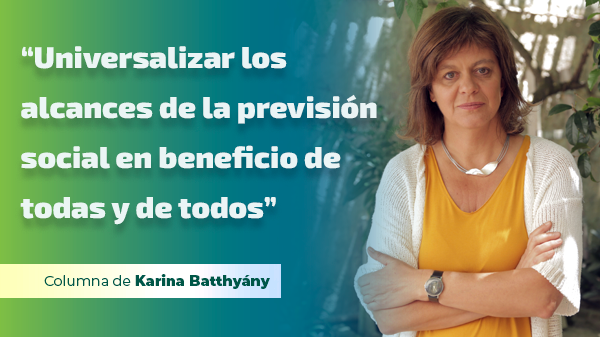
Transcript of the column by Karina Batthyány
in InfoCLACSO – May 31, 2023
In this column, I will discuss the right to social security, understood precisely as the guarantee of social protection and well-being that benefits all workers in old age or in the event of disability that may occur throughout their lives. This right is constitutionally recognized in most countries worldwide. Furthermore, it enjoys strong international recognition through the International Labour Organization (ILO) by means of its Convention 102.
The first notion of a social security system in the world dates back to the late 1800s, to the time of Otto von Bismarck, in Germany, with the Law of Compulsory Disability and Old Age Insurance, which was enacted in 1889 and over time spread to other countries.
Pension systems around the world have established and legitimized the concept of retirement—that is, leaving the workforce at a socially determined age that has varied over time—by creating collective mechanisms for distributing resources to finance benefits. In other words, it's about reaching an age where it's possible to retire from the labor market with guaranteed income, provided through solidarity across generations and countries.
Obviously, depending on the model we look at, both current and throughout history, we find differences in the levels of coverage and pension expenditures, which depend on political decisions in historical and social contexts regarding the design and implementation of these systems and the socio-demographic structure in different countries.
If we look at our Latin American region, the first pension fund for public administration employees was created in Argentina in 1904, and the first non-contributory pension system in Uruguay in 1919, while the first mandatory national social security system was instituted by Chile in 1924, which included the Workers' Insurance Fund, the National Fund for Public Employees and the Fund for Private Employees.
Today, looking at the Latin American reality, we are still far from having a unified pension system in our region. Some systems continue to have a strong state presence, while others are moving toward privatization in the management of pension funds. In all cases, they face significant limitations due to widespread informal employment, one of the main causes of low coverage in the region, in addition to demographic changes and the aging population.
Unregistered (informal) workers spend a large part of their working lives without making pension contributions and will likely reach retirement age without the right to a pension, particularly in the rural sector and among the self-employed.
Informality, low coverage, and poverty in old age are interrelated: poorer countries tend to have less developed social security systems and invest fewer resources in benefits. This limits the possibilities for public policy to effectively reduce the incidence of poverty in old age and, of course, limits the rights of this population to an independent income.
If we look at the micro level (among families) something similar happens: workers with lower incomes and lower levels of qualification are usually in the informal economy and lack pension coverage.
At the end of the 20th century, within the framework of the restructuring of Latin American economies that followed the debt crisis and the so-called Washington Consensus, the new pension paradigm, promoted by the World Bank and other international organizations, was the total or partial privatization of the old public pay-as-you-go systems. This implied the withdrawal of the State and its replacement by systems of individual capitalization and private management. As a result, coverage problems persisted and in some cases worsened.
While the privatization of public systems has been reversed in some cases, such as in Argentina, the common denominator is that all Latin American pension systems face enormous challenges that pose a significant strain on public finances. Latin America is projected to experience rapid population aging, and by 2045, projections indicate that approximately 18 percent of the total population will be 65 years of age or older.
A 2020 study by the Economic Commission for Latin America and the Caribbean (ECLAC) argues that social protection (coverage and benefit levels) offered by pension systems is unlikely to be equivalent, which could have significant economic and social repercussions. That year, approximately 57 million people were 65 and over, the minimum retirement age in most Latin American countries. ECLAC warns that by 2040, this age group is projected to reach around 111 million people, representing 15% of the region's total population.
The growing number of older adults in Latin America is compounded by informal workers who typically do not contribute to their pensions, according to the Organisation for Economic Co-operation and Development (OECD). Our region shows trends indicating that there could be more pensioners and fewer workers contributing to the system. According to the OECD, in addition to being few in number, these workers' contributions are often too irregular to finance adequate benefits. By 2050, between 63 and 83 million people could not receive an adequate pension without reforms and efforts to increase employment in the formal sector, including access to quality education.
Furthermore, we must add gender inequalities, which are another limitation of current pension systems, where the 'protection unit' is based on the family or household, defined as a stable nucleus in which the woman dedicates herself to unpaid domestic work (including childcare or care of the elderly) and who would be protected through her partner, a design that increasingly fails to reflect the reality of current households and the reality of women in Latin America and the Caribbean.
On the other hand, despite the upward trend, women still have lower labor force participation rates than men and face significant wage gaps. In several Latin American countries, the incidence of unemployment and informal employment among women who do participate in the labor market is also higher than among men. Thus, when claiming contributory retirement benefits, women are at a disadvantage: they accumulate fewer contributions and, therefore, many of them do not reach the minimum required to receive a benefit; and those who do receive benefits are lower, either because they contributed for fewer years or because their contributions and/or earnings were lower.
For all the reasons described, it is increasingly urgent to move forward with fundamental reforms, with a social focus, channeling resources that are currently allocated to policies far removed from the needs of our populations. This holds true not only in our region but also in Europe. The recent case of France, which has been in the press and media lately, is worth considering.
A pension reform imposed in mid-April by decree by President Emmanuel Macron's government has sparked strong criticism and street protests. It validated the increase in the retirement age from 62 to 64 by 2030 and brought forward to 2027 the requirement of 43 years of contributions, instead of the current 42, to receive a full pension.
Europe's second-largest economy has had a pay-as-you-go pension system since 1945, based on the principle of intergenerational solidarity, whereby current workers pay the pensions of retirees. Macron now argues that its longevity is unsustainable in a country with an aging population, where life expectancy is 85,5 years for women and 79,4 for men. He says that this is how he seeks to avoid a €13.000 billion deficit in the pension fund by 2030.
Many experts and CLACSO Working Groups addressing these issues have demonstrated the falsehood and alarmist nature of such announcements. This is also happening in Latin America, for example in Uruguay, where a reform has just been approved that raises the retirement age. Current President Luis Lacalle Pou broke one of his campaign promises not to touch pensions, introducing a set of articles initially, which were later modified to ensure the sustainability of the Social Security Bank, and which show a delay in the retirement age for both men and women in Uruguay starting in the coming years.
I'm referring to the cases of France and Uruguay to show how these issues are closely linked to the well-being of the population in our countries. Particularly the well-being of the elderly, but it's an issue that affects the well-being of society as a whole.
Thinking about how the political alignment of the most conservative sectors proposing the same reforms in different parts of the world almost simultaneously... There's an advance there in relation to everything that is social support, isn't there?
– Indeed. It's based on demographic arguments, which are undeniable. We live longer now than before. Life expectancy has increased, and that doesn't necessarily have to be a bad thing; quite the contrary: we should celebrate this and not cut back on rights associated with the notion of well-being. Ultimately, these are also ways in which ideological disputes are expressed. On the one hand, within the framework of neoliberal models, the need to cut back on these systems that provide benefits to everyone in pursuit of social well-being is placed at the center of the discussion. And on the other hand, more progressive models maintain that the way resources are managed and distributed throughout society must be changed.
If you would like to receive more information about CLACSO's training programs:
[widget id=”custom_html-57″]
to our email lists.

