
Together, we can win the battle against COVID-19
Yang Chen[1]
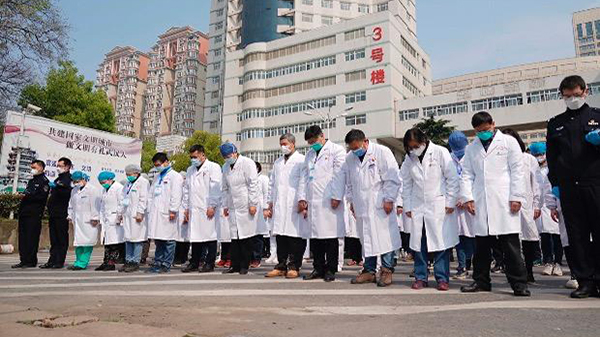
April 4, 2020, was China's "Tomb-Sweeping Day." On this day, to express deep condolences for the martyrs and deceased compatriots who sacrificed their lives fighting the COVID-19 epidemic, the Chinese State Council decided to hold a national mourning event. During this period, flags flew at half-staff across the country and at embassies and consulates abroad, and public entertainment was suspended. On April 7, after two and a half months of lockdown, Wuhan, the capital of Hubei Province, allowed public transportation to resume. We can now say that the COVID-19 epidemic has "basically stopped" in China.
However, what we did not expect is that the countries of Europe and North America have become the worst-affected areas in the world, and the epidemic situation in Latin America and Africa is also beginning to spread. The number of infected people worldwide has reached 1.2 million, and the United States alone has reached 330,000, which is far from the peak, and the turning point for the epidemic has not yet arrived.
When the epidemic broke out, Chinese academics discussed three possible outcomes for the COVID-19 epidemic. The best outcome would be that all patients would be treated within two to four weeks, and the epidemic situation would be brought under control nationwide within two to three months. The worst outcome: control would fail, and the coronavirus would sweep the world. Between these two scenarios would be a situation where the number of COVID-19 cases increases, but in a controlled manner, resulting in a much longer process—possibly up to six months to a year—to defeat the coronavirus. Judging by the current situation, China has not achieved the best possible outcome, but it has avoided the worst.
However, forecasts at that time only considered the situation in China and did not anticipate that the coronavirus would spread worldwide in such a short period. This demonstrates the difficulty of containing the virus, on the one hand, and on the other hand, it shows that it recognizes no countries, nations, races, ages, genders, religions, or social classes. There is no political correctness when it comes to the coronavirus. If it is not taken seriously, the world and its people will undoubtedly suffer greatly. This is a "global virus" that requires governments and people from all countries to unite, set aside prejudices, strengthen cooperation, and come together. Only in this way can we overcome this major crisis.
China has made enormous sacrifices in the fight against the novel coronavirus. Although the epidemic spread very rapidly at first due to insufficient knowledge of the virus, slow initial responses from local governments, inadequate medical supplies, delayed news coverage, and the mass movement of people during the Spring Festival, once a national consensus was reached, especially after the lockdown of Wuhan, the central government, local governments, social forces, and large masses of people quickly united and adopted the policy of "early discovery, early reporting, early isolation, early diagnosis, early treatment" to "leave no one unattended and no one without treatment."
Judging by its response to the COVID-19 epidemic, China not only has a strong government but also a well-organized society. The central government dispatched a central guidance group, led by the Vice Premier, to guide the entire province in combating the epidemic. Other provinces and cities where the epidemic situation was not severe provided necessary assistance to Wuhan, such as medical equipment, supplies, and daily necessities. Civilian forces, such as Commonwealth organizations and guilds, helped donate money and materials to Wuhan. The military also sent high-level medical experts to join the fight. Police officers, community personnel, delivery workers, sanitation workers, and others are fighting on the front lines against the epidemic.
The 1.300 billion people are even more disciplined and prefer to forgo traditional customs like paying for a New Year's call during the Spring Festival, staying home to ensure their own safety and that of others. They all share the belief that staying home has benefited society and the country. It's worth noting that the state covers the medical expenses of every sick person. Indeed, treatment costs are very high. Without government support, the death toll would rise dramatically.
This reflects the advantages of the Chinese system. In fact, China's model is not the only useful and efficient method for controlling COVID-19; many countries have adopted a different anti-epidemic model from China, tailored to their national conditions, and have also been successful, as in Singapore and South Korea. Conversely, some major powers not only show no sympathy toward China, but also regularly accuse and stigmatize it.
For example, there are politicians and media outlets in the United States who constantly refer to the novel coronavirus as the "Wuhan virus" or the "China virus," attributing their unfavorable epidemic situation to China. When the COVID-19 epidemic first broke out, they mocked China. When China brought the epidemic under control, they accused China's humanitarian aid abroad of being "predatory aid." When the COVID-19 epidemic erupted in their own country, they accused China of lacking transparency and providing falsified data.
In fact, the epidemic is controllable if some strict measures are taken. If you wash your hands frequently, wear masks in crowds, maintain a one-meter distance from strangers, ventilate regularly, separate meals, and reduce gatherings, you can almost guarantee you won't get infected. So why are the media still dissatisfied with China's anti-epidemic achievements? I think they're actually angry with themselves for their own choices. If it turns out that the attitudes, responses, and countermeasures they took against COVID-19 were wrong from the start, it will affect their self-confidence, their identity, and their national system—criticism they couldn't withstand.
Of course, the advantages of the Chinese system don't necessarily mean that the Western system is inherently bad, but they do highlight the West's limitations. Although accusations against China from some Western countries have only intensified, many countries have shown solidarity and friendship to China during its most difficult times. For example, the first 21 countries to provide assistance to China (South Korea, Japan, Thailand, Malaysia, Indonesia, Kazakhstan, Pakistan, Germany, the United Kingdom, France, Italy, Hungary, Belarus, Turkey, Iran, the United Arab Emirates, Algeria, Egypt, Australia, New Zealand, and Trinidad and Tobago) will be remembered in the hearts of the Chinese people. Furthermore, many friendly people from all walks of life in many countries have also supported China in combating the epidemic in various ways. China is a country that knows how to be grateful: a true friend is a friend in need. The Chinese government and people will keep this in mind and seek opportunities to provide more humanitarian aid to the international community.
Guided by slogans like "Warm and cold, we share together," what should we as human beings as a whole do?
First, we must unite, abandon parochial nationalism, embrace internationalism again, and reach a consensus on strengthening international cooperation.
Secondly, we must believe in the power of science. Overcoming the spread of the novel coronavirus requires not only the responsibility, leadership, and mobilization of politicians, but more importantly, it requires listening to the voice of scientists, using facts as our guide, and not spreading rumors or conspiracy theories.
Third, respect common sense. In the West, wearing a mask has become a political issue. But the fact is that science has shown that wearing masks can actually help reduce the transmission rate of COVID-19. It is incredibly ignorant and senseless to show prejudice against mask use.
Fourth, acknowledge humanity's vulnerability. For the past 1,000 years, humans have always felt they could control or even transform nature, but COVID-19 has exposed the insignificance and fragility of human beings. It is urgent to change our current mindset, way of life, and production methods, and to show respect for nature.
Viruses know no borders and are the common enemy of all humanity. Humans must overcome their differences and unite to face the challenges posed by the novel coronavirus pandemic.
[1] Shanghai University's Center for Turkish Studies. Professor in the Department of History at the College of Liberal Arts, Shanghai University, and Executive Director of the Shanghai University Center for Turkish Studies.
Article produced within the framework of the International Joint Research Center “Globalization and Society” (CIMI-GyS), arising from the agreement between CONICET and Shanghai University based at CEIL (Argentina).
View English version:
https://mp.weixin.qq.com/s/hMcCmLavrG99Yq55ea8BEA
Published in Spanish in China Today: http://spanish.chinatoday.com.cn/2018/gcpl/202004/t20200427_800202293.html
If you would like to receive more information about CLACSO's training programs:
[widget id=”custom_html-57″]
to our email lists.

