
They unite music, film and literature for Latinos and Balkans
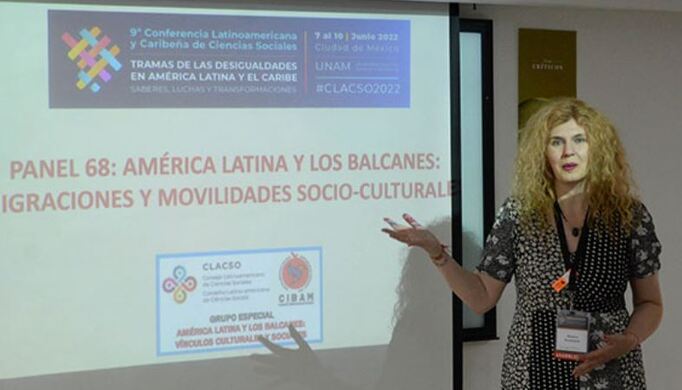
Mexican and Latin American cinema, literature, and music have been accepted and embraced by the nations that made up the former Yugoslavia, a common reference point that allows them to engage in dialogue and serves as a source of inspiration for some of their works, noted specialists gathered at the 9th Latin American and Caribbean Conference of Social Sciences: Themes of Inequalities in Latin America and the Caribbean: Knowledge, Struggles, and Transformations.
During the panel “Migrations and Human Mobility”, experts from Serbia, Brazil, Mexico and Spain agreed that the works of Carlos Fuentes, Jorge Luis Borges, Gabriel García Márquez or reminiscences of Mexican cinema left a mark on the inhabitants of the region also known as the Balkans, so that more than 100,000 of its inhabitants decided to migrate to America in search of new opportunities in the first half of the 20th century.
Bojana Kovačević Petrović, a researcher at the Ibero-American Center CIBAM, Faculty of Philosophy and Letters at the University of Novi Sad in Serbia, explained that the Balkan region had long been considered marginalized in Europe, and even after World War II, they lived under a regime that did not want to be close to either Russia or the United States, but rather sought its own path.
In every armed conflict that the Balkan region has faced, there have been significant migrations to Chile, Argentina and other nations of the American continent, bringing with them an important and invaluable cultural contribution that has among its representatives the Chilean writers Antonio Skármeta and Andrea Jeftanovic, explained the researcher.
Migrations to America meant that in the 70s, he commented, at least 150 performances by Yugoslav groups were recorded in Mexico, and their ruler, the dictator Josip Broz Tito, traveled to our country on several occasions, and even what became known as the Yu-Mex movement emerged.
“A common point of view was found, such as Mexico, and an example of this is that the film A Day in Life (starring Columba Domínguez and Roberto Cañedo) was a huge success in Serbia, and although it is not very well known here, until recently the only remaining copy of this film could be found on YouTube, with subtitles in Slovenian,” the researcher commented.
In fact, hundreds of singers performed Mexican music in Yugoslavia, from "Las Mañanitas" to many ranchera boleros, and although it is less active now, Yu-Mex maintains some of its activities.
In fact, the Bosnian Ivo Andrić , winner of the 1961 Nobel Prize in Literature, acknowledged being an admirer of Simón Bolívar; likewise, the author Vasko Popa was a great friend of Jorge Luis Borges and vice versa, Carlos Fuentes was inspired by the stories of Diocletian's Palace for his novels Terra Nostra , Birthday and All Happy Families.
“Yugoslavia was a translation empire; much Latin American literature was translated, and even today there is impressive interest in what is written in this land. That is why we are delighted that the New General History of Mexico is about to be published , which will be released soon in Serbia,” he said.
In turn, Norma Angélica Cuevas Velasco, a researcher at the University of Veracruz, presented her research work on “Latin America as a literary canvas in the work of the Serbian writer Goran Petrović . ”
Balkan migrations to Latin America, they expressed, have occurred, as in the case of Latin nations, for economic reasons, violence, aspiring to a better education or a better salary, and this is reflected in the work of the renowned writer Goran Petrović.
His work, “Atlas Described from the Sky,” offers literary imagery of journeys and maps, and along the way recovers a tradition that transcends discovery, conquest, or encounter, revealing the influence that authors such as Julio Cortázar, Jorge Luis Borges, and Gabriel García Márquez have had on the author, who has visited Mexico on several occasions, noted Cuevas Velasco. Through brief video presentations, the meeting also included María Teresa Toribio Brittes Lemos, from the State University of Rio de Janeiro, who spoke about Balkan migrations in a globalized world, especially to Brazil and their cultural influence; Milan Puh, an academic from the University of São Paulo, who discussed the points of contact and collaboration between Slavic and Brazilian studies; Isabel Story, from Nottingham Trent University, and Emilio Gallardo-Saborido, from the CSIC in Spain, who commented on the Mit sozialistischem Gruò (Socialist Group) and the cultural exchange between Cuba and the German Democratic Republic.
Source: UNAM Gazette

