
"A woman dies every 10 minutes at the hands of her partner or another family member."
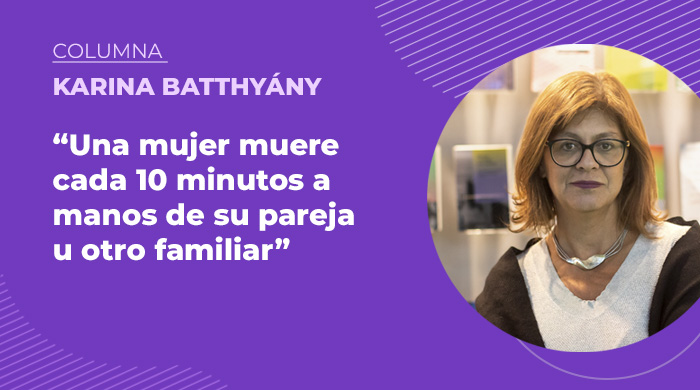
Transcript of Karina Batthyány's column
in InfoCLACSO – December 4, 2024
Gender-based violence in our region is a persistent and serious problem. We have some figures that illustrate the magnitude of this issue: in 2023, nearly 4.000 women were victims of femicide in 27 countries and territories of Latin America and the Caribbean. This equates to 11 women murdered every day because of their gender.
Furthermore, when we look at the rates by country, we find that Honduras registered the highest rate of femicides in the region with 4.6 cases per 100 women, followed by the Dominican Republic with 2.7, El Salvador, 2.4, Bolivia, 1.8 and Brazil, 1.7.
If we look specifically at violence within current or former relationships, approximately one in three women in Latin America and the Caribbean has experienced physical and/or sexual violence from a partner at some point in her life. And one in five girls in our region is affected by early and forced child marriages or unions, in many cases a manifestation of the scandalous and persistent violence against women.
In terms of legislative progress, countries in the region have laws to prevent and eradicate violence against women and girls. Fourteen countries have adopted comprehensive laws, and nineteen have specifically criminalized femicide. Despite these legal frameworks, effective implementation is very limited due to insufficient resources, including inadequate allocation of public budgets and a lack of training on gender and gender-based violence in public institutions.
There is a persistent effort in the work of social movements, particularly feminist movements like Ni Una Menos, which has brought gender-based violence to light. This work also serves to pressure for legislative changes, regulations, and budgets allocated to address this problem.
The figures mentioned show that this violence is a central problem in Latin America and the Caribbean, affecting thousands upon thousands of women and girls. Despite legislative advances, we must continue strengthening the implementation of public policies to eradicate this phenomenon and further improve data collection so that we can not only make these cases visible but also ensure they are addressed within the judicial system to protect victims.
Globally, a woman is killed every 10 minutes by her partner or family members, according to the latest data released by the United Nations. We must address these high rates of violence, taking into account regional diversity, both within Latin America and the Caribbean and in other regions of the world, in the face of patriarchy, poverty, gender inequalities, widespread violence, and armed conflict.
Gender-based violence has various dimensions, including sexual, economic, and domestic violence, femicide, and institutional violence. Responses must address these different dimensions, and academia is not exempt from this problem.
Regarding gender-based violence in academia, I would like to convene a meeting from CLACSO with the various Working Groups on feminist issues to reflect on and propose actions against gender-based violence in academia, and particularly what we can also do within our CLACSO Network.
In 2024, we set out to develop a protocol for the prevention of gender-based violence and for action in the event that it occurs, and this protocol has been approved by our Steering Committee.
We find this protocol very timely given the various activities organized by CLACSO and in the lead-up to our 10th Latin American and Caribbean Conference of Social Sciences #CLACSO2025. This protocol was developed by the Commission for the Elimination of Gender Violence from within academia, established within the framework of the CLACSO Network. It aims to address and intervene in situations of gender-based violence from an intersectional perspective across all of CLACSO's activities. We will be disseminating this new protocol in the coming weeks and throughout 2025. It complements the internal protocol that CLACSO already has in place for those of us who work in the Executive Secretariat and for those who are involved daily within the framework of our CLACSO headquarters in Buenos Aires, Argentina.
Gérard Pierre-Charles
When we were in Cuba at the end of September, first for the “V International Congress of Researchers on Youth” in Varadero, and then for the Forum “Activisms and Social Movements in Latin America and the Caribbean” in Havana, the Latin American Council of Social Sciences paid a well-deserved tribute to an essential Haitian activist from the last decades of the 20th century. This was the researcher, university professor, and politician Gérard Pierre-Charles, who died 20 years ago, on October 10, 2004.
In the 50s, Pierre-Charles was an activist in the Catholic workers' youth movement and a trade unionist. In 1959, he founded the Popular Alliance Party, which later became the Unified Communist Party of Haiti.
Because of his fight against the dictatorships of François Duvalier and Jean-Claude Duvalier, he was forced into exile in Mexico for 25 years. There he was a professor at the National Autonomous University of Mexico and taught Social Sciences and Economics at El Colegio de México, where he also directed a Master's program in Caribbean Studies.
His insightful analyses of the harsh realities of Latin America—and the Caribbean in particular—enriched an entire generation of students and researchers in Our America. He left behind numerous works—which are being compiled for new editions—one of his major works being Genesis of the Cuban Revolution.
At the September tribute in Havana, we were honored to have two members of our Steering Committee present: Tania Pierre-Charles, Gérard's daughter, representing Haiti, and Gloria Amézquita representing the Dominican Republic. We were also joined by other prominent researchers in Caribbean Studies, particularly from the Caribbean Studies Department at the University of Havana.
Commemorating Gérard Pierre-Charles also led us to reflect on the current situation in Haiti, with its recurring political, social, security, health and economic crises and the always untimely foreign interventions that do not respect – and do not even consult – the will of the inhabitants of the Caribbean island that has always been so punished.
And speaking of Haiti also means addressing the mass deportations of Haitians from the neighboring Dominican Republic. Our CLACSO Steering Committee issued a statement last week urging the Dominican government to reconsider its immigration policies and collective deportation operations, and to guarantee respect for the human rights of all persons within its territory, protect their dignity, and refrain from promoting actions that incite hate speech and reinforce xenophobic sentiments.
If you would like to receive more information about CLACSO's training programs:
[widget id=”custom_html-57″]
to our email lists.

