
A lesson from the crisis: The urgent need for a post-oil strategy for Ecuador's future

Francisco Hidalgo Flor[1]
The health crisis has become a humanitarian crisis, originating in China at the end of December and rapidly expanding globally due to the accelerated spread of Covid-19, exacerbated by global interconnectedness, acute planetary urbanization, the weakness of public health systems, plagued by decades of neoliberal policies, and disregarded by narrow ruling elites (the Trumps and Bolsonaros), now calls into question whether the world we have built is capable of protecting the lives of its inhabitants.
A humanitarian crisis has been created because the health crisis has been compounded by a labor crisis, with millions unemployed in both core and peripheral countries; a food crisis, with regions and people unable to access food; and a global governance crisis: each power is trying to save itself at the expense of the rest of the planet: hence Trump's checkmate of the weakened World Health Organization.
One of those repercussions is the oil crisis: hydrocarbons no longer guarantee the prevailing accumulation pattern, and this pattern is beginning to creak.
This event is significant for countries like Ecuador, with a long history of oil rent-seeking (for almost five decades we have exported crude oil and imported derivatives), as it puts them in a precarious position.
Oil-based rent-seeking has suffered a drastic collapse in recent days, especially on April 20th. On that day, the price of oil in international markets was -37 (minus 37): oil holders were paying to have it taken away.
In fact, before the pandemic spread globally, in mid-March, the price had already dropped to below thirty dollars, due to an oversupply from Russia and Saudi Arabia.
Days later, at the beginning of May, it fluctuates between ten and twenty dollars. But it's not just the collapse in the price of oil; that can vary, but it probably won't reach the level projected in the national budget (sixty dollars) this year.
It is the collapse of the oil rentier strategy: exploitation of hydrocarbons and speculation in futures markets, at the cost of the incessant and unstoppable destruction of nature.
This necessitates a profound change in the economy and development model of Ecuador's present and future, similar to other countries in Latin America suffering from petro-dependence.
In the context of this humanitarian crisis, it makes no sense to maintain oil exploitation and extractivism as the cornerstones of any country's economy in the world, since it is evident that their evolution deepens global environmental deterioration and the destruction of ecosystems.
This is even more true for countries like Ecuador, a nation with significant social, ethnic, biological, and ecosystemic diversity, where the goal should be to maintain and enhance that diversity, not annihilate it.
During Ecuador's 1999 crisis, which we are now beginning to resemble, the urgent need for post-oil strategies was already highlighted, both due to the country's limited reserves and the environmental and human repercussions. Even then, it was clear that the country needed to move beyond oil dependency.
That's why proposals emerged that surprised the world with their innovation, such as the Yasuní initiative, to leave underground the oil reserves located in this region of the Amazon, with its high biodiversity.
But it was torpedoed from a developmentalist ruling elite, blinded by the momentary increase in the price of raw materials (commodities phase) and the voracious appetite for multimillion-dollar contracts for overpriced mega-projects.
Now in 2020, as we debate ways to confront the crisis, it is crucial for Ecuador's strategic vision to reinstate post-oil proposals as the foundation for both domestic and international policy. It would be a grave mistake to turn a blind eye and persist on the path of extractivism.
The roller coaster of oil rent-seeking
Oil rent-seeking has been the backbone of the primary-export accumulation pattern from the mid-70s to the present day; its ups and downs have been incessant, with periods of prosperity marked by price increases and periods of misfortune by the collapse of hydrocarbon prices.
Attempts at industrialization were always weak, nationalist efforts sabotaged by state administrations eager for immediate profits, including those of the previous decade, and pressure from transnational corporations, including Chinese ones.
It is relevant to present the reader with information on the evolution of Ecuadorian exports over the last twenty years. Let's look at the following graph, which was prepared[2] based on Central Bank data[3].
Chart No. 1: Trends in Ecuadorian exports 2002-2019
(in thousands of dollars FOB)
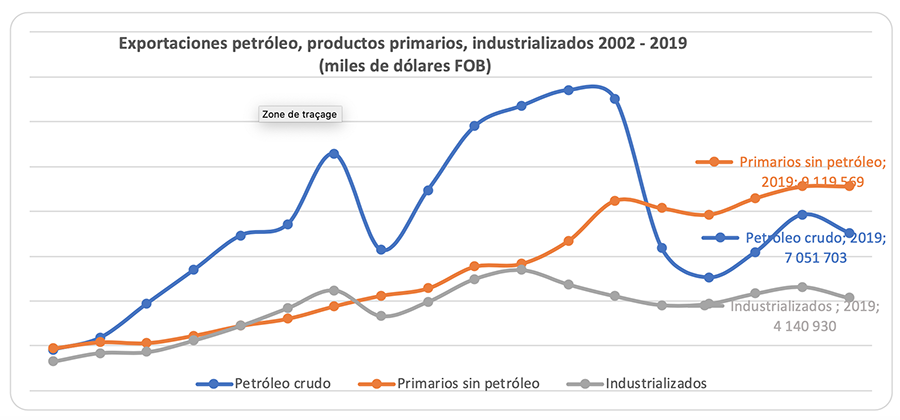
Let's analyze the evolution from the beginning of the 21st century onwards of the country's main exports: crude oil, non-oil primary products, and manufactured goods.
The trend in crude oil exports resembles a roller coaster, with severe drops in 2002, 2009, and 2015, and notable increases in 2008 and 2013-2014 (the best year being 2013 with exports amounting to 13.400 billion). By 2019, crude oil exports had fallen and barely reached 7.000 billion dollars (almost half of their peak). This was surpassed by the value of non-oil primary exports (shrimp, bananas, flowers), which reached 9.120 billion dollars (this was their best year, followed by 2018 with 9.100 billion). It should be noted that the trend in the evolution of exports of industrialized goods (petroleum derivatives, processed seafood products, metal manufactures) remains constant (its best year was in 2012 with 5.400 billion dollars) and now remains in third place with 4.100 billion dollars.
The collapse of oil exports is highly likely for 2020, but exports of primary and manufactured goods will also fall, probably returning to levels seen fifteen years ago. The entire primary-export model is creaking on all sides.
Let's add the complication that comes from dollarization, therefore, a country lacking monetary policy.
It's time to break the cycle we've been following since the late 19th century, from the cocoa boom to the banana boom, then to the oil boom. Betting on a supposed mining boom is a mirage. It would be Ecuador's worst strategic mistake.
It is essential to rethink a post-oil and post-extractive Ecuador.
The country demands genuine public policy strategies, not temporary fixes; a shift in direction and a reorientation of the dynamics of production, labor, food, and environmental preservation, which simultaneously generate equity and inclusion.
We envision a framework for sustainable production aligned with labor and nature, an alliance between rural and urban areas, and a decentralization and deconcentration that empowers inland regions. We speak of transforming the relationship between local and national markets, the need for coordination between regional and national production, an industrialization model linked to job creation, an agricultural model focused on feeding the working class with healthy and fresh food, empowering Indigenous, Montubio, and Afro-descendant communities, supporting populations at the parish, canton, and provincial levels, and reducing emigration rates.
Therefore, a pillar of the post-oil strategy is to place family and peasant farms in a key role in sustaining life, redistributing land, water, and markets, and guaranteeing access and ownership for small and medium-sized producers. New opportunities must be opened up in the interior provinces for the landless, for rural women and youth. Therein lies one of the keys.
[1] Professor of Sociology of Development at the Central University of Ecuador, researcher at Sipae. Member of the CLACSO Working Group “Critical Studies of Rural Development”.
[2] Prepared by: Sipae, I thank María Quizphe and Eliana Anangonó for their support in collecting data and preparing the graph.
[3] Source: Statistics from the Central Bank of Ecuador; see: https://contenido.bce.fin.ec/documentos/PublicacionesNotas/Catalogo/Anuario/Anuario32/IndiceAnuario37.htm
If you would like to receive more information about CLACSO's training programs:
[widget id=”custom_html-57″]
to our email lists.

