
“A key dimension for gender equality is Economic Autonomy”
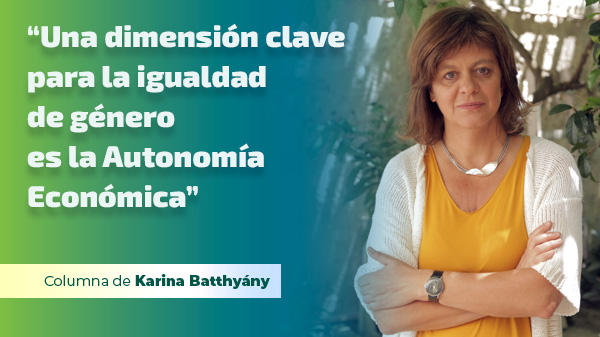
(Transcription of Karina Batthyány's Column)
(in InfoCLACSO – March 15, 2023)
We are in Madrid, Spain, participating in a triangular cooperation initiative, within the framework of European Union cooperation with Oxfam, focused on the issue of care. We are also giving presentations and analyses on the current state of care in Latin America and the Caribbean, where 13 countries are making progress in this area compared to what is happening in Spain and the European Union in general. It is truly an interesting working experience, one of the priority areas for CLACSO and the Platforms for Social Dialogue.
It's March, the month that CLACSO designates as Women's Month. Today, in this column, I propose we analyze the latest information on a key dimension for gender equality: Economic Autonomy. And not only for gender equality, but also for the fulfillment of women's rights, specifically—among others—the right to participate in the labor market and to have their own income to make their own decisions.
So, for economic autonomy, let's look at some of the ILO (International Labour Organization) reports: It shows us that the post-pandemic recovery has allowed, in general terms, the dynamics of employment to return in 2023 to pre-pandemic levels, that is, to 2019.
By placing a gender lens on this type of information, we see that at the end of 2022 the unemployment rate at the regional level reached almost 7 percent of the economically active population, falling from the 9 percent it had reached in 2001 and even breaking through the pre-pandemic floor which was 8 percent at the end of 2019.
What happened to female employment at the regional level? The recovery of female employment in the last year (in 2022) has been stronger than that experienced by male employment. In other words, women's employment has recovered more on average than men's employment.
The greater recovery in women's labor force participation can be explained by two main factors: firstly, the recovery of jobs in the economic sectors hardest hit by the pandemic, which remain highly feminized sectors such as tourism, education, and paid domestic work. It's worth remembering that these were precisely the sectors that almost disappeared during the pandemic, especially tourism and paid domestic work.
That's the first factor, but also the gradual easing of difficulties in balancing paid work with caregiving responsibilities as educational and childcare services reopened. In other words, these tensions in terms of balancing paid and unpaid work, as services that had been suspended during the pandemic resumed, allowed women to return to their jobs more easily.
While the employment rate for women increased by 24 percent between the second quarter of 2020 and the third quarter of 2022, for men that increase was only 19 percent. This indicates that, in this employment recovery, the female employment rate has recovered faster than the male rate. This positive trend meant that in the third quarter of 2022, the female employment rate exceeded the rate for the same quarter in 2019 by 1 percent, while the male employment rate remained similar in both quarters.
We can say that the drop in unemployment is good news. The ILO rightly points this out, but also highlights an important detail: the regional participation rate is still slightly lower than pre-pandemic levels. In other words, when we look at labor market participation rates at the regional level, we are still a little behind pre-pandemic levels, that is, those of 2019.
In only two of the 15 countries surveyed by the ILO in 2022 did the economic participation rate—which measures the proportion of the population actively participating in the labor market, whether actually working or actively seeking employment—exceed 2019 levels. In the other 13 countries, this rate remains below 2019 figures. This data shows that there are people who were previously active in the labor force but, even at the beginning of 2023, had not returned to paid work or actively sought employment.
This gap between the active and the so-called inactive, that is, those who are not in the labor market, also has a strong gender bias.
In the third quarter of 2022, the labor force participation rate specifically for women at the regional level was 52 percent, 23 percentage points lower than that of men, which was almost 75 percent. And the employment rate for women was 47 percent, almost 23 percentage points lower than that of men, which stood at 70 percent.
In turn, the other indicator that is always considered in these cases is the unemployment rate; that is, the percentage of people without actual employment was 8.4 percent for women and 5.7 percent for men. Here we see once again this gap and how unemployment always affects women more than men.
In particular, women with lower levels of education in the third quarter of 2022 continued to be significantly further from the employment level of the same quarter in 2019. We are comparing data from 2019 and 2022.
Indeed, in addition to that gender gap, when we look at the situations of women, those with lower levels of education have a greater impact in terms of their ability to find employment in the labor market.
At the other end of the spectrum, if we look at the employment rate for men with middle and higher levels of education, it remained at the same levels as three years prior. In other words, we observed no change for men, but we did for women.
Employment trends have therefore shown different intensities between men and women. On average, women have recovered more quickly after the loss of female jobs at the height of the pandemic, but the job recovery following the crisis has been driven primarily by the recovery of informal jobs, where women are predominantly present.
The 2022 Labor Outlook for Latin America and the Caribbean, where the ILO presents these figures, is a report that highlights these problems and the capacity of our economies to effectively sustain labor income and create new formal jobs, given the current situation in the Latin American and Caribbean region, and of course, within the context of global challenges. It therefore warns of the real possibility of continuing with job recovery, while also noting rising inflation and administrations in various Latin American and Caribbean countries facing severe fiscal constraints.
This social panorama of Latin America, as presented in the report by ECLAC (Economic Commission for Latin America and the Caribbean), also addresses the issue of economic autonomy and labor markets in terms of male and female participation. Specifically, it points out that the partial recovery of employment has occurred under these conditions of informality, and that this type of employment now represents, worryingly, around 70 percent of net job creation in several countries of the region.
Therefore, this is an issue that should prompt us to reflect once again, particularly within our Platforms for Social Dialogue on work and the dynamics of the labor market in our region today, given this recovery. But once again, gender gaps and the growth of the informal sector in our region are emerging.
Let's remember: When we talk about informal jobs, we are talking about jobs without any kind of protection or social security.
There are new regulations, new laws to control, for example, issues related to wages, but if issues related to care or violence are not taken into account, there has to be a balance in how all these issues are addressed, and the interconnectedness is fundamental…
That's why we always talk about the different dimensions of inequality, particularly in this case, gender inequalities in the dimension of economic autonomy. We can't analyze the phenomena of political participation without referring to the dimension of economic autonomy; we can't talk about economic autonomy without talking about care work. Because a fundamental basis for women's incorporation into the labor market is resolving care issues, and we must also keep violence in mind. This gender-based violence becomes a central problem in women's lives; that is, economic autonomy becomes an obstacle to their incorporation and participation in the labor market. Therefore, we are always careful to consider these three dimensions along with others that we will be analyzing.
-Given that it's Women's Month, I wanted to mention that it's been 5 years since the assassination of Marielle Franco in Brazil. What are your thoughts on this?
We were remembering that brutal murder, which remains unsolved, where these dimensions of inequality converge, because it demonstrates discrimination in all its forms, leading to the assassination of Marielle Franco. A Black woman, a politician, fighting for her rights, defending diversity, and brutally murdered. This event truly speaks to how important and ever-present the issue of gender inequality is in our Latin American region, and the importance of continuing to work every day of the year, especially in March, Women's History Month, to try to build more just and equitable societies in our countries for everyone. Indeed, we cannot continue to allow this type of violence and atrocities. So, we were remembering this brutal murder, and at CLACSO, in homage to Marielle Franco, we have named our auditorium after her.
If you would like to receive more information about CLACSO's training programs:
[widget id=”custom_html-57″]
to our email lists.

