
Tourism at all costs in the Dominican Republic
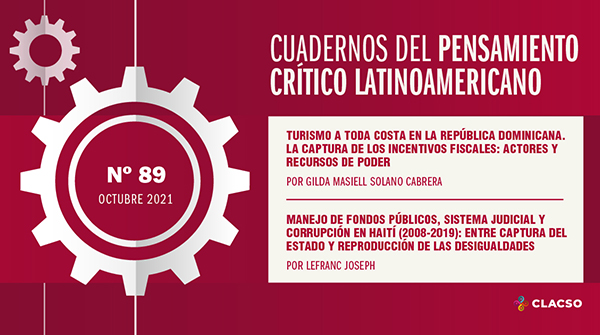
Within the "Latin American Critical Thought Notebooks" Collection, CLACSO presents "Tourism at All Costs in the Dominican Republic: The Capture of Tax Incentives - Actors and Resources of Power," by Gilda Masiell Solano Cabrera, and "Management of Public Funds, the Judicial System, and Corruption in Haiti (2008-2019): Between State Capture and the Reproduction of Inequalities," by Lefranc Joseph.
Tourism at all costs in the Dominican Republic. The capture of tax incentives: actors and resources of power
Gilda Masiell Solano Cabrera *
Since the 1990s, tourism has been the Dominican Republic's main source of foreign exchange. With a population of nearly 10 million, it is the third country in Latin America and the Caribbean to receive the most non-resident tourists (6.7 million), making it one of the leading tourist destinations in the Caribbean, Central America, and South America.
From a traditional point of view, the dynamism and magnitude of the macroeconomic figures indicate that the sector has been successful due to its contributions to the economy: its contribution to the Gross Domestic Product is 7.6%, to employment 7%, it represents approximately 38% of the exports of goods and services and 25% of the total foreign exchange generated in the country (Central Bank of the Dominican Republic, 2018).
However, from a critical and comprehensive perspective, it cannot be ignored that this has been possible at the expense of significant environmental, social, and fiscal costs that are inconceivable within any economic model that aims for sustainability. The predominant tourism development model is enclave or "all-inclusive" [1] , which results in approximately 80% of the generated revenue leaking out (resources remain in the countries that send tourists).
Regarding the research carried out, we studied in particular the actors who exercise their power, through various mechanisms, to influence the reform decisions of the framework that regulates tax incentives for tourism to attract foreign investment, that is, Law 158-01 for the Promotion of Tourism Development, adjusting them in scope, composition and duration to the business strategies of expansion of the hotel-real estate sector, at the cost of what this implies in redistributive terms and, therefore, in the democratic quality of public institutions.
Meanwhile, this research summary will present the main conclusions and lines of action proposed in our case study to counteract the capture of public policy , which in monetary terms has cost the Dominican Republic US$820 million in ten years (40% of current tax revenues in 2018).
The main evidence we found to affirm that a capture is indeed taking place is that this legislation does not correspond to the spirit of its creation: to accelerate a process of development of the tourism industry in regions of great potential that have not reached the expected level of development to date [2001].
Looking back almost 20 years, 85% of the hotel supply is highly concentrated in five of the country's thirty-two provinces, almost the same as in 2000 when the figure was 84% in just four provinces. It should be noted that 72% of the rooms are located in hotel complexes with more than 300 rooms, operating under the enclave or all-inclusive model. Similarly, an analysis of the incentives granted through this law has shown that, between 2001 and 2018, 58% went to the Bávaro-Punta Cana tourist area (269/466), where almost half of the country's hotel supply (nearly 40 rooms) is also located.
Meanwhile, despite numerous studies showing that tax incentives—especially tax holidays —are not cost-effective [2] , the tourism elite, represented by the National Association of Hotels and Tourism (Asonahores), have managed to adapt legislation to the requirements of hotel and real estate tourism capital to maximize the profitability of their investments.
These elites wield such economic power that they pose a latent threat to political power should it dare to make decisions that harm the interests of their companies. Within this context, they face several dilemmas: a poorly diversified economy with tourism as the primary source of foreign exchange, a dependent position on the major tourist-generating countries that control global flows of people, finance, and trade, and, consequently, a business model with minimal redistribution of profits.
Daude, Gutiérrez and Melguizo (2014), referring to the Dominican tourism elites, stated that key actors work from within the institutional framework to seek the results that best suit their objectives through two avenues: pressure to preserve their privileged positions when they have control (they become important lobbyists to prevent changes) and pressure to modify the rules of the game when they do not control the mechanisms (they exert significant pressure to change the situation).
In our study, analyzing the five modifications made to the current legislation (Law 184-02, Law 318-04, Decree 835-08 that modifies its application Regulations, Law 253-12 and Law 195-13), we have concluded that even having control over the mechanisms and a privileged position, these put pressure on us to move towards a better position under a changing business context.
Law 195-13 was the most drastic and final modification: they managed to expand the geographical coverage of the exemptions to the entire country, extend them from 10 years for another 15 years and apply them not only to new construction and initial equipment, but also to the remodeling and/or renovation of existing hotel facilities and already classified tourism projects that are in use of the exemptions.
According to Luis Emilio Rodríguez, president of the Board of Directors of Asonahores between 2012-2014, in his end-of-term speech he stated: “From very early in our administration, we had the need to defend our sector from the onslaught of the tax reform [2012]… with the enactment of law 195-13 we made sure that the direct effects on the tourism sector were amended.”
And how did they carry out the capture? Well, according to the reconstruction of the events with the evidence provided by the Senate of the Republic, the following actions were identified:
(i) the development of internal legislative debates without adequate technical checks and balances and balance of interests;
(ii) elites work to legitimize a discourse in public opinion, ensuring that the legislative power takes for granted the premises regarding the benefits of the incentives
(iii) There are common interests between the political and business elites, a situation that the elites have exploited to hold private meetings with key political actors—lobbying— outside of deliberative institutional spaces. This latter mechanism will eventually combine with another— revolving doors —to exert a more powerful influence ( the Minister of Tourism from [2008-2020] owns two real estate companies and has a very close relationship with businesspeople, even putting himself forward as a presidential candidate in his party's primary elections).
Given the above, we propose 9 lines of action to counteract the capture of this public policy:
- To move towards a more diversified economic model that is less dependent on a sector so fragile in the face of external variables such as tourismThe Dominican economy is heavily dependent on foreign exchange earnings from tourism, which, along with other exports, foreign investment, bonds, and remittances from migrants, make up the current income in the balance of payments. Furthermore, the income generated by the sector relies heavily on the volume of tourists brought in by tour operators and international hotel chains. Tourism is also not the best productive specialization for a developing country, as it has been clearly demonstrated that there is no direct relationship between tourism and development: the workforce is largely unskilled, requires little technology at the destination and constant state support, has low productivity, and jeopardizes the conservation of existing and future natural resources.
- Design and implement long-term strategies for greater territorial diversification of tourism, using models with stronger community ties and low environmental impact. More quality, less quantity. It's not just about rethinking economic dependence on tourism, but also the dependence on the enclave model that predominates in the hotel sector. While we can't say that the enclave model exists solely due to market capture, since we've already demonstrated that even in the absence of incentives, other dynamics promoted it (currency devaluation, the internationalization of Spanish hotel companies, the Dominican State's weak tax collection, among others), we can say that the way incentives are designed promotes large-scale hotel and real estate developments that create elitist spaces and degrade areas through tourism. The active role of the Ministry of Tourism through Development Plans is key in this regard.
- To restore the leading role of the Ministry of Finance in the governance of tax incentives for their proper design, implementation, evaluation, as well as in their subsequent reforms. This action aims to restore the Ministry of Finance's leading role in decisions that cause changes in current legislation and also in the institutionalized spaces for managing these measures.
In this regard, it is necessary to redefine the role of the private sector on the Tourism Development Council, so that it cannot have the same deliberative power as the governing body in deciding whether or not to grant incentives to companies. The business community cannot act as both judge and jury. Furthermore, it is urgent to conduct more in-depth studies that model what would happen in the absence of the incentive framework, because this can no longer be the reason for not questioning it. Since we also do not know what would happen, we are limiting ourselves to proposing measures that, in the meantime, improve its governance, limiting the power of the business elite over the scope, composition, and duration of the exemptions.
- Evaluate the relevance and coherence of the current incentive framework and its design to reverse its regressive nature and reduce the tax evasion and avoidance it produces. A more sophisticated design is needed, one that retains only those programs whose design guarantees a geographical redistribution of hotel offerings, the professionalization of human capital, adds value to natural and cultural resources, and includes minimum investment requirements, job creation clauses, and proof of solvency for participating companies, among other prerequisites. It is also important to restore the role of the Ministry of Finance, given the need to strengthen the mechanisms created to detect fraudulent practices and curb the erosion of resources through commercial entities established for such purposes. This would discourage elites from capturing political power.
- To make the measurement of tax spending on tourism more transparent. Undoubtedly, efforts to measure the revenue lost by the State after granting tax exemptions and exonerations are becoming increasingly accurate. However, the figures for each tax are underestimated, so there is no certainty about the true amount of tax benefits enjoyed by the sector.
- To ensure greater representation of the social sector in decision-making spaces. This is absolutely essential, as in democratic societies like the Dominican Republic, it is what ensures the legitimacy of deliberative processes. This involves academia, independent specialists, NGOs, small and medium-sized tourism businesses and related sectors, etc. Any reform decision must be preceded by a cost-benefit analysis to measure its economic and social impact and, subsequently, by a debate tailored to the circumstances where arguments for and against are presented. Regarding the composition of Confotur, which excludes the social sector, the choice must be made between representing all interests or, conversely, making it solely a public body. As it stands, it is exclusionary and unbalanced in terms of negotiating power.
- To oversee the work of legislators in the working committees of both chambers of the National Congress. This is to ensure that deliberative processes on matters of public interest are conducted with the necessary technical quality, are participatory, and respect legislative timelines. Decision-making must be transparent and operate within a clear and timely accountability system. Not only decision-making, but also the internal discussion process must be transparent to detect lobbying, interference from the executive branch, and any other pressure tactics employed by business elites to advance their own interests and undermine the common good.
- Promote the development of participatory processes related to land management and the protection of public assets. Actions must come not only from the public sector; citizen will also has a role to play in reversing the processes of capture through collective action and the dissemination of an alternative discourse that reveals the adverse effects created by the actors who capture certain policies that, at first glance, seem to have nothing to do with improving people's quality of life. In our case study, this point is clearly reflected when we analyze the effects of the enclave model on the reproduction of economic and social inequalities.
- Finally, the academy y Specialized research centers also play a fundamental role in disseminating critical studies that address tourism as a comprehensive view, embedded in a financialized capitalist system and dependent on the central economies that dominate global flows of people and trade, with almost no redistribution of the benefits produced and with an avid interest in accumulation without limits, even at any cost.
Management of public funds, the judicial system and corruption in Haiti (2008-2019): between state capture and the reproduction of inequalities
Lefranc Joseph *
Presentation
There is a general consensus among scholars that corruption has been a defining feature of Haiti's political history for centuries. Transparency International (TI) reports consistently rank the country among the ten most corrupt in the world. At the same time, the overall situation in Haitian society appears to be worsening across the board. Indeed, combined data from the Haitian Institute of Statistics and Informatics, the World Bank, and the United Nations Development Programme (UNDP) suggest that 58,6% of Haitians live in poverty, on less than US$2,5 a day, and that 24,7% live on less than US$1,25 a day. The GDP per capita is US$760. Regarding basic services, the UNDP estimates that only 64,8% of the population has access to safe drinking water. The unemployment rate is 28,9%, and the primary school enrollment rate is 88%. This research studies the mechanisms that have led to the predominance of corrupt practices and, more systematically, the capture of the State in its relationship with the judicial system and the reproduction of inequalities in Haitian society.
Analysis
First, we find that political and administrative corruption is one of the defining elements of political practices in Haiti. The idea that 'stealing from the state is not stealing' has served for more than two centuries as a normative axis to justify the misappropriation of public funds and assets. The analysis indicates that, in the Haitian political system, there are two key elements that favor systematic corruption in the capture of the state: consensus and a specific exercise of reflective capacities.
Political consensus is a framework for political action established among political actors when they decide that a law cannot be applied or that it is simply preferable that it not be applied. Through this framework, it is possible to disregard aspects of the Constitution if a certain consensus can be established among key political actors—that is, those who wield sufficient political power.
The consensus in question has a repetitive character here. At each difficult stage, considered a crisis, it is presented to all actors as the obvious solution. It is closely related to reflective capacities, that is, the mental aptitudes that individuals possess to situate themselves within a given social context and guide their actions. In the Haitian political-administrative context, the use of reflective capacities is based on personal deliberation without reference to a binding legal framework.
In a context of legal inefficiency, reflective capacity is a key tool used by actors in the process of producing political consensus, indispensable when they deem it preferable for the law not to be applied. Thus, the political-administrative logic of managing public funds, services, and goods, based on a political culture of corruption, is governed by these two elements.
Secondly, in Haiti, discourses on the relationship between the judicial system and the executive branch often present it as if it were an entity unaffected by the political culture of corruption. In reality, the judicial system, in its organization and operation, is fundamentally dependent on the executive branch. This can be interpreted as an explanation for why the judicial system shows little interest in taking corruption cases seriously. Thus, it functions as a tool within the mechanisms that produce the political culture of corruption. In its interaction with this political culture, the judicial system becomes the administrative and structural support of corruption and, by extension, of state capture.
In this sense, key actors in the judicial system tend not to perceive acts of corruption as a problem or a crime. Adding to the judicial system's dependence, the logic of political consensus between actors in the executive and legislative branches leaves little room for the efficient functioning of the judicial system. Thus, the judicial system, far from being an independent system or branch of government, depends, both in theory and in practice, on political power exercised abusively. In this sense, the analysis suggests that the judicial system is part of the overall corruption network. The ordinary judge will use their position to enrich themselves in ways they believe are 'normal'.
Third, state capture has a profound impact on the Haitian state's capacity to formulate and implement policies that address problems affecting the majority of the population. Thus, in the Haitian case, due to systemic corruption, the phases of public policy—from formulation to implementation and evaluation—are driven not by the need to solve public problems, but by their potential to offer opportunities for corruption. One example that illustrates this observation is the implementation of the Free and Compulsory School Program (PSUGO).
This program, implemented in 2012, aimed to address the major problem of access to basic education in Haiti. It also sought to fulfill the constitutional requirement in this area. By 2013, more than 7,000 schools were participating in the program. According to a 2013 audit conducted by the ULCC, based on a sample of 500 schools, nearly 25% were found to be operating in irregular conditions.
The corruption strategy essentially consisted of creating fictitious schools or students. It can be hypothesized that this was just one form of corruption practiced primarily by a specific group of actors: school principals. There were reports of other forms of corruption that went uninvestigated. The key takeaway here is that corrupt practices stemming from the widespread corruption have hindered the state's efficiency in implementing this program.
Guidelines
According to the research findings, public administration reform is necessary to curb systemic corruption, state capture, and their associated consequences. The discourse surrounding reform is not new. In a 2019 interview with Agence France-Presse, in the context of anti-corruption protests in Haiti, the Haitian president presented administrative reform as a priority for his government. According to him, the key areas of focus were: “constitutional reform, energy sector reform, digitalization of the public administration, and customs reform.”
In this type of discourse, administrative reform is equated with the modernization of the public administration's physical infrastructure. Consequently, the corrupt practices that have become a fundamental and defining characteristic of public administration do not receive the attention they deserve. When they are discussed, it is generally in the context of protests (such as public denunciations), or in a nearly neutral manner (as in reports from the Court of Auditors), or as political instruments aimed at opponents (as in political speeches or, sometimes, Senate reports).
A genuine reform of the public administration is necessary to foster a new regulatory framework for administrative action. However, beyond administrative infrastructure, this reform must be geared towards transforming the country's political culture. To achieve this, it must rest on two key elements: (i) political responsibility and accountability; and (ii) the restructuring of the judicial system.
It is known that, in theory, Haiti has legal mechanisms designed to guarantee political accountability. The separation of powers enshrined in the current Constitution should, in theory, guarantee the right to petition and to be held accountable. However, in practice, the administrative apparatus is dominated by corrupt practices ranging from ordinary patronage to the outright squandering of public funds. Therefore, what is needed is not another anti-corruption law or institution, but a transformation of the political and administrative culture that for decades has provided the normative and justificatory framework for these practices. This transformation is fundamental to establishing the institutional integrity of the Haitian state.
Within the same framework of public administration reform, a restructuring of the judicial system is necessary. Research has revealed that current regulations on corruption in Haiti make the judicial system overly dependent on the executive branch. Beyond this dependence, there is a more pervasive and widespread influence of virtually every powerful actor in the executive and legislative branches on key actors within the judicial system.
This reality, fostering corruption and state capture, leaves little room for law. Therefore, to combat corruption and hold accountable those in all three branches of government (executive, legislative, and judicial), an independent judicial system, founded on the rule of law, is essential.
* Economist, specializing in international development economics, with experience in the design and evaluation of social policies. She received a research grant as part of the CLACSO/OXFAM Competition, 2nd edition, 2019-2020, “Elites, State Capture, and Inequality in Latin America and the Caribbean.” Email: [email protected]
[1] The enclave or all-inclusive model is the business type adopted in the Dominican Republic since the late 1980s. The enclave category includes hotel complexes, cruise tourism, theme parks, among others. Large residential real estate complexes geographically concentrated along the coast (such as condo-hotels with casinos, marinas, and shopping malls) are also prominent in the country.
[2] See Jiménez and Podestá (2008), ECLAC (2008, 2015), OECD (2010, 2012), UN-CIAT (2018), World Bank (2017), ECLAC-OXFAM (2016, 2019), ICEFI (2019).
* Professor at the State University of Haiti. Member of the Centre for Research and Training in Economics and Social Development (CRESFED) Haiti. Recipient of a research grant as part of the CLACSO/OXFAM Competition, 2nd edition, 2019-2020, “Elites, State Capture and Inequality in Latin America and the Caribbean.” Email: [email protected]
If you would like to receive more information about CLACSO's training programs:
[widget id=”custom_html-57″]
to our email lists.

