
Energy Transition in Latin America and the Caribbean: Perspectives of Political Ecology
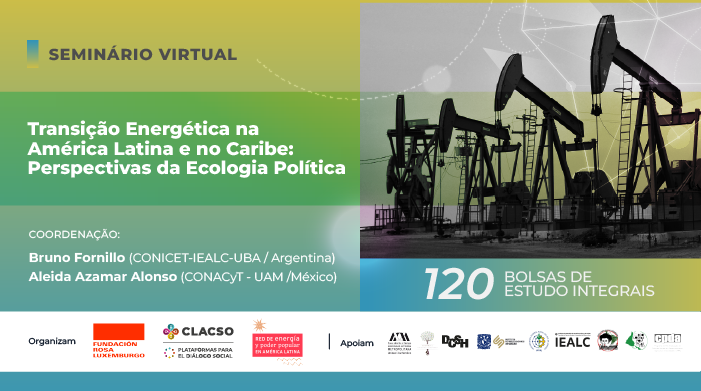
The Latin American Council of Social Sciences (CLACSO), the Rosa Luxemburg Foundation and the Network of Energy and Popular Power in Latin America invites you to participate in the Virtual Seminar on Energy Transition in Latin America and the Caribbean: Perspectives of Political Ecology.
Coordination:
Bruno Fornillo (CONICET-IEALC-UBA / Argentina)
Aleida Azamar Alonso (CONACyT – UAM /Mexico)
General coordination and organization:
Carla Vázquez (FRL – Mexico, Central America and Cuba)
Elisangela Soldatelli (Regional Climate Program – FRL Brazil and Paraguai)
Florencia Puente (FRL – Cone Sul)
Alejandro Gambina (CLACSO)
Teaching team:
maristella svampa (CONICET, Argentina), Luke Ferrari (UNAM-CONACYT, Mexico), Lucio Cuenca (OLCA, Chile), Fabrina Furtado (Universidade Federal Rural do Rio de Janeiro, Brazil), Tatiana Roa Avendaño (Censat Agua Viva, Colombia), Terramar Institute (Ceará, Brazil), Melisa Argento (GYBC, Argentina), Hernán Scandizzo (OPSur, Argentina), REMA (Mexican Network of People Affected by Mining) – Geocommons (Collaborative Cartography in Defense of the Commons, Mexico), Thea Riofranco (Providence College, United States), Irene Vélez Torres (former Minister of Mines of Colombia), Gonzalo Castelgrande (Association of Officials of the State Power Plants and Electrical Transmissions, Uruguay), Moisés Barón Cárdenas (USO Workers' Trade Union of Colombia), Sandra Rátiva Gaona (ONERGIA, Mexico), and Pablo Bertinat (Ecological Workshop, Argentina).
Registration: Até 09/18/2023 | Start: 03/10/2023
* 120 scholarships will be awarded to activists of social movements, members of community organizations, students, researchers, public officials and the general public who carry out activities related to the topic in question.
Workload: 12 weeks – 90 hours.
In the exchanges and Latin American debate spaces convened by the Network of Energy and Popular Power in Latin America, we have identified and analyzed the energy scenarios of the region and the forms that the current energy transition assumes. In this reflection process, we mainly highlight the "false solutions to the climate crisis" that are being promoted by the global North, with the consent of the governments of the South, to assume the decarbonization path as a "response" to climate agreements.
It is a neocolonial logic that, through the expansion of mining and energy projects, keeps our countries in the same situation of dependence, subordination and dominance. These projects and their form of implementation are presented as an economic solution to the individual crisis, under the pretext of contributing to the reduction of stove gas emissions to mitigate the climate and energy crisis. However, what is happening in many territories where these projects are planned and installed is the increase in environmental conflicts, or a deepening of inequality, the exploration and expropriation of indigenous, Afro-descendant, rural and traditional populations.
In this context, we seek to deepen a Latin American critical perspective, from the popular field, based on concrete, territorial experiences, articulated with conjunctural and systemic analyses. We invite you as the objective of strengthening ourselves collectively based on diverse knowledge, multiple geographical feelings, and time for the production of individual and collective thought.
We seek to build a common base in the discussions on the problems and limits that we encounter in the regional scenario towards a fair socio-ecological transformation and review the political concepts that we are building for the debate. A priority is to promote a space for dialogue on perspectives in ecoterritorial, feminist, anti-racist and decolonial perspectives that help us strengthen alternatives and build anti-patriarchal and anti-extrativist perspectives on current horizons.
A global ecological crisis, the gradual exhaustion of fossil fuels and the imperial tensions situate the energy transition in the center of the political scene. After the pandemic, a simple concept of transition such as the incorporation of renewed sources was adopted by the global North and green capitalism as a central space for accumulation and innovation. However, the idea of energy transition needs to be discussed, as it can be a vehicle for the social control of energy, the public management of technology and the energy quest, as well as the implementation of concrete experiences of decolonization and emancipation. Currently, energy and political ecology are intrinsically linked. A wide range of topics will be presented to understand in depth the meanings and possibilities of application of the new energy paradigm, in a dialogue supported by the world of workers, feminisms, social movements and perspectives of socioecological transition.
Main goal:
- Understand, from a perspective of political ecology, the global dynamics of energy transition in the hegemonic direction and the processes of popular and community management, contemplating the close relationship between geopolitical, socio-environmental and socio-economic conflicts in Latin America.
Specific objectives:
- Promote the joint characterization of the policies necessary for the construction of a transition with justice from the global South, starting from the multisectoral disputes that develop in the relationship with energy in Latin America (visiting workers, the popular economy, the defense of life based on an ethics of care, hair access to land and habitat, etc.).
- Analyze proposals regarding the democratization of energy access, with a view to the construction of a popular energy transition.
- Make visible the debates, tools and social technologies built by the organizations and their articulation process at the regional level.
- Rethinking the role of workers in relation to reconfiguring two energy systems in the region.
- Geopolitics of energy: dynamics of the energy question in the context of global accumulation.
- Historical construction and transformations of the energy matrix in Latin America: the oil cycles and extreme energies.
- Neoextrativism and climate change: the limits of the notion of energy transition.
- Critical minerals of the mining-energy consensus in Latin America: lithium and rare earths.
- Habitat, electromobility and infrastructure in the North-South dynamics of the energy transition.
- The role of the State in transition: public companies and energy as an emancipatory project. Or the case of Colombia and Uruguay.
- Debates around energy sovereignty and socioecological transformation: communities, feminisms and the world of work.
- Energy alternatives, current experiences and the creation of meaning in Latin America: proposals and perspectives.
There will be weekly meetings, in virtual mode (synchronous) on fourth fairs, at 6:00 p.m. (BR/ARG) / 3:00 p.m. (MX) / 4:00 p.m. (COL).

120 full scholarships will be awarded to activists of social movements, members of community organizations, students, researchers, public officials and general public officials who carry out activities related to the topic in question.
Registration requirements:
- Registration must be done through the CLACSO website.
- Os e as candidatas devem:
- Preencher your personal data;
- Briefly describe your interest in participating (the relevance of the topic for your organization, territories and areas of activity);
- Indicate its proximity to the Portuguese language (not in the case of registrations of Spanish speakers) and in the Spanish language (not in the case of registrations from Brazil). This information is relevant to the organization of work and tutoring teams.
- The study packages available will be awarded respecting regional diversity and gender equity.
- This call will remain open until 18/09/2023.
CM Plenary: You belong to a Plenary Member Center of CLACSO.
Associate CM: You belong to an Associated Center of CLACSO.
Without link: You do not have any links to CLACSO.
In all cases, payment may be made by letter of credit, deposit or bank transfer.
|
|
Payment in a parcel until 30/09 |
Payment on a parcel after 30/09 |
|
CM Plenos |
$75 |
$150 |
|
CM Associates |
$95 |
$190 |
|
No connection |
$95 |
$190 |
More information: [email protected]

