
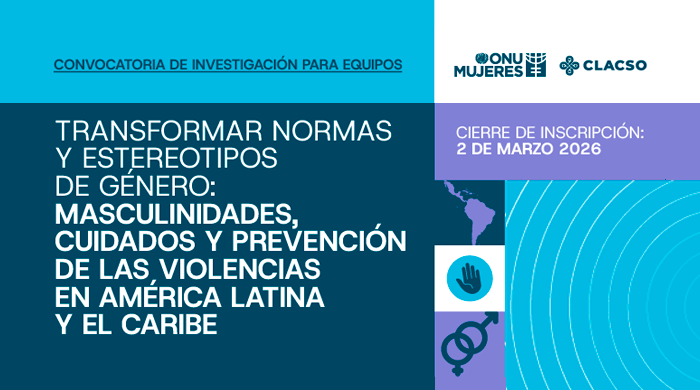
Transforming gender norms and stereotypes: masculinities, care and violence prevention in Latin America and the Caribbean
Background
The Latin American Council of Social Sciences (CLACSO) and UN Women have promoted several joint initiatives in recent years aimed at strengthening knowledge production on gender equality and the right to care. Continuing this agenda and building on the work developed in the Platform for Social Dialogue on Care and the Platform for Social Dialogue on Rights, Violence, and Gender Equality, both promoted by CLACSO, the two institutions are launching a new research call focused on... transformation of gender norms and stereotypes and its relationship with masculinities, the social organization of care and prevention and addressing of violence against womenThe recent Advisory Opinion OC-31/25 The Inter-American Court of Human Rights reinforces this approach by emphasizing that gender stereotypes “They are harmful when they contribute to perpetuating historical patterns of discrimination.”, and by linking the state's obligation to modify sociocultural patterns with the duty to counteract stereotypical roles that legitimize or exacerbate violence against women, in accordance with the Belém do Pará Convention (art. 8.b).
In Latin America and the Caribbean, the field of care work has become a key area for understanding how gender inequalities and the stereotypes that underpin the social division of labor operate and are reproduced. The almost exclusive assignment of caregiving tasks to women not only reflects an unjust social organization but also expresses deeply ingrained gender norms and mandates that naturalize female subordination and disengage men from the daily responsibilities of care.
However, reflections on the role of men and masculinities within this framework have received less attention, despite their strategic importance for promoting broader cultural transformations. Available evidence shows that patriarchal masculinity, understood as a set of oppressive social gender norms, influences both the organization of care work and the legitimization of practices of control, inequality, and violence. In this sense, moving towards co-responsible and caring masculinities not only expands the possibilities for socially reorganizing care work, but also constitutes a central axis for challenging gender stereotypes, transforming social norms, and preventing various forms of gender-based violence.
This Call seeks to contribute to this problematic field of knowledge through studies that delve into two possible axes and sub-axes: the first of them "Changes in gender norms and stereotypes towards the care society: Policies and initiatives for the advancement of co-responsible masculinities”This project proposes to investigate the practices, meanings, life trajectories, and structural factors that influence men's participation—or lack thereof—in caregiving. This involves exploring care not only as an activity but also as an autonomous human right that concerns men; analyzing the tensions between masculine mandates and the shared social responsibility for care; and examining the intersections between gender, social class, ethnicity, territory, age, sexual orientation, gender identity, and other factors that shape diverse experiences. It also seeks to promote research that examines public policies, institutional strategies, and community actions aimed at fostering co-responsible masculinities. This includes initiatives that transform social norms, policies on shared fatherhood, comprehensive health and wellness initiatives, communication strategies that challenge gender stereotypes, labor policies related to caregiving and leave, as well as innovative experiences in men's participation in paid care services.
A second focus of this Call for ProposalsNorms, stereotypes and mandates of masculinity in the prevention and approach to gender-based violence from a care approach” This research area aims to deepen the understanding of the relationship between norms, stereotypes, and mandates of masculinity and gender-based violence, focusing on both its prevention and its management from a care-based approach. This area proposes to analyze how patriarchal masculinity (expressed in stereotypes associated with control, domination, exclusive provision, and the denial of care) contributes to the reproduction of different forms of violence against women, as well as the tensions and transformations that emerge from alternative and co-responsible masculinities. This area also calls for research into public policies, campaigns, community strategies, and experiences aimed at transforming violent norms and stereotypes, along with interventions targeting men who have perpetrated or are perpetrating violence, as part of care policies and recidivism prevention. This analysis also includes the methodologies and lessons learned from these approaches, the care required by the professional teams involved, and the impacts of economic violence (particularly the failure to fulfill caregiving responsibilities) on family and community dynamics. Finally, it includes an analysis of masculine norms and stereotypes in digital environments.
Based on the identification of these areas, this Call proposes two thematic axes as a guiding framework for the construction of rigorous, situated research proposals aimed at strengthening the understanding of policies and initiatives that seek to break with the cycles of discrimination and violence based on traditional gender stereotypes, and to deconstruct patriarchal masculinity in relation to care and the prevention of violence against women, girls and adolescents in Latin America and the Caribbean.
AXIS 1: Changes in gender norms and stereotypes towards the care society: Policies and initiatives for the advancement of co-responsible masculinities
Sub-themes: masculinities and care as an autonomous human right; men's social and gender co-responsibility in the social organization of care work; masculinities and care in men's life cycle; masculinities, care, and intersectionality; men's participation in comprehensive systems and public care services; institutional, communicational, narrative, and community advocacy policies for the promotion of co-responsible-caring masculinities; public and institutional policies aimed at transforming social norms of gender and masculinity with a care focus (comprehensive, mental, and sexual health; co-responsible fatherhood; digital well-being; approaches to problematic substance use); care work policies and parental leave in employing organizations; training, professionalization, and labor market integration of men in paid care work; masculinities and care in extraordinary contexts (humanitarian emergency, environmental crisis, human mobility, contexts of confinement, etc.).
AXIS 2: Norms, stereotypes and mandates of masculinity in the prevention and approach to gender-based violence from a care approach
Sub-themes: Construction and reproduction of masculine stereotypes (control, domination, exclusive provision, denial of care) and their link to different forms of gender-based violence; tensions between hegemonic, alternative, and emerging masculinities from a care perspective; Public policies, campaigns, community strategies, and experiences aimed at transforming violent stereotypes and promoting co-responsible, caring, and non-violent masculinities; Attention to men who have perpetrated or are perpetrating gender-based violence as a care policy; methodologies, approaches, and lessons learned; care provided by the professional teams involved; Non-compliance with child support payments and other forms of abandonment as expressions of economic violence and resistance to co-responsibility in care; Analysis of masculine norms and stereotypes in digital environments and preventive strategies to address harassment, bullying, and other forms of online violence.
RULES OF THE CALL FOR APPLICATIONS
- The information provided in the registration form is considered a sworn statement.
- Collective applications are expected (teams of between 3 and 5 members).
- At least one of the members of the applicant team must maintain accredited links with a CLACSO Network Member Center.
- If the project is selected, the team must submit a letter of support signed by the highest authority of the Member Center with which the proposal is linked.
- If applicants are affiliated with a CLACSO member center, the center must not have any outstanding membership fees for the year 2025.
- Team composition must respect gender parity. Teams are expected to be intergenerational, integrating researchers from diverse backgrounds and experiences.
- The teams must be made up of trained researchers, that is, those who hold a master's degree, doctorate or equivalent, and proven academic track record; and researchers in training, that is, those who are pursuing master's/doctoral studies or have a degree.
- Proposals from researchers who are currently recipients of fellowships or grants under other research calls, scholarships, or essays organized by CLACSO will not be accepted. Applications from researchers who have been selected in a CLACSO research call will be accepted, provided that the recipient has fulfilled all obligations in a timely manner.
- Members of the Steering Committee or officials of the Executive Secretariat of CLACSO, or officials of UN Women, may not participate.
- Each researcher may only participate with one proposal in this Call.
- To register the research proposal, the team must select one of its members as responsible for registering the project; that person must open the form and include the other team members.
- Should the project be awarded and any travel be necessary, the winners will be responsible for covering the costs of medical insurance or similar expenses.
- Completed research projects will not be accepted. Proposals may be linked to ongoing research processes, but the final works must be original and unpublished products and developed within the period established by the call for proposals.
- Texts written in the four languages commonly used in Latin America and the Caribbean (Spanish, Portuguese, English and French) will be accepted, depending on the country of origin of the proposal.
- Proposals must be uploaded to the registration system, completing the form that appears once the personal and academic data of those who make up the research team have been completed.
- In the first stage, the submitted proposals will be reviewed for their formal and administrative aspects to ensure their compliance with the competition rules. Proposals that do not meet the established requirements will be rejected.
- Applications that pass to the next stage will be evaluated by an International Committee composed of experts who will assess the quality and relevance of the proposals, which will be submitted under a pseudonym.
- The Call may be declared void or a smaller number of projects may be selected, if the proposals submitted do not meet the required quality and consistency.
- Situations not covered in this document will be resolved by the convening institution.
- The ruling will be irrevocable and unappealable.
- The research projects will develop their work plan between April 2026 and September 2026. This plan will be implemented under the facilitation of tutors assigned by CLACSO.
- The progress and final reports submitted by the researchers will be evaluated by the tutors.
- The final products to be delivered will be at least two:
- Chapter for a collaborative book. The chapter should be between 12.000 and 15.000 words (excluding appendices and bibliography) in Times New Roman 12-point font, single-spaced. This is an approximate length guideline, and CLACSO and UN Women reserve the right to make revisions or exceptions if deemed necessary. Furthermore, once submitted, CLACSO and UN Women may request adjustments and changes from the researchers to ensure the final research chapters meet institutional criteria for publication. The text structure is flexible, adhering to academic writing conventions and CLACSO's editorial guidelines, as well as APA style and gender considerations.
- Executive Summary. A short, publishable document summarizing the main findings and recommendations of the research.
- Texts written in Spanish and Portuguese will be accepted, depending on the country of origin of the proposal.
- Access the CLACSO website orgThe online registration system will be available from February 2, 2026.
- Register in the CLACSO Single Registration System (SUIC). The generated username and password will be required each time you wish to access the system to consult, modify, add, or submit information for this or any other CLACSO activity. Applicants who are part of collective proposals must open a single form This will include all researchers on the team. One of the authors must also be designated as responsible for the registration. This same person will receive the corresponding monetary award if the proposal is selected by the Jury.
- Identify the proposal by indicating its title and the pseudonym of the applicant(s). Applications with pseudonyms that correspond to the applicant's first and/or last name will not be accepted. Once the corresponding fields are completed, the system will enable the uploading of the following data.
- Applicants must indicate their institutional affiliation with a CLACSO Network Member Center on the application form. The updated list of member centers can be found at: https://www.clacso.org.ar/clacso/centros_miembros_clacso/inicio.php.
- Complete the form personal and academic data and attach the curriculum vitae in free format; the digital copy of the identity document, passport or ID card; the digital copy of the highest academic degree obtained (or proof of degree in process) and the photograph.
- The proposal must be filled out on the form that appears once the personal and academic data has been completed.
- Once registration is closed, the system will produce an electronic certificate of receipt that will serve as proof of application.
Registration deadline: March 2, 2026
Winners will be announced on March 27, 2026.
Project implementation: April 2026 to September 2026
Final report submission: September 7, 2026
The results will be published on the CLACSO website. The winners will be contacted by email.
Queries: [email protected]

