
Earth, life and future: On the road to ICARRD
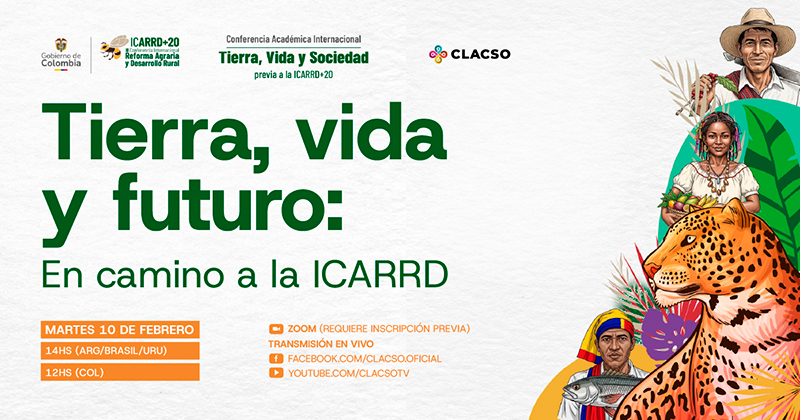
Within the framework of the preparatory process towards the Second International Conference on Agrarian Reform and Rural Development (ICARRD+20), was carried out February 10 Tuesday the webinar “Earth, life and future: On the road to ICARRD”, conceived as a space for strategic and high-level dialogue between public institutions, academia and social movements around a central and urgent issue: agrarian reforms for the 21st century.
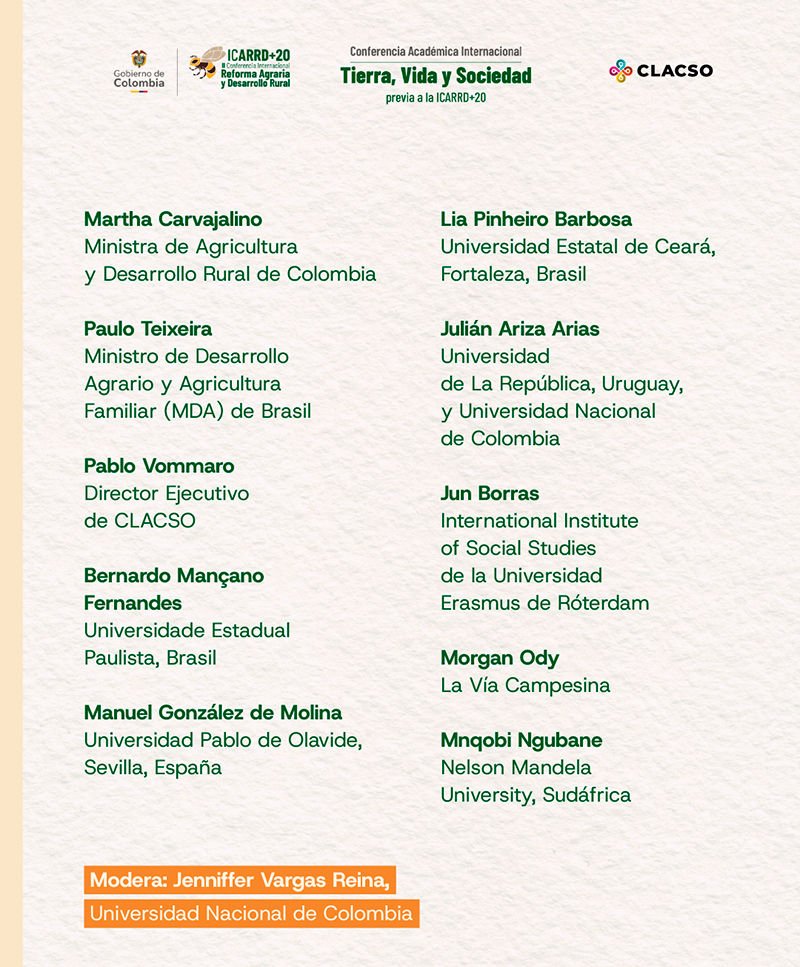
The panel included key figures in the agricultural debate at the regional and global levels:
Itayosara RojasEnvironmental Advisor, representing Martha Carvajalino, Minister of Agriculture and Rural Development of Colombia
Raquel Rizzi, Director of Programs of the Executive Secretariat of the Ministry of Agrarian Development and Family Farming of Brazil, representing the Minister of the portfolio, Paulo Teixeira.
Pablo VommaroExecutive Director of CLACSO
Jun BorrasInternational Institute of Social Studies, Erasmus University Rotterdam
Bernardo Mançano Fernandes. Paulista State University, Brazil
Manuel Gonzalez de MolinaPablo de Olavide University, Seville, Spain
Lia Pinheiro Barbosa. State University of Ceará, Fortaleza, Brazil
Julian Ariza AriasUniversity of the Republic, Uruguay / National University of Colombia
Morgan OdyLa Vía Campesina
Mnqobi NgubaneNelson Mandela University, South Africa
Moderation by Jenniffer Vargas ReinaNational University of Colombia
By opening the debate, Pablo Vommaro argued that "We are facing a polycrisis and a civilizational crisis that expresses the exhaustion of a prevailing order. It is also a time of contested transitions. From this position, and as a network of critical and transformative thought, we join the global call towards #ICARRD20."
And I add: “We cannot approach agrarian reform solely as a technical issue or a matter of land distribution; it is fundamentally a political issue to halt systematic dispossession and violence. We need to reclaim the public sphere: to place the State and public policies at the center to reconstitute ways of life and threatened biocultural heritage; comprehensive justice: understanding that agrarian justice is intertwined with climate, gender, racial, and social justice; land for those who work it: redistributing concentrated land ownership to guarantee fundamental rights. Special mention must be made of rural youth, often forced to migrate due to extractive economies, but who today are key players in building evidence, proposals, and alternatives.”
He closed with an invitation: "See you in Cartagena to debate the meaning of these transitions in the face of an extractive and predatory capitalism."

