
Pandemic times in Argentina: Some issues of the health system
Carlos Fidel*
A specter haunts human societies, infecting them with disease and death. This sinister wave mutates into new strains, making it more efficient and dangerous, insatiably claiming its share of victims with each passing day. It spreads across the globe, traveling by air and also by land, circulating between neighboring countries' borders and through the movement of people within nations, extending along inter- and intra-urban routes; a movement facilitated by the opening of new channels for the flow of goods and people. These channels of interconnection and communication expanded and deepened starting in the 1980s, when globalization—a feature of capitalism's reproductive logic—configured the phase of globalization, a modality governed by the hegemony of concentrated fictitious capital, located within the international financial circuit.
In the current phase of capitalist development, the authoritarian intervention of multilateral credit organizations conditioned the design and application of neoliberal social and economic policies, which resulted in shaping the national systems of prevention and health care for their inhabitants.
The COVID-19 pandemic spread in a fragmented and unequal socio-economic scenario; nation-states failed to establish a defensive strategy of joint cooperation, not even among countries that had been making progress in integration in the political and economic dimension.
The responses of nation-states were highly diverse, ranging from those that denied the consequences of the virus to those that, from the outset, perceived the situation and acted accordingly in the face of the devastating effects the pandemic could cause. The latter adopted procedures learned from past plagues, thus restricting the movement of people with other countries as much as possible, while internally implementing isolation and social distancing; they used time-honored strategies, which the population followed according to the cultural circumstances and social and individual behaviors of each region or country.
Meanwhile, the Medical-Industrial-Pharmaceutical-Financial Complex undertook the research and production of new vaccines and medications . The major pharmaceutical companies, protected by the monopoly of patents , continued their business logic of maximizing profits. As a result, they increased their earnings and their stock prices rose on the stock markets: “In addition to Novavax and Moderna, other companies in the sector that have also benefited include the German company BioNTech and Johnson & Johnson, whose shares have risen 88,40% and 10,3%, respectively, on Wall Street. The British company AstraZeneca has also benefited, achieving a 19,18% increase on the London Stock Exchange …”.
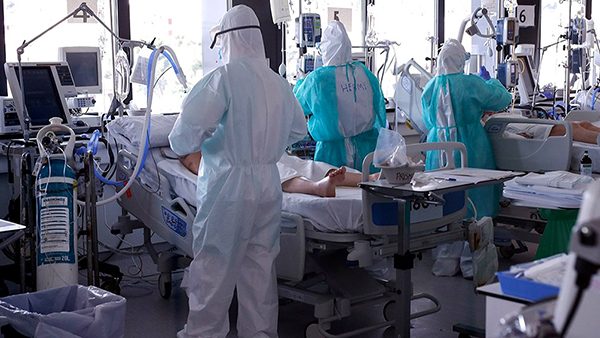
In every country, healthcare prevention and care systems have been and continue to be under extreme strain due to this emergency. Their entire workforce is overworked and generally underpaid. Healthcare systems in each country have different organizational structures, shaped by the level of social development and socioeconomic progress. This results in countries with a strong state presence and others with a nearly nonexistent and long-standing private sector.
In Argentina, the healthcare system is divided into three subsectors. Generally speaking, and undoubtedly schematically, these include the poor and excluded population served by the public system, formal workers covered by union-run social security programs, senior citizens in a specific and targeted system, and middle- and upper-income segments in the private system. However, in reality, we find overlaps, contradictions, and unexpected phenomena, such as highly specialized and complex public centers with highly trained staff coexisting with private clinics or private medical companies offering very low quality and services. What we observe is a system with relatively autonomous areas of operation, characterized by a lack of coordination at the national and local levels, and a strong presence and push for the commodification of access to medications and healthcare, especially during periods of neoliberal governments. (in: Fidel, Carlos; Di Tomaso, Raúl; Farias, Cristina (2013): “Health and Habitat: Assemblies in the Municipality of Quilmes, Argentina” in the book: “(Dis)Encounters between Social Reforms, Health, Poverty and Inequality in Latin America”. UNQ-CLACSO Publishing House. Volume II.
At this time, and anticipating the emergence of new pandemics, it is essential to engage in collective reflection on the organization and operation of drug and vaccine production, not only in the areas of prevention and healthcare. This call to rethink these issues is vital; it compels us to consider national policies, ideally integrated into regional agendas, and to adopt strategies understood as state policies.
A central dilemma is whether we pursue a path that leads to sovereignty or to the consolidation of an asymmetrical relationship with the global healthcare system . Considering the first phase, which is the local production of medicines and vaccines, this calls into question the ethical validity of "patents," a monopolistic production model that underpins the commercial interests of the current global and concentrated Medical-Industrial-Pharmaceutical-Financial Complex.
In Argentina, there are many precedents on the path to "health system sovereignty," but we will mention a few recent ones. These include the Remediar Plan, the Generic Drugs Law, and the construction of new hospitals and health centers in strategic locations. These actions have reduced the inequality gap between healthcare services and individual economic means. Public and free training of a specialized workforce in various health-related fields has a long history, creating a critical mass essential for designing and implementing a roadmap to sectoral sovereignty.
Public universities, the private sector, and the public sector in general are already undertaking initiatives in this area. We can mention laboratories that are making progress in drug and vaccine research at several national universities located in the greater Buenos Aires metropolitan area. The production of high-efficiency face masks by a partnership between public institutions and a textile SME is also very important. We could continue mentioning initiatives that have already been implemented and others that are underway.
Active collaboration between various public and private actors, both national and international, is already underway for the mass production and distribution of vaccines and medicines, not only to combat the current pandemic but also to establish a smart, robust, and continuous production process. If this momentum and effort continue along the path of industrial development, the country will surely be able to reposition itself in the international division of labor in a short time, producing medicines and vaccines to meet domestic market demands and, eventually, export to other countries.
Health prevention and care is a priority; management must be organized in a coordinated manner and with policies that consider a proportionate territorial deployment.
A sovereign healthcare system must sustain and act in the face of a wide range of challenges and questions; we will point out a few:
• What are the links between economic/social policy and health prevention and care strategies?
• What are the links between territorial segregation, living conditions, and health coverage?
• What are the capabilities and obstacles for research and production of medicines and vaccines at the local level?
Bibliography:
(http://biblioteca.clacso.edu.ar/clacso/gt/20191219033726/Estudio-1-OMySC.pdf).
(https://www.eluniverso.com/noticias/2020/12/23/nota/8720509/pandemia-impulso-ganancias-farmaceuticas-sector-salud-este-ano/).
Fidel, Carlos and Valencia Lomelì, Enrique (compilers)” (2013): “(Dis)Encounters between Social Reforms, Health, Poverty and Inequality in Latin America”. UNQ-CLACSO Publishing House. Volume I Volume II. https://www.clacso.org.ar/librerialatinoamericana/inicio.php?totalRows_rs_libros=1480&orden=titulo.
Fidel, Carlos; Di Tomaso, Raúl; Farias, Cristina (2013): “Health and Habitat: Assemblies in the Municipality of Quilmes, Argentina” in the book: “(Dis)Encounters between Social Reforms, Health, Poverty and Inequality in Latin America”. UNQ-CLACSO Publishing House. Volume II. (https://es.scribd.com/document/465590085/Politicas-sociales-pdf)
*Consulting research professor at the National University of Quilmes (UNQ). Co-coordinator of the CLACSO Working Group on Poverty and Social Policies.
If you would like to receive more information about CLACSO's training programs:
[widget id=”custom_html-57″]
to our email lists.

