
Territories, knowledge and networks in the social sciences and humanities
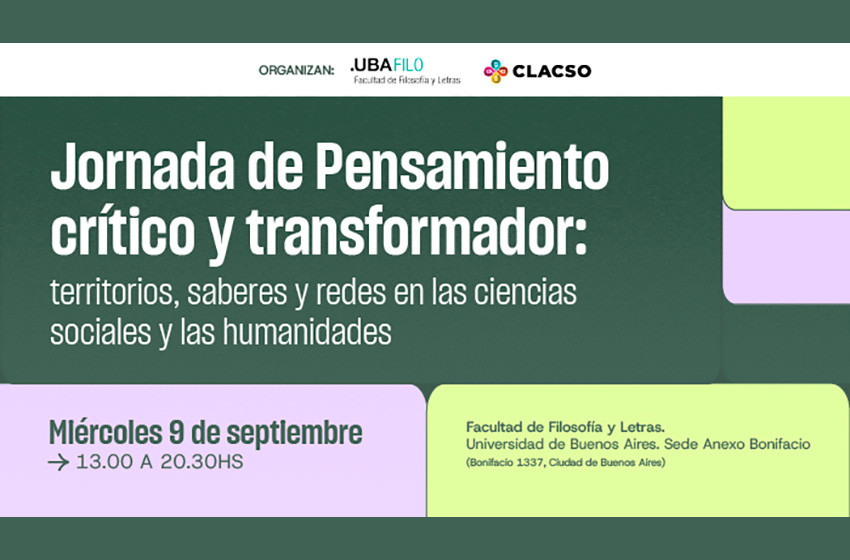
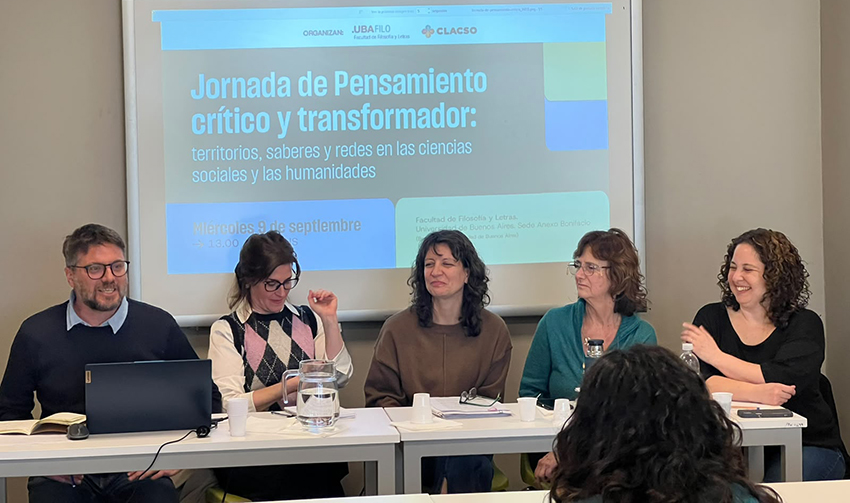
On Wednesday, September 9, the Latin American Council of Social Sciences and the Faculty of Philosophy and Letters of the University of Buenos Aires convened the Day of Critical and Transformative Thinking “Territories, knowledge and networks in the social sciences and humanities”
The meeting was conceived as a space for reflection on the relationship between the social and contemporary cultural configurations. Through dialogue among researchers affiliated with various CLACSO Working Groups, the program invited a critical examination of how knowledge is produced, circulated, and transformed in our societies.
Within this framework, special emphasis was placed on exploring definitions of what a CLACSO Working Group is and what role it can play not only as an academic subnetwork but also as a collective space for producing thought for transformation. In addition to exchanging experiences and ways of articulating regional networks, the importance of territorial impact, commitment to social issues, and the role of research in the social sciences, humanities, and arts in building more just, democratic, and inclusive futures were highlighted. In particular, the current challenges of open science, digital technologies, and higher education in contexts of increasing internationalization were addressed, while regressive policies that undermine public education and science were also analyzed.
The event provided an opportunity to strengthen institutional ties and continue envisioning situated, collaborative knowledge practices committed to social change. The gathering was open to students, faculty, and researchers, both established and in training, with the aim of fostering a broad space for exchange, debate, and academic reflection. The invitation was extended to the entire community of the Faculty of Philosophy and Letters at the University of Buenos Aires.
From 13:00 to 20:30 Argentina time (UTC-3)
Venue: Faculty of Philosophy and Letters. University of Buenos Aires. Bonifacio Annex (Bonifacio 1337, Autonomous City of Buenos Aires).
PROGRAM
9:00 to 10:00 am |
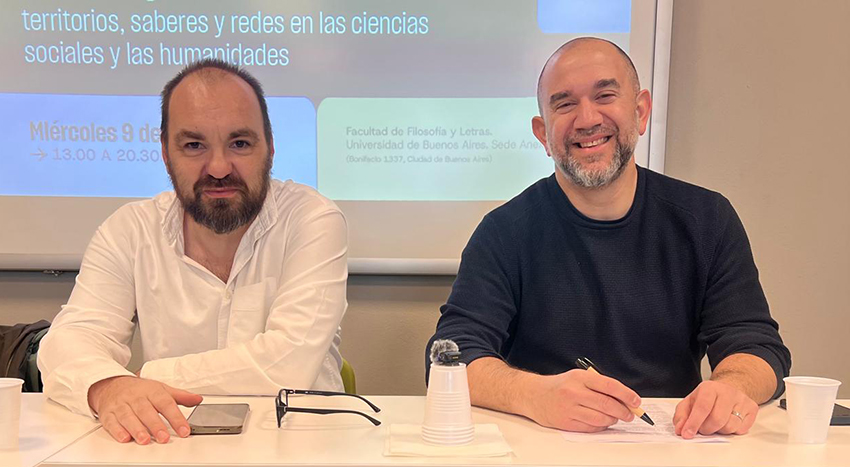
Opening table
Pablo Vommaro – Executive Director CLACSO
Ricardo Manetti – Jerónimo Ledesma – Secretary of Research, Philosophy Department, University of Buenos Aires
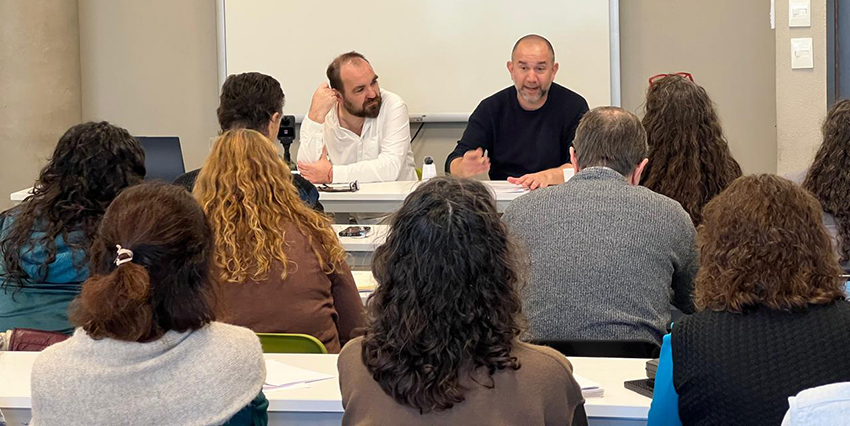
“We are inaugurating a historic day between CLACSO and the Faculty of Philosophy and Letters of the UBA , in a collectively and participatively planned effort to enhance Latin American critical thinking, ” Pablo Vommaro began his remarks.
Among other concepts, he argued that “thinking about the connection between social sciences, humanities, arts, and culture is key to expanding the territories of transformative knowledge. This event highlights collaborative work and opens the door to building new networks and regional projects. Producing knowledge is not a neutral, objective, or solitary activity: in contrast to the individualistic logic of academia, we are committed to reclaiming the social and collaborative dimension of our knowledge.”
He added that “the university and science should not simply be at the service of communities, but rather work with them, being an active part of their dynamics and transformations. We are moving towards processes of co-construction where academic and scientific knowledge engages in dialogue on equal terms with popular, ancestral, and territorial knowledge.”
Furthermore, he analyzed that “CLACSO Working Groups are not merely a collection of researchers: they aspire to be true communities of thought and action (…) We reaffirm our commitment to public, free, secular, and co-governed universities: higher education is a human right and a common good, not a privilege or a commodity. Defending public education and science in these times implies not only supporting institutions, but also having the audacity to rethink them, strengthen them, and recover their social legitimacy. Faced with hate speech, denialism, and attacks against democracy, the response must be more critical thinking and more political imagination. Our agendas must address the urgencies of the present: territorial inequalities, the climate crisis, the reconfiguration of work, and disputes over land and the time of our youth. Contesting digital territories requires a critical appropriation of artificial intelligence: without bias, with data sovereignty, and with a focus on algorithmic justice.”
Vommaro concluded: “The social sciences and critical arts are more necessary than ever: not only to interpret the world, but to transform it and imagine different futures. As Paulo Freire taught us, this is the time to build the 'viable unprecedented': that which does not yet exist, but which is urgent and possible. Faced with uncertainty, the motto remains: we either invent or we fail. Our commitment is collective, rigorous, and profoundly transformative.”
13:30 hs to 15:00 hs |
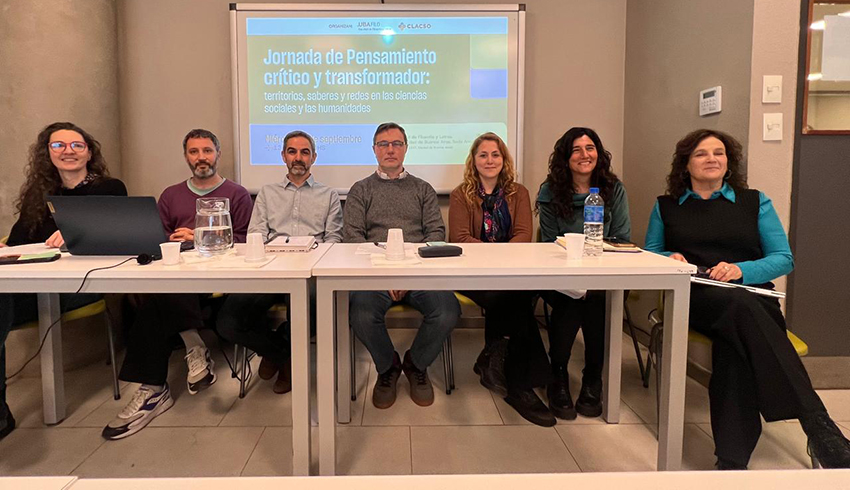
Panel Thinking in networks: the role of CLACSO Working Groups in the face of the challenges of our time
Ana Carolina Hecht (Coord.) and Mariana García Palacios – Education and Interculturality Working Group
Pablo Volkind – Coordinator. Working Group Agrarian Histories: Present and Future Challenges for Land and Labor Disputes
Julián Kan – Coordinator, Working Group on Regionalism, Integration and Autonomy in the Face of Global Hegemonic Dispute
Myriam Feldfeber – GT Educational policies and the right to education
Pablo Cosentino – Coordinator, Working Group on Political Ecologies from the South/Abya Yala
Moderated by: Magdalena Rauch – Coordinator of Research and Working Groups CLACSO
9:00 to 10:00 am |
Panel: Higher Education in a Global Context: Policies, Networks, and Academic Cooperation
Laura Rovelli – Open Science as a Common Good Working Group
María Inés Maañón – GT Popular Education and Critical Pedagogies
Lucía Caride – GT Educational policies and the right to education
Gabriela Novaro – GT Education and Interculturality
Moderated by: Alejandro Gambina – Director of Training and Postgraduate Studies, CLACSO
5:00 PM to 6:30 PM |
Panel: Between Territories and Knowledge. Strategies for Influence in Social Sciences and Humanities
Cecilia Incarnato GT Mobile and Politicized Social Science
Antonella Delmonte Alasia – GT Migrations and South-South Borders
Joaquina de Donato – GT Lefts and Latin American and Caribbean sociopolitical realities
Marcela Beatriz Cabrera – GT Violence in Central America
Moderated by: Pamela Brownell – Research Secretariat FILO-UBA
18:45 PM to 20:15 PM |
Panel Open Science and Information Technologies: Challenges for the Social Production of Knowledge
Judith Naidorf – GT Mobile and Politicized Social Science
Mercedes Palumbo – GT Popular Education and Critical Pedagogies
Axel Kesler – GT Educational policies and the right to education
Victoria Orce – GT Arts Education and Decoloniality
Moderated by: Fernanda Pampín – Director of Publications CLACSO
FILO-UBA / CLACSO certificates were issued.
They organized
Latin American Council of Social Sciences
Faculty of Philosophy and Letters of the University of Buenos Aires

