
"We need to revisit the social pacts."
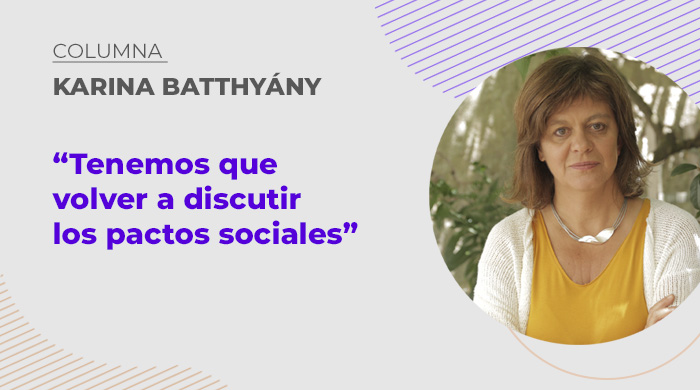
Transcript of Karina Batthyány's column
in InfoCLACSO – February 28, 2024
CLACSO was in Bogotá, Colombia, participating in a forum convened by the Ministry of the Interior, specifically by the Vice Ministry of Social Dialogue, headed by Lilia Solano, in preparation for our #CLACSO2025 conference. There, we discussed social dialogue and public policy, absolutely central and strategic pillars of our work in recent years. We embraced the idea of social dialogue as the foundation for building alternatives for the Latin American and Caribbean region. This region is currently experiencing critical moments regarding the new social pacts so necessary today.
At the regional level, we observe several debates that question the role of the state—that is, the role of politics in general and public policies in particular. In this sense, in the most unequal region on the planet, where inequality is increasing and wealth is becoming more concentrated, a fundamental element for these new social pacts is being challenged: the construction of a welfare system. This is a major outstanding issue in the Latin American and Caribbean region.
When we talk about well-being, we are referring to access to social benefits or services that, unfortunately, remain a privilege because they are not universally available. These crises and discussions highlight the consequences that the commodification of public, state, and common resources has on everyone's lives in Latin America and the Caribbean.
We can mention Argentina, where absolutely everything public is being questioned on a path toward rampant privatization or commodification. The global pandemic made one thing very clear in this debate about the role of the state: far from the rhetoric about the death of the state and its supposed inaction in public affairs, the opposite was proven. States have a central role in implementing public policies capable of effectively transforming reality for everyone. The role of public policies is crucial in the realm of well-being.
We need to revisit, agree upon, and build these social pacts based on our understanding of public policies that address the challenge of constructing universal systems of protection and welfare. We must shift the primary focus of attention away from individuals, placing life and the care of life in all its forms at the center. For this, the State, especially the welfare state, acquires an absolutely central and crucial role.
Furthermore, in Latin America and the Caribbean, we have a pressing need for regional integration and cooperation. At CLACSO, we are proposing a shift in the focus of the discussion by promoting broad social dialogue, meaning that it involves not only the academic sector, which produces knowledge for public policy, but also those with public responsibilities, as well as social movements and organizations. These groups shape the citizens' agenda and exercise citizen oversight of policy implementation.
To address equality as a central tenet of the proposed social dialogue and new social pacts, we must work in a cross-cutting and intersectional manner, taking into account social, economic, cultural, political, generational, territorial, racial, ethnic, and gender dimensions, among others. We cannot speak of social pacts without speaking of participatory democracy, solidarity, interdependence, and co-responsibility at both the micro and macroeconomic levels.
All these dimensions and themes are also relevant to my visit to Belém do Pará, Brazil. There, the emphasis will be on building social pacts, collective well-being, and social welfare: the dimension of care in its relationship between global, national, and local levels. It will also explore how local public policies can address these dimensions in terms of inequalities. This applies particularly to gender inequality, but also to social inequalities in general, such as those related to care. The sexual division of labor must be placed at the center of the discussion in order to transform it.
Today, in Our America, these disputes and themes are central to understanding the lives of many of its citizens. Colombia and Brazil, two different countries, but with a central intersection. Many people are excited about the road to the Latin American Conference of Social Sciences, #CLACSO2025.
– Through close collaboration with our CLACSO Member Centers in Colombia, our representative Carolina Jiménez, and various national and district authorities in Bogotá, we will be building a space for encounter and exchange. And, above all, for planning and developing alternatives from the social sciences and humanities, which CLACSO convenes every three years.
– Finally, March, Women's Month, is about to begin.
Yes, that's what we call it at CLACSO. Throughout the month, we'll be carrying out a wide range of activities across our various programs. There will be initiatives related to research, training, knowledge dissemination, publications, and communication. We have a very full agenda, and we want to invite everyone to participate throughout March.
If you would like to receive more information about CLACSO's training programs:
[widget id=”custom_html-57″]
to our email lists.

