
Recent Trends in Open Science and Open Access Science Policies in Ibero-America

On Tuesday, December 16, the publication “Recent Trends in Open Science and Open Access Scientific Policies in Ibero-America” was presented, produced by CLACSO and the Carolina Foundation, which reconstructs and analyzes the state of research and scientific policies in open access, open research data and open science in Ibero-America and investigates its impact on the evaluation of research trajectories, scientific publications and research impact indicators.
The report prepared by Dominique Babini and Laura Rovelli from the Latin American Forum on Scientific Evaluation (FOLEC) of CLACSO, along with technical assistance in the field survey by Paola Oliveira and the general review by Pablo Vommaro, invites us to update the ongoing debates and to reinstate the contributions and positions of Ibero-America on the subject, in light of the privileged scenario of the preparation of UNESCO's global recommendation on open science.
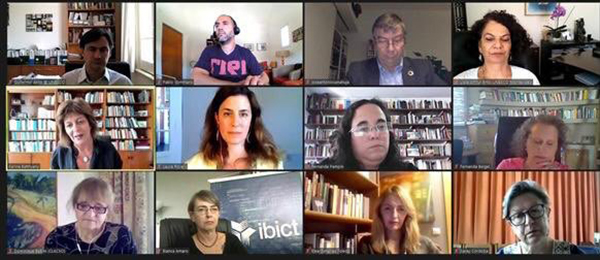
Opening words:
Lidia Brito, Director of the UNESCO Regional Office for Science in Latin America and the Caribbean
Karina Batthyány, Executive Secretary of CLACSO
José Antonio Sanahuja, Director of the Carolina Foundation
Moderated by: Pablo Vommaro, Director of Research at CLACSO
The research presents updated information from nine countries in the Ibero-American region: Argentina, Brazil, Chile, Colombia, Costa Rica, Cuba, Spain, Mexico, and Peru.
Some of the main results of the study reveal that both internationally and regionally, open access is a long-standing movement, driven since the mid-1990s; while open science as a driving force has gained prominence since the beginning of the new century and is lagging behind alternatives that improve individual and collaborative research processes, their communication and reproducibility in order to accelerate the production and use of new knowledge in society.
In pronouncements on this topic from Latin America and the Caribbean, the approach to knowledge as a public good and to open access managed by the academic community as a common good, on a non-profit basis, stands out. Added to this are proposals to review evaluation policies based on publication incentives with impact factors, insofar as they affect the local autonomy of research agendas, while discouraging good open access practices and research processes that interact with society.
One of the current predominant trends, driven by international and regional organizations, is the expansion of open science through the expansion of platforms where researchers share data, publications, experiments and equipment.
If you would like to receive more information about CLACSO's training programs:
[widget id=”custom_html-57″]
to our email lists.

