
Taxation of the super-rich in Brazil
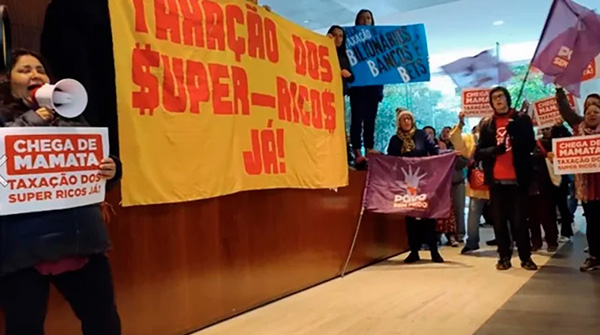

O Brazil, which on July 6 and 7, received the Cúpula dos BRICS+ lives, at this moment, an intense political discussion driven by social mobilizations and debates, both in traditional media and in social networks, as well as in collective actions that aim to occupy the streets of the country. With the objective of expanding the agenda of confrontation with multiple social inequalities and giving continuity to the implementation of proposals already present in his government program, President Lula recently launched some initiatives to the Congress, anchored in the principle of establishing “tributary justice”: first he foresees the isenção of the income tax (IR) for people who earn monthly at 5 thousand reais (about 900 dollars), as well as a tax for those who receive more than 50 thousand reais (about 9 thousand dollars); Secondly, based on the principle of registration of IOF tax rates – Tax on Financial Operations (credit, exchange, insurance, some fixed income titles and investment funds), a tax that falls predominantly on the population of the highest income, proposes to increase the tax to 20%. super-rich years (mensal hair allowance less 308 thousand reais - more or less 56 thousand dollars - among other resources), fixed rate between 2% and 15%.
At this time, most of the time Congress is rejeitou on purpose, based on the argument that the government spends excessively on public and social policies and fails to guarantee “fiscal adjustment” and balance in public accounts. On the other hand, the Congress is one of the main spenders of public resources to guarantee the privileges of parliamentarians who are responsible for the work of thousands of Brazilians who are forced to flee from their rights. This challenge was due to a strong reaction against social networks, with complaints focused on the distance between the Congress and the population, and the responsibility of the president of the Chamber, Deputy Hugo Mota, who became one of the two main sources of criticism, both on the networks and on the streets. The hashtags «#CongressoInimigoDoPovo» and «#CongressoDaMamata» occupy (and continue to occupy) the digital spaces in significant geometric progress. In addition to positioning two users, the government joined the debate, with the dissemination of a vast communication campaign, at the same time fun and enlightening, which stimulates mobilization, as well as judicial action by the Supreme Federal Court (STF), with no sense of reverting to the decision of Congress.
Despite the significant changes and public policies implemented in Brazil by the current government and those that triumphed between 2003 and 2016 (year of parliamentary coup against then President Dilma Roussef), the national project of the dominant classes prevails, maintaining the country as one of the most uneven societies in Latin America. In a population of approximately 213 thousand people, more than 180 thousand live in precarious situations, between 25 and 30 thousand constitute the lower, middle and upper middle classes, and barely 180.000 people (whose income exceeds 10 thousand dollars per month) They comprise a concentrated class of the super-rich who dominate the economy, politics, culture and corporate media.
This has led to a significant and unprecedented dispute of positions, capable of clarifying the existence and persistence of two national projects: on the one hand, or of maintaining the serious and historical social polarization, resulting from a deeply unequal society; On the other hand, a national project with a minimum level of well-being for the majority, anchored at this time by the proposal of “tributary justice” aimed at the Lula government, as a possibility of opening paths for a better distribution of income in the largest economy of Latin America and the Caribbean.
Diante disso, or Latin American Council of Social Sciences (CLACSO) supports the political, intellectual, academic and social efforts in searching for alternatives to build a less unequal Brazil, in order to defend a “tributary justice” in which “that more people” pay more taxes and lack continuity construction of a more just and democratic society.
11 July 2025

