
Subjectivities on the run: mobility and migrations in the Global South
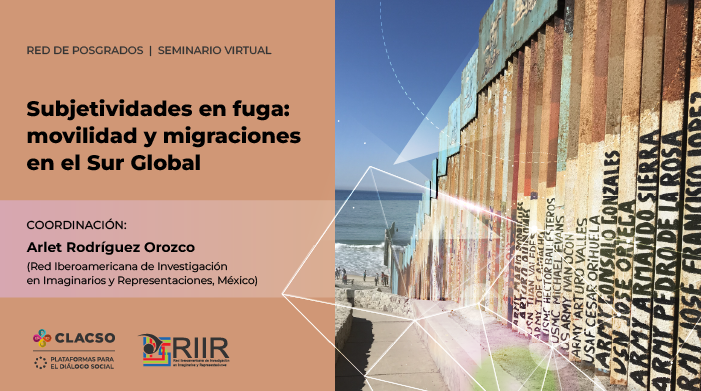
Seminar 2315
ChairCLACSO
Coordination: Arlet Rodríguez Orozco (Ibero-American Network for Research on Imaginaries and Representations, Mexico)
Teaching team: Arlet Rodríguez Orozco (Ibero-American Network for Research on Imaginaries and Representations, Mexico) and Sergio Prieto Díaz (CONACYT-ECOSUR Chair, Mexico)
Home: 09/10/2023 | Registration: 08/05/2023 to 06/10/2023
Workload: 12 weeks – 90 hours.
To inhabit the world is to traverse it. It is to question the divisive principles of society. It is to walk among rivers of legislation and cross the barriers of cultural landscapes.
This seminar is proposed in a transdisciplinary workshop dynamic in which the experience of the analytical-synthetic study of the migratory phenomenon will be shared.
Throughout the 10 sessions of the Seminar-Workshop we will be building a pragmatic scenario by presenting the methodological principles of Transdisciplinary Integration applied to the practical, intimate and profound understanding of the study of migratory movements.
The seminar will require group participation and will be assessed through the writing of an essay in which participants can defend transdisciplinary theses that account for the phenomenon in its integrated study. Therefore, it is aimed at scholars interested in developing transdisciplinary research and teaching programs with an emphasis on, but not limited to, migration-related topics.
It will be taught by Sergio Prieto Diaz, CONACYT Research Chair attached to El Colegio de la Frontera Sur (Mexico) and coordinator of the Transborder Research Laboratory-LIT, and by Arlet Rodríguez Orozco, Coordinator of the Center for Research, Intervention and Transdisciplinary Integration in Science and Art CENIT and member of the Ibero-American Network of Research in Imaginaries and Representations (RIIR).
The social sciences constitute an interrelational field of study by definition. This reflects the connection that societies have with the multiple interacting ecosystemic spheres. Their complex and interrelated nature often exceeds academic logic, and although higher education programs and their lines of research are increasingly incorporating interdisciplinary proposals, most approaches continue to be overwhelmed by phenomenal nuances that are elusive through methods still anchored and restricted to disciplinary research. Migration is to return to the wandering condition of the original quest: structures, and risks/limits of the (im)equilibrium of ecosystems between human beings, society, and nature.
The issue of migration is, by definition, a complex field, encompassing a range of processes that can extend from natural migrations to forced displacements, raising questions that reach the very limits of (im)mobility. At the same time, it compels us to transcend the representational constraints, both academic and colloquial, of understanding human displacement as an inevitable fate. It is therefore necessary to propose the development of new conceptual representations to recognize subjects in transition, critiquing the victimizing view of migrants as expelled and without an agenda, and thus redefining social incorporation and integration. Mobility, an inherent characteristic for the understanding, reproduction, and possibility of human beings and the rest of nature, becomes migration, and the process/phenomenon becomes a problem when it crosses or challenges the state-centric boundaries within which the territories of the modern-colonial world have been organized. From this perspective, human (im)mobility is inherent to and representative of the characteristics,
To understand social evolution through reflection on human (in)mobilities it is necessary to cross disciplinary boundaries because while mobility and migration traverse geographical territories, social transformation crosses all socio-environmental dimensions.
The seminar will address questions surrounding the dimensions involved in (im)mobility processes; the dynamics of interaction between actors, factors, and (im)mobility processes; the dimensions that influence the emergence and proliferation of a spectrum ranging from the dynamic habitability of the world to forced displacement; the subjective transformation of these populations and their subjectivities; and other emerging issues. These questions will be addressed methodologically to provide tools for formulating research within an interdisciplinary and transdisciplinary framework. Collaborative reflections will contribute to the classic categories of mobility and migration, considering the relevance of incorporating the notion of (im)mobility and permanent flight due to its analytical capacity to enhance the understanding of the complexity and interrelation between human, social, and environmental processes. This includes the various configurations of rootedness and permanence, both voluntary and forced, which lend a more structural and systemic character to understanding the processes of socio-environmental justice and sustainability.
Objective
- To imagine, share, generate and propose conceptual and methodological approaches and tools from transdisciplinarity and integrative studies from critical perspectives
Specific objectives
- To foster a space for creative discussion for transdisciplinary theoretical and methodological development that allows for a better understanding of complex socio-environmental phenomena such as (in)human (in)mobilities.
- Develop a theoretical field on interdimensionality in the processes of (in)human (in)mobilities and migration.
- To encourage the production of transdisciplinary research in the field of migration studies.
- Presentation of various transdisciplinary approaches, the constructs that identify them, and the fields of knowledge covered by their theoretical-methodological proposition.
-
Deepening of the transdisciplinary theoretical and methodological framework of Basarab Nicolescu
-
Wandering gazes. Migrations and displacements
-
The journey through the dialogic horizon
-
Global South. Human constructions of the migration narrative
-
Pragmatic dilution of the steps, encounters, stumbles, and discoveries during migratory experiences
-
Detection of inflection points produced by migration within the framework of building systems for socio-environmental justice.
- Wehrden, H. et.al. (2019). Interdisciplinary and transdisciplinary research: finding the common ground of multi-faceted concepts. Sustainability Science 14:875–888
- Mirel Petrariu, Adrian 2012, Levels of Reality in Social Systems / Niveluri de Realitate în sistemele sociale, thèse de doctorat en Philosophie, Babeş-Bolyai University of Cluj-Napoca / Université Babeş-Bolyai de Cluj-Napoca / Universitatea Babeş-Bolyai din Cluj-Napoca, Cluj-Napoca, Roumanie.
- Rodríguez Orozco, A. "I, the other: transdisciplinary theory through the relief of the Self", in F-ILIA Magazine No.5 (2022): 171-192.
- Mirel Petrariu, Adrian 2012, Levels of Reality in Social Systems / Niveluri de Realitate în sistemele sociale, thèse de doctorat en Philosophie, Babeş-Bolyai University of Cluj-Napoca / Université Babeş-Bolyai de Cluj-Napoca / Universitatea Babeş-Bolyai din Cluj-Napoca, Cluj-Napoca, Roumanie.
- Ochoa Flores O. (2020). Memories on the shore of the lake. The recursive memory-forgetting in the defense of territory in Atenco, Texcoco and Chimalhuacán. National School of Anthropology and History, Mexico
- Prieto Díaz, S.; and Camargo Martínez, A. 2023. Borders of the Southern Border. Between (re)organizations of territory and (re)distributions of population. In Castillo, Guillermo (coord.), Central American migration in contemporary Mexico. Socio-spatial processes and dynamics of exclusion. Institute of Geography, National Autonomous University of Mexico.
- Prieto Díaz, S. 2021. Border reorganizations in southern Mexico: towards a new vortex of human (im)mobilities. In Nexos, Migrant Observatory.
- Mirel Petrariu, A. 2012, Levels of Reality in Social Systems / Niveluri de Realitate în sistemele sociale, thèse de doctorat en Philosophie, Babeş-Bolyai University of Cluj-Napoca / Université Babeş-Bolyai de Cluj-Napoca / Universitatea Babeş-Bolyai din Cluj-Napoca, Cluj-Napoca, Roumanie.
- Prieto Díaz, S. 2022. “Cartographies of Migratory Subalternity: bestialization, inhumanity and counter-hegemony on the Mexican border”. El Colegio de la Frontera Sur. E-ISBN: 978-607-8767-59-5.
- Iconoclasts: Risler, J.; and Ares, C. (2013), Collective Mapping Manual. Critical Cartographic Resources for Collaborative Creation Processes. Available at www.iconoclasistas.net/post/manual-de-mapeo-colectivo-en-pdf
- Prieto Díaz, S. 2022. Towards a critical, transdisciplinary, and emancipatory methodology of human mobility: Migrant Mapping. In Studies in Social Sciences Review, 3(1), 166–185.
|
|
Discount for one payment until 30/09 |
In one payment after 30/09 |
|
CM Plenos |
$75 |
$150 |
|
CM Associates |
$95 |
$190 |
|
No link |
$95 |
$190 |
FAQ
The basic requirements for taking a seminar are:
- Availability of at least 4 hours per week to dedicate to the seminar course.
- Internet access.
- Reasonable handling of communication and computer tools.
- Language proficiency in the language in which the course will be taught. The official languages are Spanish and Portuguese.
The seminars last 12 weeks, plus the completion of a final project. A total of 90 hours of dedication will be credited.
A course consists of twelve classes, each accompanied by required reading bibliography, supplementary bibliography, discussion forums and training activities proposed by the teaching team, partial deliveries and a final project.
The course is online and asynchronous. Some instructors may propose synchronous activities. In those cases, the time and date will be agreed upon beforehand between the teaching team and the students to ensure everyone's participation.
To pass the seminar, you must participate in at least 80% of the discussion forums and activities proposed by the teachers, have completed the scheduled partial deliveries, and pass the final work.
|
|
Discount for one payment until 30/09 |
In one payment after 30/09 |
|
CM Plenos |
$75 |
$150 |
|
CM Associates |
$95 |
$190 |
|
No link |
$95 |
$190 |
The possible payment methods are credit card, bank transfer and bank deposit.
Inquiries: [email protected]

