
2021 Seminars
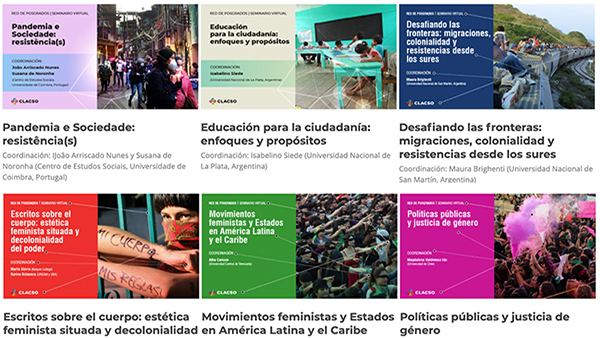

The Virtual Training Space of the CLACSO Postgraduate Network offers a comprehensive program of virtual seminars aimed at researchers, doctoral and master's students, public policy officials and the general public, interested in carrying out critical and rigorous training on the most diverse topics and disciplines of the Social Sciences.
CLACSO's virtual teaching platform has been a pioneer in the field of virtual education, developing, for almost two decades, virtual courses characterized by their academic quality and their political commitment to the major issues and problems of our region.
Pandemic and Society: resistance(s)
Coordination: IJoão Arriscado Nunes and Susana de Noronha (Centro de Estudos Sociais, Universidade de Coimbra, Portugal)
Citizenship education: approaches and purposes
Coordination: Isabelino Siede (National University of La Plata, Argentina)
Challenging borders: migrations, coloniality and resistance from the south
Coordination: Maura Brighenti (National University of San Martín, Argentina)
Writings on the body: situated feminist aesthetics and decoloniality of power
Coordination: Marta Sierra (Kenyon College, United States) and Karina Bidaseca (National University of San Martín and University of Buenos Aires, Argentina)
Feminist movements and States in Latin America and the Caribbean
Coordination: Alba Carosio (Central University of Venezuela)
Public policies and gender justice
Coordination: Magdalena Valdivieso Ide (University of Chile)
Gender and inequalities
Coordination: Marisa Ruiz Trejo (Autonomous University of Chiapas, Mexico)
Social policies, inequality and democracy
Coordination: Pablo Gentili (Secretary of Educational Cooperation and Priority Actions, Argentina and Professor at the State University of Rio de Janeiro, Brazil)
The challenges of legislating on gender-based violence against women
Coordination: Alicia Ruiz (University of Buenos Aires, Argentina)
Historical background of public policy on violence against women
Coordination: Dora Barrancos (University of Buenos Aires and CONICET, Argentina)
Economic impact of violence against women
Coordination: Marilane Teixeira Oliveira (Flacso Brazil)
Digital archives, sources and repositories: preservation, access and possibilities for use in the classroom
Coordination: Darío Pulfer (Pedagogical University, Argentina) and Nicolás Arata (CLACSO)
Teaching social sciences in the face of the challenges of digitality
Coordination: Inés Dussel (DIE-CINVESTAV, Mexico), Patricia Ferrante and Manuel Becerra (UNIPE, Argentina)
"Doing" social sciences from Latin America: teaching and research
Coordination: Rebecca Lemos Igreja (University of Brasilia, Brazil), Odile Hoffmann (IRD/France and CIESAS/Mexico) and Camilo Negri (University of Brasilia, Brazil)
Recent history, public uses of the past, and collective action
Coordination: Ana María Barletta and Emmanuel Kahan (IdIHCS/ FaHCE-UNLP)
Space and memory: pasts and political violence in Latin America
Coordination: Loreto López (University of Chile) and Ana Guglielmucci (University of Buenos Aires)
Disappearances. A transnationalized Latin American category
Coordination: Gabriel Gatti (University of the Basque Country/Euskal Herriko Unibertsitatea) and María Martínez (National University of Distance Education, Spain)
Afro-descendants, Racial Justice and Human Rights
Coordination: Jackeline Aparecida Ferreira Romio (Universidade de San Paulo, Brazil), Tarsila Flores (Mecanismo Nacional de Prevenção e Combate à Tortura, Brazil), Cidinalva SCNeris (Universidade Federal do Maranhão) and Katia Regis (Universidade Federal do Maranhão)
Racism and nation
Coordination: Santiago Arboleda Quiñónez (Andean University Simón Bolívar, Ecuador) and Saúl Hernández Rosales (Center for Ethnic Development Studies, Peru).
Care systems and policies in Latin America
Coordination: Natalia Genta (University of the Republic, Uruguay)
Migration, gender and care
Coordination: Lucia Scuro (Gender Affairs Division – ECLAC)
The social organization of care
Coordination: Eleonor Faur (National University of San Martín, Argentina)
If you would like to receive more information about CLACSO's training programs:
[widget id=”custom_html-57″]
to our email lists.

