
Seminar-workshop. Motherhood and Fatherhood in Latin America and the Caribbean Today: Dialogues between Research and Social Action
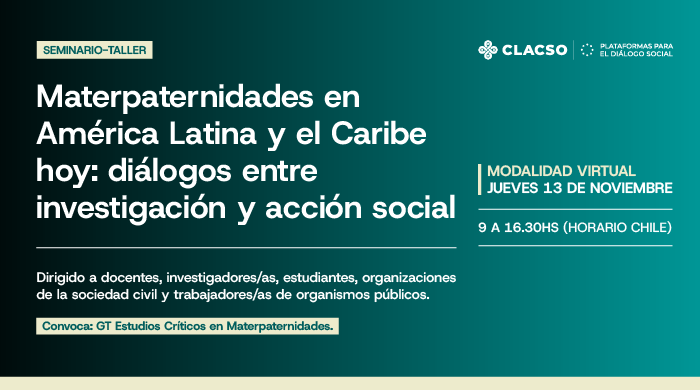
November 13 | Virtual format
9:00 a.m. to 4:30 p.m. Chile
📢 Free virtual activities via MEET with prior registration ????
Aimed at teachers, researchers, students, civil society organizations and public sector workers
El CLACSO Working Group on Critical Studies in Motherhood and Fatherhood It is oriented towards discussing and making visible the production of knowledge and interventions that, in Latin America and the Caribbean, observe them from a critical, contextual and intersectional perspective and emphasize their connection with social changes related to family, gender, childhood, reproduction, work, cities and other aspects.
To exchange ideas and delve deeper into the themes and issues that define this field of study, the Working Group invites professors, researchers, students, civil society organizations, and public sector employees to participate in the seminar-workshop “Motherhood and Fatherhood in Latin America and the Caribbean Today: Dialogues Between Research and Social Action,” to be held virtually (via Google Meet) on November 13, 2025. Participation is free and registration is required using the form below.
Organized by
CLACSO Working Group on Critical Studies in Motherhood and Fatherhood
Queries: [email protected]
PROGRAM
(program time reference GMT-4, Chile)[1]
COMPLETE PROGRAM
9:00 AM | Opening
Ana Vergara (University of Santiago, Chile, Coordinator of the CLACSO Working Group on Critical Studies in Motherhood and Fatherhood)
9:20 a.m. I CONFERENCE: When assessments of parenting lead to judgments about motherhood. Diagnostic technologies for parental skills
Carla Villalta (UBA/CONICET)
10:00 AM | Break
10:15 am l PANEL: Tensions and possibilities for dissident mothers/fathers in Chile
Participants:
Leonora Beniscelli, PhD (c) in Sociology, Alberto Hurtado University.
Fer Ojeda, trans activist for Diverse Migration.
Coordinator: Caterine Galaz (REDIGER, University of Chile).
11:15 am | Break
11:30 am | PANEL: Building an archive for “searching mothers” in Argentina
Participants:
Soledad Gesteira, PhD in Anthropology (ICA-FFyL: UBA/ CONICET)
Claudia Raimondo, visual artist and activist of the group Hermanados por la búsqueda (Brothers for the search).
Coordinator: Soledad Rojas (ICA-FFyL: UBA / CONICET – REDIGER).
2:30 p.m. | Participatory workshops (choose one)
1) Black Motherhood and Quilombolas in South-Sul Dialogue: Epistemological Reconfigurations, Knowledge and Affirmative Actions in Brazil and Angola
Dolores Galindo. UFCG – INCT Kaleidoscope.
Zizele Ferreira dos Santos. UFCG – INCT Kaleidoscope.
Milena Freitas Machado. UFBA – INCT Kaleidoscope.
Helena Cosma da Graça Fonseca. Universidade Santo Agostinho de Angola / UFCG – INCT
Kaleidoscope.
Luciene Tavares da Silva Lima. UFCG – INCT Kaleidoscope.
Tamille dos Santos Ferreira. UFRB/UFCG – INCT Kaleidoscope.
Ludmilla Vitória. UFCG – INCT Kaleidoscope.
2) "Make kin, not babies." Designing kinship beyond the human
Claudia Calquin. School of Psychology, Usach.
Claudia Fonseca. Department of Education, Usach
3) Exploration of socio-territorially situated livestock farming for the formulation and implementation of Public Policies
Luna Bedoya-Valderrama. Ibero-American University Corporation IBERO (Colombia) –
Public Policy Committee on Parenting Practices of the Colombian College of Psychologists
COLPSIC.
4) Motherhood and fatherhood in extreme contexts: imprisonment and abandonment
Jeanine Anderson. Pontifical Catholic University of Peru.
Ana Paula Méndez. Pontifical Catholic University of Peru.
5) Maternal figures: productivity, care, pleasures
Rossana Blanco. University of the Republic, Uruguay.
6) The technologization of parenting. Motherhood, fatherhood, childhood and adolescence in digital environments
Pilar Anastasia Gonzalez. National University of Cordoba and National University of San
Martin.
Florencia Gastaminza. National University of San Martín.
Laura Frasco Zucker. National University of San Martín.
4:00 PM to 5:00 PM | Extended discussion and closing remarks
[1] Other time zones
7:00 a.m. to 1:30 p.m. (Mexico)
8:00 a.m. to 2:30 p.m. (Peru, Colombia, Ecuador)
9:00 a.m. to 3:30 p.m. (Chile, Bolivia, United States)
10:00 a.m. to 4:30 p.m. (Argentina, Uruguay, Brazil)
2:00 PM to 8:30 PM (Netherlands)

