
Race, gender and rights from the perspective of coloniality
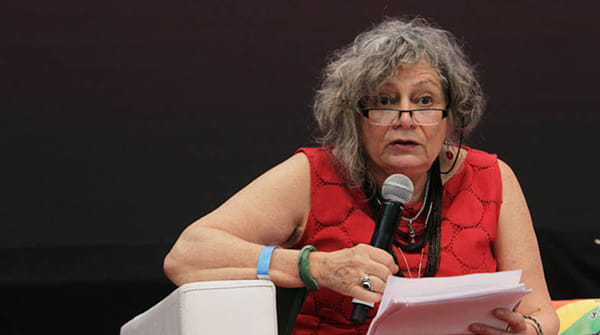
Seminar 1903
Chair: CLACSO
Coordination: Rita Segato (UnB, Brazil)
Home: 30 / 04 / 2019 | Registration: 04/02/2019 al 20/04/2019
Workload: (12 weeks) 48 hours of work with the teacher and 120 hours of total dedication
Payment methods
If you have a link with a CLACSO Associated Center:
- Paying in one payment: USD 95 (includes issuance and shipping costs of the digital certificate).
If you do NOT have a link with a CLACSO Associated Center:
- Paying in one payment BEFORE 31/03/2019: USD 150 (includes issuance and shipping costs of the digital certificate).
- Paying in one payment: USD 190 (includes issuance and shipping costs of the digital certificate).
Course presentation:
This course addresses the intersections of race and gender across the continent. It develops a critique of multicultural and essentialist discourses on race and gender, restoring the historicity of both hierarchies. It examines the impact of colonial modernity on the gender structures of pre-colonial/state intrusion communities. It elaborates a critique of the negative influence of global identity politics on race and gender, relocating both within national and regional matrices of historical otherness.
Contents:
- The question of the nation as a fundamental theme: National formations of otherness and critique of global multiculturalism
- The theoretical and political perspective of the critique of Coloniality
- A key difference with Postcolonial theory
- Dilemmas that arise when the State seeks to embrace or legislate Difference
- From Community Justice to the Law of Demarcation: the difficult path of the Bolivian experience
- The challenges of attempting pluralist constitutionalism, with examples from Bolivia and Ecuador
- The solution through radical relativism, as defended by Esther Sánchez Botero based on her Colombian experience
- The solution through historical pluralism and the return of community deliberative jurisdiction based on a Brazilian debate about a borderline case
- Race and Racism from a Latin American Perspective
- When the University wants to embrace difference: a reflection based on the struggle for “quotas” for black students in Brazil.
- Intersectionality based on two Brazilian cases: where are the black women?
- Historicizing gender: the colonial inflection captures low-impact patriarchy and transforms it into the lethal patriarchy of colonialism/modernity
- Gender as a colonial invention
- Inconsistencies in Oyeronke Oyewumi's analysis: Did gender not exist or was it different?
- The paths of capital in the apocalyptic phase of colonialism/modernity: the State-Capital pact as a pact of a criminal State
- Segato, Rita Laura: “Introduction” and “Political Identities /Historical Alterities: A Critique of the Certainties of Global Pluralism” in The Nation and its Others. Race, Ethnicity and Religious Diversity in Times of Identity Politics (Buenos Aires: Prometeo 2007)
- Rufer, Mario: “Temporality as politics: nation, forms of the past and postcolonial perspectives”, Mem.soc / Bogotá (Colombia), 14 (28): 11-31 / January-June 2010
- Segato, Rita Laura: "Anibal Quijano and the perspective of the Coloniality of Power" in Segato, Rita The Critique of Coloniality in eight essays and an Anthropology on Demand. Buenos Aires: Prometeo, 2015
- Quijano, Aníbal: “'Race', 'ethnicity' and 'nation' in Mariategui: open questions”; “What about race!”; and “Coloniality of power, Eurocentrism and Latin America”, in Palermo, Zulma and Pablo Quintero (eds.): Aníbal Quijano. Founding Texts. Buenos Aires: Ediciones del Signo, Colección El desprendimiento, 2014.
- Xavier Albó: “Main characteristics of Customary Law”, summary of some elements of the larger document “Commentary on the case studies of the Community Justice Project 1” (mimeo)
- _: “Indigenous Justice in Plurinational Bolivia.” In Boaventura de Souza Santos and José Luis Exeni Rodríguez (eds), Indigenous Justice, Plurinationality and Interculturality in Bolivia. La Paz: Rosa Luxemburg Foundation and Abya-Yala eds., 2012, pp. 201-248.
- Yrigoyen Fajardo, Raquel Z.: “The horizon of pluralist constitutionalism: from multiculturalism to decolonization”. Presented at the VII RELAJU Congress, Lima, Peru, 2010.
- Sánchez Botero, Esther: “Too much law and too little anthropology: the negative impact of globalized law on ethnic societies” (final text forthcoming)
- Segato, Rita Laura: “Que cada povo teça os fios da sua história: O pluralismo Jurídico em diálogo didático com legisladores”. Its latest and revised version in Rev. Direito.UnB, Vol. 1, No. 1, January to June 2014. Spanish version: “Que cada pueblo teja los hilos de su historia: la colonialidad legislativa de los salvadores de la infancia indígenas”, in Segato, Rita: La Crítica de la Colonialidad en ocho ensayos y una Antropología por demanda. Buenos Aires: Prometeo, 2015
- Segato, Rita Laura: “The Monochromaticity of Myth, or Where to Find Africa in the Nation,” in The Nation and Its Others: Race, Ethnicity, and Religious Diversity in Times of Identity Politics. Buenos Aires: Prometeo, 2007.
- Segato, Rita Laura: "The Color of Prison in Latin America: Notes on the Coloniality of Justice in a Continent Under Deconstruction," Nueva Sociedad No. 208, March-April 2007. Also in Segato, Rita: The Critique of Coloniality in Eight Essays and an Anthropology on Demand. Buenos Aires: Prometeo, 2015
- Segato, Rita Laura: “The Deep Channels of the Latin American Race – A Re-reading of Mestizaje.” Buenos Aires: Revista Crítica y Emancipación, Year II, No. 3, 2010. Also in Segato, Rita: The Critique of Coloniality in Eight Essays and an Anthropology on Demand. Buenos Aires: Prometeo, 2015
- Segato, Rita Laura: "Cotas: why do we react?" USP Magazine, São Paulo, no. 68, p. 76-87, dez. Jan. fev. 2005/2006
- Segato, Rita Laura: “Race is a Sign”, in The Nation and its Others. Race, ethnicity and religious diversity in times of identity politics. Buenos Aires: Prometeo 2007
- Segato, Rita Laura: “Introduction: Coloniality of Power and an Anthropology on Demand”, in Segato, Rita The Critique of Coloniality in Eight Essays and an Anthropology on Demand. Buenos Aires: Prometeo, 2015
- Segato, Rita Laura: "Decolonial Gaps for a Latin American University." Havana, Cuba: Casa de las Américas Magazine No. 266, 2012. Also in Segato, Rita: The Critique of Coloniality in Eight Essays and an Anthropology on Demand. Buenos Aires: Prometeo, 2015
- Segato, Rita Laura: L'Oedipe Noir. Des mères e des nourrices. Paris: Payot et Rivages, Petite Collection Payot, 2014. Spanish version “El Oedipe brasilero: colonialidad y forclusión de género y raza” in Segato, Rita La Crítica de la Colonialidad en ocho ensayos y una Antropología por demanda. Buenos Aires: Prometeo, 2015.
- Segato, Rita Laura: BLACK WOMEN = SUBJECT OF DIREITOS e as Convenções para a Eliminação da Discriminação, Brasilia-DF: AGENDE-UNIFEM-DFID, 2006.
- Lugones, María: “Heterosexualism and the Colonial /Modern Gender System”, Hypatia vol. 22, no. 1 (Winter 2007)
- Segato, Rita Laura: "Gender, Politics, and Hybridity in the Transnationalization of Yoruba Culture," in The Elementary Structures of Violence. Buenos Aires: Prometeo, 2013 (2003 1st Edition). Segato, Rita Laura: "Gender and Coloniality: From Low-Intensity Community Patriarchy to High-Intensity Colonial-Modern Patriarchy," in Segato, Rita: The Critique of Coloniality in Eight Essays and an Anthropology on Demand. Buenos Aires: Prometeo, 2015.
- Segato, Rita Laura: “Sex and the norm: state front, patriarchy, dispossession, colonity”, Revista de Estudos Feministas, Florianópolis, 22(2): 304, May-August/2014, and in Segato, Rita: The Critique of Coloniality in eight essays and an Anthropology on demand. Buenos Aires: Prometeo, 2015
- Segato, Rita Laura: “Introduction,” in Segato, Rita: The War Against Women. Madrid: Traficantes de Sueños, 2016. Segato, Rita Laura: “Writing on the Bodies of Murdered Women in Ciudad Juárez.” Mexico City: Ediciones de la Universidad de Claustro de Sor Juana, 2006. Also in Segato, Rita: The War Against Women. Madrid: Traficantes de Sueños, 2016
- Segato, Rita Laura: "The New Forms of War and Women's Bodies," REv. Sociedade e Estado, Volume 29 Number 2, May/August 2014. Also in Segato, Rita: The War Against Women. Madrid: Traficantes de Sueños, 2016
- Segato, Rita Laura: “Patriarchy from the margins to the center: Disciplining, territoriality and cruelty in the apocalyptic phase of capital”, Segato, Rita: The War Against Women. Madrid: Traficantes de Sueños, 2016.
FAQ
The basic requirements for taking a seminar are:
- Availability of at least 4 hours per week to dedicate to the seminar course.
- Internet access.
- Reasonable handling of communication and computer tools.
- Language proficiency in the language in which the course will be taught. The official languages are Spanish and Portuguese.
|
|
Discount for one payment until 16/03 |
In one payment after 16/03 |
|
CM Plenos |
$75 |
$150 |
|
CM Associates |
$95 |
$190 |
|
No link |
$95 |
$190 |

