
International Seminar: Labor Relations and Collective Action in the Face of Political Regime Changes in Latin America
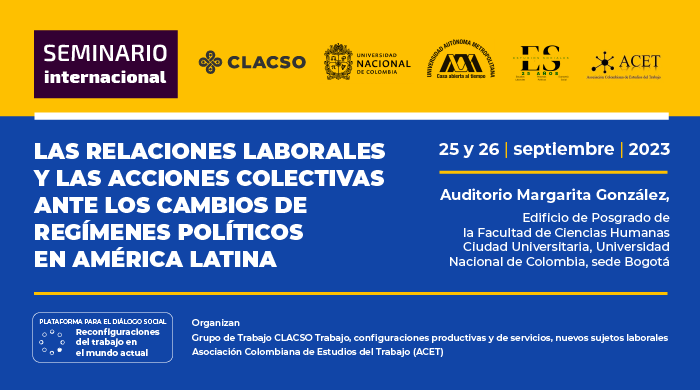

International Seminar: Labor Relations and Collective Action in the Face of Political Regime Changes in Latin America
September 25 and 26, 2023 | Hybrid format
Margarita González Auditorium, Postgraduate Building of the Faculty of Human Sciences
University City, National University of Colombia, Bogotá campus
The CLACSO Working Group on Labor, productive and service configurations, new labor subjects, together with the National Congress of the Colombian Association of Labor Studies (ACET) , with the support of the National University of Colombia and the Metropolitan Autonomous University (Mexico), invite you to participate in the International Seminar: Labor relations and collective actions in the face of changes in political regimes in Latin America.
The 21st century has witnessed political regime shifts in Latin America: the rise of progressive governments, followed by the rise to power of right-wing coalitions, and populist governments that have reinstated neoliberal policies and criteria in the areas of labor and social security, leading to increased precariousness. This places the role of the state, unions, management, and other organizations in labor relations, production, and service structures at the center of the debate. Indeed, there is a resurgence of labor and union issues in Latin America that warrants an assessment of our current situation and future direction in light of these changes.
Thus, after more than 30 years of neoliberalism being established in the region, it becomes important to re-examine and debate these issues and problems from the current political context. This objective is central to this seminar.
The first seminar convened by the CLACSO Working Group on Work, productive and service configurations, new labor subjects, will be held on September 25 and 26 in a hybrid format in the city of Bogotá, Colombia, within the framework of the National Congress of the Colombian Association of Labor Studies (ACET).
It is expected to account for the changes in labor relations with respect to the new situation (economic, political and labor context) of each country; in relation to the actions of the classic actors in labor relations: management, the State and unions.
PROGRAM
September 25
9:00 to 9:45 am | Opening
Marcela Hernández Romo and Maria Aparecida Bridi, coordinators of the CLACSO Working Group on Work, productive and service configurations, new labor subjects
Pablo VommaroDirector of Research at CLACSO
Natalia GianatelliResearch Coordinator at CLACSO
Diana Soler OsunaPresident of the Colombian Association for Labor Studies
They are present at the inauguration.
Carlos Guillermo ParamoDean of the Faculty of Human Sciences of the National University
Hiller Hernández MuñosDirector General of the National Trade Union School
Juan Nicolás Escandón HenaoDirector of Fundamental Rights, Ministry of Labor
10:00 to 12:00 pm | TABLE 1
José Ricardo Ramalho, Roberto Véras de Oliveira and María Aparecida Bridi (Brazil): Work and union in Brazil: an agenda of setbacks and a hope of hope
Marcela Hernández (Mexico): Labor Reform in Mexico: A New Labor and Union Configuration?
Juan Carlos Celis Ospina (Colombia): The world of Colombian work: conflicts, recognition and reforms in the first year of the government of change
Julio Cesar Neffa (Argentina): The structural framework within which labor relations develop
Mariela Quiñones (Uruguay): Reconfiguration of labor relations and union action in the context of the Uruguayan government's "turn to the right"
11:15 to 12:00 am | Debate
12:00 to 14:00 pm | Lunch
2:00 PM to 14:00 PM | TABLE 17
Antonio Aravena Carrasco (Chile): The Chilean trade union model and the discussion on sectoral bargaining
José Dari Krein (Brazil): Structural characteristics of the labor market and its contemporary challenges in Brazil
Cecilia Senen González (Argentina): Labor relations, unions and collective action in Argentina. A sectoral analysis in times of pandemic
Luis Fernando Castro Lopez (Bolivia): The perspective of the factory trade union movement in a context of economic recession and the advance of labor flexibility in Bolivia
Pedro Amaury Miranda Bello (Mexico): Outline of new union trends in Mexico, international opportunities and limitations: empirical evidence through the new Collective Bargaining Agreements
Francisco Eduardo Pucci Garmendia (Uruguay): Collective action in the new forms of work in contemporary Uruguay
11:15 to 12:00 am | Debate
16:15 to 17:00 pm | Meeting of the CLACSO Working Group on Work, productive and service configurations, and new labor subjects
September 26
9:00 to 12:00 am | TABLE 3
Hector Lucena (Venezuela): Labor relations and power
Juan José Morales Márquez (Mexico): Trade union corporatism as a means of controlling the workers' struggle and legitimizing political power in Mexico
Ana Natalucci and Ernesto Pablo Mate (Argentina): The working class in Argentina. Experiences of work, collective action and labor institutions between 2011 and 2019
Patricia Rocha Lemos, Andréia Galvão and Patrícia Vieira Trópia (Brazil): Collective organization strategies of caregivers and caregivers in crisis situations
John Fredy Piragauta (Colombia): Labor narratives in times of political change: collective voices and resistance in Latin America
Andrea Torres, Jazmin Goicoechea and Alejandra Rivera (Peru): Trade union organization of working women as an alternative of resistance against neoliberalism
10:30 to 12:15 pm | Debate
12:15 to 14:15 pm | Lunch
14:15 to 17:00 pm | Meeting of the CLACSO Working Group on Work, productive and service configurations, and new labor subjects
ORGANIZE
CLACSO Working Group on Work, Production and Service Configurations, and New Labor Subjects
Colombian Association of Labor Studies (ACET)
SUPPORT
National University of Colombia
Metropolitan Autonomous University, Mexico
Postgraduate studies in Social Studies, Labor track



