
International Open Access Week 2026
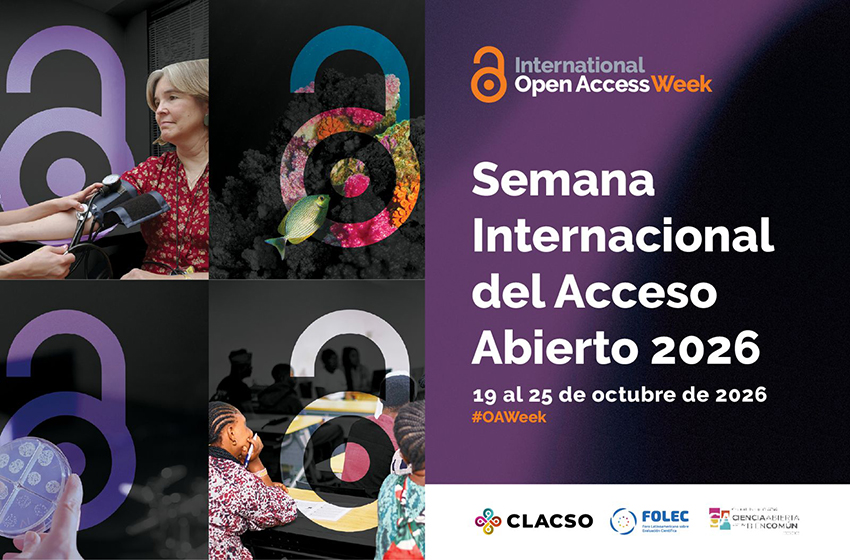
International Open Access Week “ The cost of knowledge ” is celebrated from October 19 to 25.
The specific theme of the CLACSO conference is: “ Privatization, commodification and precarization of the common goods of knowledge: the costs in the Global South ”.
CLACSO's participation takes place from Monday, October 19th to Friday, October 23rd in five 90-minute panels, one per day, from 9 to 10:30 Mexico time | 10 to 11:30 Colombia and Peru time | 12 to 13:30 Argentina and Brazil time.
Organized by: Latin American Council of Social Sciences, Latin American Forum for Scientific Evaluation (FOLEC) and CLACSO Working Group “Open Science as a Common Good”.
The Scholarly Publishing and Scholarly Resources Coalition (SPARC) poses the slogan as a question about who pays for knowledge and who benefits: corporate concentration and commercial control of scientific communication, invisible human costs (peer review, unpaid editing), global inequality in knowledge production, use of research to train artificial intelligence systems without consent or compensation, and environmental costs of digital infrastructure.
Addressing the price of knowledge from the perspective of the commons involves analyzing the social, epistemic, and exclusionary costs that the Global South assumes when adopting commercial publishing models.
For decades, Latin America and the Caribbean have maintained the world's most consistently non-commercial scientific communication system: journals and repositories that do not charge for reading or publishing, managed by universities and public institutions. This trajectory is now under pressure. International Open Access Week 2026 proposes asking how much it truly costs to produce and sustain knowledge, and who bears those costs. From the region's perspective, this question demands a contextualized response: the costs are not only financial, and they are not distributed neutrally.
First cost: privatization
Infrastructures that were once public or community-owned—repositories, publishing systems, indexed databases, evaluation platforms—are now in private hands; data produced with public funding is being restricted; scientific output is being used to train artificial intelligence systems without the consent or compensation of its authors and institutions, while platforms track the reading habits of researchers. The cost here is not measured by the price paid, but by the lost ability to make decisions about one's own infrastructure.
Second cost: commodification
The commodification of flow and value operates even when formal ownership doesn't change hands. Application publishing charges (APCs) and transformative agreements shift the barrier from the reader to the author; commercial metrics and rankings define what gets published, in what language, and what is considered valid; and open access diamond programs that outsource processes to external providers reintroduce market logics under the guise of being non-profit. Added to this is the less visible human cost: writing, peer review, editing, and editorial management constitute a massive, unpaid subsidy from public academia to private profitability. No position of neutrality toward these dynamics is truly neutral: the absence of a stance reinforces the patterns that sustain them.
Third cost: precarity
The precariousness of scientific and university systems, teaching, and research is exacerbated by the rise of far-right governments in the region. This is not just another cost on the list: it is the condition that makes the other two possible. An underfunded scientific system cannot sustain its own infrastructure and ends up depending on commercial platforms; a precarious research community is unable to challenge the evaluation criteria used to measure it. Privatization, commodification, and precarity are intertwined, and that is why defending science as a common good is not a technical agenda but a political and collective task that simultaneously demands sovereign infrastructure, cooperative funding models, and decent material conditions for those who produce knowledge.
CLACSO Programming
Five 90-minute panels, one per day – Free activity with mandatory registration
– Monday 10/19 · [Opening] Privatization, commodification and precarization of the common goods of knowledge
9 to 10:30 a.m. Mexico | 10 to 11:30 a.m. Colombia and Peru | 12 to 13:30 p.m. Argentina and Brazil
Panelists:
• Pablo Vommaro (Executive Director of CLACSO)
• Arianna Becerril García (UAEM, Redalyc/AmeliCA and GT “Open Science as a common good”)
• David Oliva Uribe (Senior Consultant, Communication and Information Sector, UNESCO)
Moderation: Fernando Ariel López (UMET, CITRA-CONICET and GT “Open Science as a common good”)
– Tuesday 20/10 · Geopolitics and internationalization of open science
9 to 10:30 a.m. Mexico | 10 to 11:30 a.m. Colombia and Peru | 12 to 13:30 p.m. Argentina and Brazil
Panelists:
• Daniela Perrotta (CLACSO – FOLEC)
• Dominique Babini (CLACSO and GT “Open Science as a common good”)
• Fernanda Beigel (CONICET and GT “Open Science as a common good”)
• Guido Riccono (CONICET and GT “Social, Mobile and Politicized Science”)
Moderation: Luis Adolfo Ortega Granados (University of Guadalajara and GT “Open Science as a common good”)
– Wednesday 21/10 · The costs of epistemic and technological sovereignty
9 to 10:30 a.m. Mexico | 10 to 11:30 a.m. Colombia and Peru | 12 to 13:30 p.m. Argentina and Brazil
Panelists:
• Gabriel Vélez Fourth (University of Antioquia and GT “Open Science as a common good”)
• Esther Juliana Vargas Arbeláez (Francisco José de Caldas District University and GT “Open Science as a good
common")
• Lautaro Matas (The Reference)
• René Ramírez Gallegos (GT “Latin American social thought and theory and university internationalization”)
Moderation: Martín Tena (University of Guadalajara and GT “Open Science as a common good”)
– Thursday, October 22nd · AI and research data. Extractivism of the digital commons
9 to 10:30 a.m. Mexico | 10 to 11:30 a.m. Colombia and Peru | 12 to 13:30 p.m. Argentina and Brazil
Panelists:
• Gustavo Archuby (UNLP, Argentina)
• Fernando Ariel López (UMET, CITRA-CONICET and GT “Open Science as a common good”)
• Isabel Jiménez Becerra (Doctorate in Education and Territory from the UGC and GT “Appropriation of digital technologies and intersectoralities”)
• Andrés Tello (GT “Digital Territories and AI: Political and Subjective Challenges”)
Moderation: Laura Rovelli (CONICET and GT “Open Science as a common good”)
– Friday 23 · Science policies within the framework of open science as a common good
9 to 10:30 a.m. Mexico | 10 to 11:30 a.m. Colombia and Peru | 12 to 13:30 p.m. Argentina and Brazil
Panelists:
• Violeta Vázquez Rojas Maldonado y Pedro Ovando (SECIHTI, Mexico)
• Maribel Cabrera (UNE, Union of Spanish University Publishers)
• Ricardo Casate Fernández (Ministry of Science, Technology and Environment of Cuba and Working Group “Open Science as a common good”)
• Sayri Karp (EULAC)
• Guillermo Chavez (Latindex UNAM)
Moderation: Fernanda Pampín (CLACSO)
Live broadcast via Zoom from the Autonomous University of the State of Mexico - UAEMex
Languages: Spanish and Portuguese.
Call for transmission nodes
Universities, research centers, and institutions in the region are invited to become TRANSMISSION NODES. The proposal is that the event serve as input for each institution to convene its own academic and scientific community, participate in the live broadcast of the panel discussion, continue the debate in person, and share its institutional progress on the topic.
Inquiries to: [email protected]

