
“Social Security in a growth model with social inclusion”
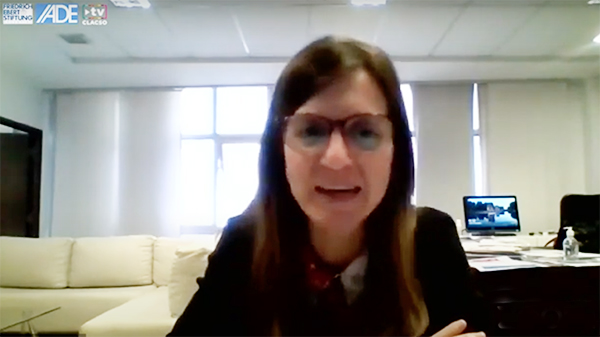
On August 4, the Latin American Council of Social Sciences (CLACSO), the Friedrich Ebert Foundation, IADE, and the CLACSO Working Group on Social Security and Pension Systems organized the Third Meeting: “The Social Challenge in Times of Pandemic: Structural Changes in Welfare Regimes?” The speakers were: Fernanda Raverta, Executive Director of ANSES Argentina; Simone Cecchini, Officer in Charge of the Social Development Division of ECLAC; Karina Batthyány, Executive Secretary of CLACSO; and Svenja Blanke, FES Representative for Argentina and Director of the journal “Nueva Sociedad.” The moderator was Nicolás Dvoskin of the Argentine Institute for Economic Development.
Fernanda Raverta spoke about the current social security system in her country and recalled certain past policies.
“To characterize the Social Security system in Argentina and, in this time, to highlight its value –Raverta stated–, let us remember that it has a history with at least two major milestones. One that has to do with having put the boys and girls of Argentina on an equal footing, those sons and daughters of salaried workers with those sons and daughters of unemployed workers. And this has to do with a measure that was taken more than 10 years ago, when the President of the Nation, Cristina Fernández de Kirchner, established, through the signing of a decree, the universal child allowance, later also including the pregnancy allowance. This puts Argentine boys and girls of working parents on an equal footing with boys and girls of unemployed parents, because there is a family allowance that this agency also implemented that is related to the family wage of workers. And this is not insignificant: in Argentina there are more than 2 million recipients of the universal child allowance and about two million recipients of family allowances, which means that in Argentina – at least in terms of food assistance for children from the third month of conception until 18 years of age – they are considered and linked to the State through a cash transfer benefit that, in some way, sets a starting point in the analysis of Social Security. Obviously, these issues that I am pointing out will characterize a time and a path for each of these benefits in an economic model of economic growth with social inclusion, a model where work and production are at the center of the stage, and not an economic model where financial speculation ends up ordering macroeconomic decisions. These policies have different scopes. But what must be said is that we start from the premise that in Argentina, the boys and girls of Argentine families have a link with Social Security through a right that is the universal child allowance or the family allowance. It should also be mentioned that during the government of then-President Néstor Kirchner, those people over 60 years of age in the case of women and 65 years of age in the case of men were included, especially at times when the economic model meant that Argentina did not meet this premise we mentioned of economic growth and social inclusion, they did not have their contributions and were left unprotected in terms of Social Security and our pension system. The decision to include more than 98% of people of retirement age who would not have been able to due to requirements, basically due to issues beyond the control of those men and women, namely that they did not have employers who paid their contributions while they were working, also established that starting point of Social Security that we are currently experiencing this pandemic, which is undoubtedly a minimum standard of rights for those under 18 and those over 60 and 65.”
If you would like to receive more information about CLACSO's training programs:
[widget id=”custom_html-57″]
to our email lists.

