
The PISAC COVID-19 book was presented
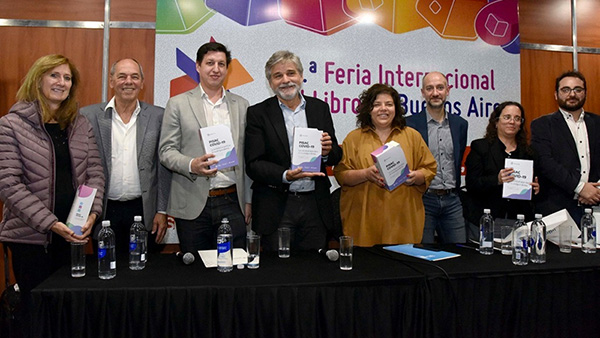

On Wednesday, May 10, the book “PISAC COVID-19: Argentine Society in the Post-Pandemic Era” was presented at the Buenos Aires International Book Fair. Among those present were the Minister of Science, Technology and Innovation, Daniel Filmus; the Argentine Minister of Health, Carla Vizzotti; the President of the National Agency for the Promotion of Research, Technological Development and Innovation (R&D&I), Fernando Peirano; and the Director of Publications at CLACSO, Fernanda Pampín.
The three volumes of the work bring together the conclusions, contributions and proposals of the Social Sciences from the 19 investigations carried out during the pandemic by some 6.700 researchers from all over the country who developed 90 network project proposals to investigate the new scenarios from the perspective of the Social Sciences and Humanities.
Daniel Filmus He stated: “One of the main conclusions of the pandemic is that the State was present, but also that it wasn't enough. This was because the State we inherited from Macri's neoliberal government lacked the necessary conditions to address demands at different levels. A State with present policies isn't enough; we need to know how to implement them, how to solve our people's problems. Social scientists have valuable contributions to make in this process of knowing how to reduce the inequalities that the pandemic exacerbated.”
The Minister of Health of the Argentine Nation, Carla VizzottiHe highlighted the importance of the publication of this book and emphasized that in the midst of the greatest humanitarian crisis of the last one hundred years, “the State was present and coordinating. In that sense, universities; researchers; scientists, were reformulated to respond to the pandemic.”
For his part, the president of the R&D&I Agency, Fernando PeiranoHe emphasized that “the Pisac COVID experience fills us with pride and leaves us better prepared to face a difficult battle. To confront head-on the adversaries of our country's development, who often express themselves directly in the political arena, portraying a country that doesn't need science and technology, a country where needs must be met by the market.”
At the same time, Fernanda Pampín He stated that “these three volumes appear as the tangible result of a vast collaborative effort, the product of the work of so many public agencies, researchers from across the country, and the academic community of more than forty national universities over more than three years. Seeing all that work embodied in a book, available to society, is a tremendous satisfaction and an achievement that must be recognized as a testament to teamwork, and for which I want to congratulate and thank the Ministry of Science, Technology and Innovation, the National Agency for Scientific and Technological Promotion, and the PISAC program.”
He added that “CLACSO’s editorial policy seeks to establish itself as a platform for the circulation of critical Latin American and Caribbean knowledge, and for this reason, one of our guiding principles has been, is, and will continue to be open access, a principle that recognizes that research funded with public resources, such as this, must be available to the society that subsidizes it. We believe that making volumes like the ones we are gathered here today freely available to society is a tool that works against the commodification of knowledge and in favor of its democratization, and of more equitable, contextualized, pluralistic, and inclusive models of academic publishing.”

The meeting was also attended by Mariano Hermida, president of the Council of Deans of Faculties of Social Sciences and Humanities (CODESOC); Sandra Carli, member of the Advisory Committee of the PISAC COVID-19 call; and moderated by Guido Giorgi, Chief of Staff of the I+D+i Agency.
The PISAC COVID-19 call was a call organized by the I+D+i Agency –with support from the Ministry of Science, Technology and Innovation and the Council of Deans of Social Sciences and Humanities (CODESOC)– for collaborative research projects in Social Sciences and Humanities to generate new knowledge focused on the study of Argentine society during the COVID-19 pandemic and post-pandemic.
The initiative had the special participation of an Academic Committee made up of researchers who shaped the foundations of this call and collaborated with the monitoring of the projects: Sandra Carli, Mario Pecheny, Juan Ignacio Piovani, Andrés Ponce de León, Lizzie Wanger, Patricia Breppe and Gisela Spasiuk.
If you would like to receive more information about CLACSO's training programs:
[widget id=”custom_html-57″]
to our email lists.

