
Ancestral knowledge and multilingualism in the Caribbean in higher education
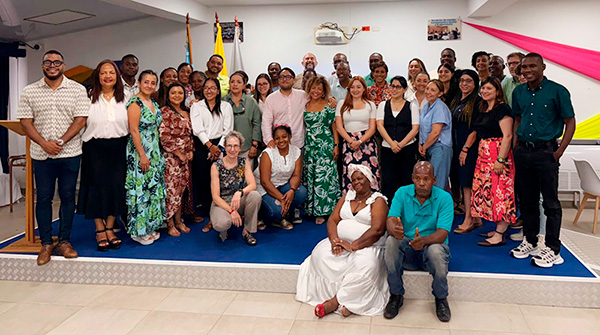

From December 12 to 14, academic leaders, Raizal communities and government representatives – with CLACSO represented by its Academic Secretary Pablo Vommaro and by Camila Downar from the Directorate of Training and Postgraduate Network – came together to discuss an inclusive, innovative and culturally representative educational model in San Andrés, capital of the Colombian archipelago of Providencia and Santa Catalina, in what was called “ International Meeting: Ancestral knowledge and plurilingualism of the Caribbean in higher education: Learnings and perspectives ”.

The call for proposals established that the Caribbean, known for its cultural, linguistic, and ethnic diversity, is the result of a complex history of encounters and conflicts, marked by processes of colonization, resistance, migration, and transculturation. These processes have shaped a mosaic of ancestral knowledge and cultural practices that have resisted hegemonic impositions and that today represent an invaluable asset for its communities. However, global dynamics and dominant models of development and education have tended to marginalize these identities, homogenizing educational approaches and relegating ancestral knowledge and linguistic diversity to a secondary status.

Higher education in the region, particularly in territories like San Andrés, Providencia, and Santa Catalina, faces tensions between the demands of a globalized world and the need to preserve and strengthen their cultural identities. These islands, historically inhabited by Raizal communities, have been the scene of struggles for the recognition of their language, their history, and their rights as distinct peoples. San Andrés Creole, along with the cultural expressions and ancestral knowledge of these communities, represents not only a legacy but also a tool for educational and social transformation.
However, the imposition of dominant languages, educational policies disconnected from local contexts, and the lack of a critical and intercultural approach in educational processes have generated significant challenges. These include the progressive loss of Indigenous and Creole languages, the invisibility of local epistemologies in university curricula, and the lack of public policies that promote inclusive, equitable, and culturally relevant higher education.

In a world where globalization and internationalization tend to prioritize dominant languages and knowledge systems, the Caribbean has both the opportunity and the responsibility to build a higher education system that not only responds to global dynamics but also recognizes and values the richness of its ancestral knowledge and linguistic diversity. This requires a critical approach that questions the power structures inherent in traditional education systems and promotes transformative models of higher education based on the dialogue of knowledge systems and respect for local cultures.
In this context, the International Meeting: Ancestral Knowledge and Multilingualism in Higher Education in the Caribbean was conceived as a space for critical reflection, multicultural dialogue, and collective action. It sought not only to highlight the tensions and challenges facing the region but also to develop proposals for integrating ancestral knowledge and multilingualism as central elements of higher education in the Caribbean. Furthermore, it envisioned a framework for regional and international cooperation that fosters strategic alliances, promotes academic mobility, and strengthens cultural identities as tools for social, cultural, and sustainable development.
The thematic axes were:
-Multilingualism in higher education: Challenges, opportunities and its role in regional integration.
-Ancestral knowledge and higher education: Recognition and appreciation in academic contexts.
-Strategic alliances in higher education: Academic mobility and regional cooperation for the development of the Caribbean.
If you would like to receive more information about CLACSO's training programs:
[widget id=”custom_html-57″]
to our email lists.

