
Democratic breakdown and constitutional impeachment proceedings
When the power of the Demos burst onto the Athenian government (6th and 7th centuries BC), it did so within a patriarchal context dominated by the self-proclaimed " good classes" : the class of the aristoi , or aristocrats, supposedly owners of virtue ( areté ), and the class of the oligoi , or oligarchs, owners of wealth (olive groves). Breaking with this division of society into patrician and plebeian classes, Democracy has forged its path to the present day through a dual movement of equality and pluralism. This democratic rupture is not a mere moment of popular political violence, but a complex network of irruptions ranging from demands for rights to the communal control of society's overall productive forces.
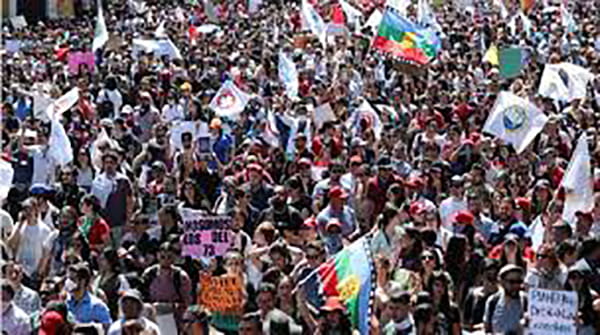
Hence, the current rebellion of the Chilean people has demonstrated that the worst breakdown of our democracy, which occurred between 1973 and 1990, cannot be overcome through a mere gradual transition without an effective democratic rupture . Only such a democratic rupture can break down the institutional barriers designed to perpetuate the neoliberal model now being challenged.
As stated after 2011 in the Political Line of the Libertarian Left party (now part of Social Convergence), the democratic rupture is, first and foremost, the crossing of a threshold by popular movements. The threshold that separates society from politics. This transgression is initially paradoxical, as it implies recognizing that the separation between society and politics is intentionally maintained by the latter. It is not an evolutionary achievement of society that prevents it from acting politically, but rather a specific institutional configuration of politics that perpetuates this impediment.
Some fundamental objectives of the current Chilean democratic rupture include dismantling what Fernando Atria has called institutional “locks”: supermajority quorums required by the constitution that prevent the enactment of, for example, a decent labor code or a law on political parties and popular elections that would decisively combat the nefarious clientelist networks (already even involved with drug trafficking). Another fundamental objective of the Chilean democratic rupture is to eliminate the reactionary third chamber function exercised by the Constitutional Court. Finally, the most strategic objective of the Chilean democratic rupture is to develop a constituent power (in addition to a new constitution) capable of abolishing the neoliberal subsidiary state, replacing it with a new state founded on nationalistic, territorial, cultural, and other types of communalities. These communalities, which govern the state, imply a genuine republicanism in which public goods are produced by the public sector. Communal republicanism that is not restricted to the state bureaucratic apparatus (essential for reconstruction after the neoliberal catastrophe), as caricatured by the extremists of price theory, but opens itself to communities and assigns a serious and relevant complementary role to markets.
The tactical and strategic notions of democratic rupture will be discussed in a few theses later; however, it is evident that the democratic radicalism of the Chilean popular movements is the fundamental compass for these notions. This is not about sacralizing horizontality and assembly-based decision-making, but rather about recognizing that, despite all predictions, these practices have overcome numerous obstacles to become the awakening of a different kind of politics.
From the movements for democratic rupture have emerged principles such as pluralism and procedures such as universal suffrage that cannot be eradicated without democracy itself dying out. However, this does not mean that pluralism and universal suffrage alone are sufficient for democracy to exist. This analysis has characterized the commitment of the Chilean left to democracy, and especially that of the anti-Stalinist revolutionary left rooted in libertarian Marxism and, more recently, in feminism.
The Chilean Revolutionary and Libertarian Left has never sought to abolish principles such as representation and the delegation of power; it has simply demonstrated that these principles are insufficient to sustain democracy in complex societies. This is precisely the opposite of the liberal view, which argues that the complexity of modern societies prevents democracy from progressing beyond representation, the delegation of power, electoral procedures, and parliamentary pluralism.
The rupture movement that Democracy enacts in patriarchal and class-based societies like Chile stems from concrete history. Therefore, the libertarian critique of perpetual gradualism and the idea of democratic transition does not imply that this rupture is achieved primarily through popular political violence. In Chile, today more than ever, we have solid evidence to prove that perpetual gradualism exacerbates political violence instead of preventing it. Direct mass action is thus not only more effective as a form of protest, but also prefigures the communal-republican subjectivities capable of sustaining the forms of communal life necessary for a socialist horizon.
Therefore, in a deeply patriarchal and class-divided society like Chile, the break with inequalities and the uniformity of life operates as the very soul of democracy. Specifically in the Chilean case, the democratic rupture functions as a constant challenge to the capacity of the neoliberal model to produce justice, including the destabilizing challenge expressed today in social mobilization and in the multitude of actions that include the constitutional accusation against the government.
Despite certain colonial undertones in the slogan “For a New Social Pact,” it lends a radical legitimacy to the initiatives aimed at removing the government. President Piñera’s government has not only blocked the new social pact but has also violated the previous, shameful pact. That earlier transitional pact—which some of us consider shameful and vulgar—stipulated: we may be governed by tribunes subservient to neoliberalism and patriarchy, but not by those who bear direct political responsibility for grave human rights violations.
In these days when the "Never Again" of the Chilean center-right is shattering into a thousand pieces, the democratic rupture is a necessary condition to stop a new breakdown of Democracy still built on the persistent institutional locks of the previous breakdown.
If you would like to receive more information about CLACSO's training programs:
[widget id=”custom_html-57″]
to our email lists.

