
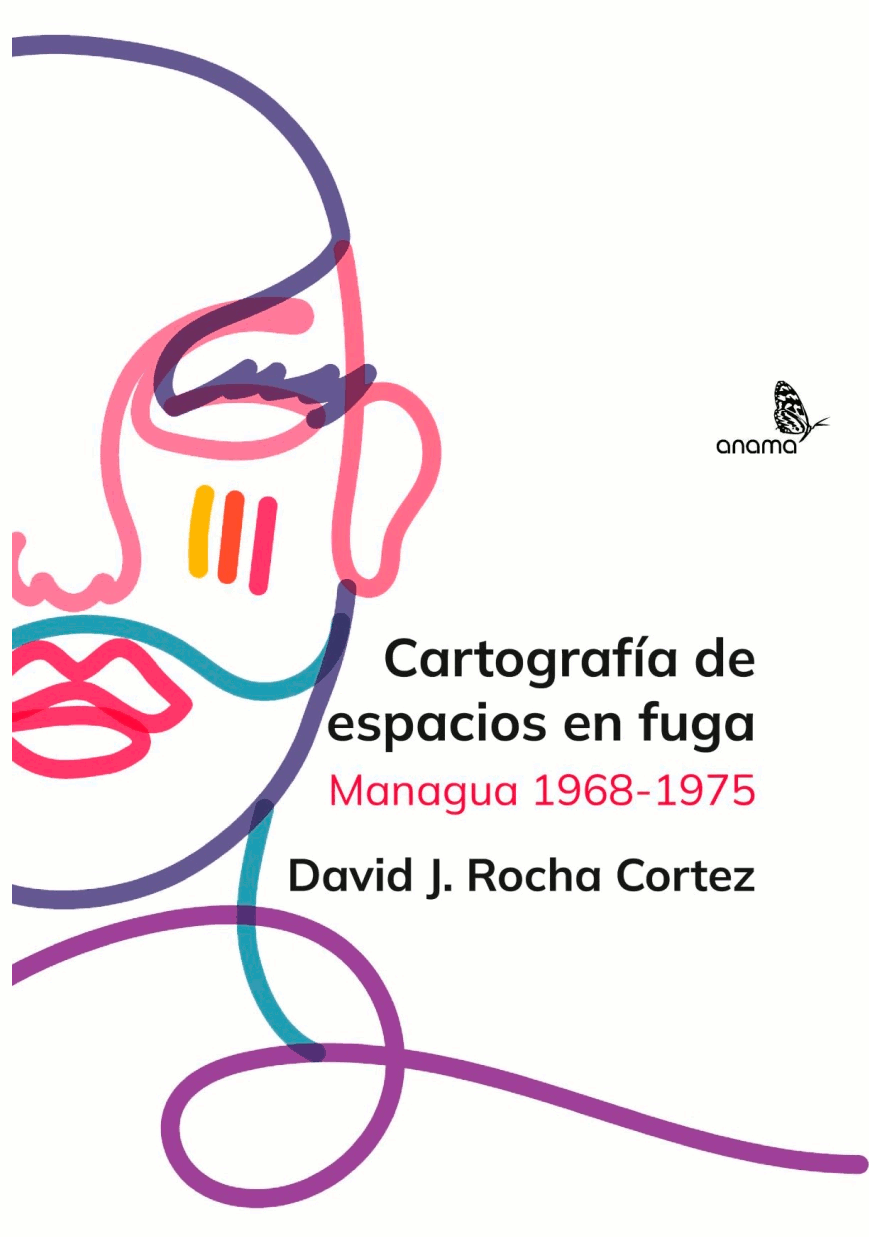
Rocha, David (2022). Cartography of spaces in flight. Managua 1968-1975. Managua: Anamá Ediciones. 144 pages
Amaral Arévalo
State University of Rio de Janeiro, Brazil
[email protected]
Central America is a region characterized by marginalization in LGBTIQ+ academic studies, although in recent years it has overcome the precariousness of research in all its forms, despite the establishment of new tyrannies and dictatorships. It is in this context that a number of Central American and Central Americanist researchers have undertaken the quixotic task of transforming this space into a territory for searching for and reconstructing the memory of sexual and gender alterities. David Rocha's book, Cartography of Spaces in Flight , is representative of this process.
Rocha casts a bawdy gaze upon the city of Managua, with the goal of “historicizing our narratives and relating past and present to see ourselves as a whole” (p. 12). Through a desiring and erotic cartographic wandering, he finds bodies, subjectivities, voices, and memories to classify and reconstruct the spaces of homosocialization in the city of Managua between 1968 and 1975 and to analyze the subjects/users of these spaces and their relationship with the sociopolitical context.
“The place that the memories of homosexuals have in cities” (p. 12-13), is at the same time a methodological question that guides and an epistemic question that confronts that polycentric, mobile, segregated, disordered, walled physical network of Managua, which has placed the gays behind, on the margin of the city, and, consequently, in the oblivion of the social imaginary and of the urban memories of the city.
The rescue of the dirty memories of the official and dominant discourse of the city is inscribed in the time between 1968 and 1975. This historical moment is representative for Managua because of the physical transformations as a consequence of the 1972 earthquake. In this context, Rocha shows that the representation of the spaces of homosocialization and the subjects/users of these was different before and after the earthquake.
Regarding the sociopolitical context, the research is situated within the Somoza dictatorship. At this point, Rocha exposes a separation of identities: the "cochón" (a derogatory term for gay men) and discreet masculinities, which, as he will demonstrate in the different chapters, have points of connection but are treated differently by those in power. The "cochones"—markedly feminine homosexual subjects, most often living in precarious economic circumstances—will be the most visible subjects, constantly repressed, and some of their memories will become inscribed in the socio-urban imaginary of the city, as in the case of La Sebastiana.
As for discreet masculinities, homosexuals with a masculine performance , thanks to their public pact with heteronormativity, they will be able to maintain their class privileges, carry out their sexual practices with other men clandestinely; but in official memory, their dissident sexual practices will enter the field of silence, oblivion and invisibility.
In the "cochona cartography," Rocha manages to construct an initial map of urban homosexual culture between 1968 and 1972. He makes visible spaces categorized as abject in the urban discourse of Managua. This action is a "symbolic way of constructing reparation and justice" (p. 39) for sexual alterities. This cartography establishes three categories of urban spaces of homosociality.
The first category: Brief spaces . These were located in marginalized areas and, in many cases, connected to sex work. These spaces can be characterized as a periphery, consisting of geographical meeting points (Darío Park), entertainment venues (El Sapo Triste), and marginal establishments such as bars (Bar Angelita; El Hippie). In these places, visibility was restricted to homosexual individuals, who mingled with other patrons.
The border , in this context, represents a meeting place, a boundary, and simultaneously a point of connection. In this instance, the border alludes to the La Tortuga Morada nightclub. This space was shared by gay and straight men. Their point of connection lay in their shared social class. The nightclub was the brainchild of Roberto Rapaccioli, an openly gay young man. It was closed in 1970 due to police pressure.
The central point on the map, yet simultaneously a marginalized area of the city, is Swan Lake, derided as Duck Pond to denote its marginalization and the presence of homosexuals there. This was a dual space: by day it functioned as a soup kitchen, and by night as a bar, which included a space for sexual encounters between men. The Pond was the most important space for homosocialization in pre-earthquake Managua. It was the only visible and openly gay bar, frequented by people from different social classes.
This desiring cartography reveals the existence of different spaces for homosocialization and encounters between peers of the same identity. This existence may have generated a false impression of inclusivity within Managua. This fragile balance of restricted visibility would be shattered when a moral panic erupted following the public denunciation of Bernabé Somoza's presence in Charco de los Patos. The Somoza dictatorship responded forcefully to maintain intact the pure citizenships and the hegemonic masculinity that can be characterized as heterosexual, white, and virile, and which is assumed to be the model for all of society.
To maintain the purity of this model, the stain that taints it must be criminalized and exterminated. The transvestites suffered a process of criminalization that consisted of the capture and public display of transvestite homosexuals in the dictatorship's media outlets, since "Sexual immorality will be defined by the feminization of the male body" (p. 74). In this process of sanitizing the "deviant city" (p. 72), the Charco de los Patos (Duck Pond) was closed. Simultaneously, the 1972 earthquake would reconfigure the spaces of homosocialization and further segment homosexual individuals.
After the earthquake, the rubble in downtown Managua was redefined as precarious geographical spaces for sexual encounters ( cruising ) and sex work. The ruins of the Margot Cinema, the National Park, the cathedral, the San José Church, among others, became spaces occupied by sexual minorities. These areas represented greater risks of violence for those who wandered through these abandoned spaces. In this process of reconfiguration, a segmentation of gay men emerged. Older men continued to use the rubble, as a kind of nostalgia for the former spaces of homosocialization that had existed there; in contrast, younger men left the city center and began to use the spaces that opened up along the Masaya highway. This generational division must also consider the characteristics of social class and gender identity and expression.
One of the main findings of the "cochona" cartography carried out by Rocha lies in making visible that within the dominant official memories there is an omission of the persecution of homosexuals between 1968 and 1975. To transgress this one-sided memory, the category of "Underground Memories" is proposed to present a polyphony of voices and ways of remembering the silenced memories of homosexual subjects in Managua through the recovery of the spaces of homosocialization, or as Rocha calls them: Spaces in flight.
David Rocha's text shows us how the memories of sexual alterities, like their bodies and identities, are at the mercy of extermination, censorship, and oblivion; as in the case of La Sebastiana, who, despite having a place in the social imaginary of Managua, would have been forgotten were it not for Rocha's research, since she died months after he interviewed her. Recovering the transgender memories of Nicaragua and Central America from the recent past is a race against time that we must not postpone.

