
Global risks in declining systems. In light of COVID-19
Nivaria Ortega Monche1
Among the global risks identified by Time magazine for 2020 were environmental concerns, the reshaping of US-China relations through the lens of technological leadership, and the discontent of Latin America's unsatisfactory democracies. Those responsible for the study probably never suspected that a pandemic would plunge the entire world into unprecedented uncertainty in less than two months. Authors like Ulrich Beck have asserted that risk is the defining characteristic of contemporary societies. It is precisely at this moment that the West seems to have grasped the full extent of that definition.
In the globalized, interconnected, and interdependent world of the 21st century, risks are as vast as the world that sustains them. The adage of the so-called "butterfly effect" states that the flap of a butterfly's wings in Sri Lanka can cause a hurricane in the United States. Contemporary societies seem arranged like dominoes: it's impossible for one to fall without affecting the entire board. The word "risk" evokes one side of a coin, the other being uncertainty. My purpose here is to reflect on some of the most relevant manifestations of this uncertainty and its impact on democratic systems already in decline.
To do this we will analyze three aspects: the tension between sovereignty and supranationality, the contradictions involved in combining security and democracy, as well as the dilemma between capitalism and ecological sustainability.
The tension between state sovereignty and supranationality can be traced back to the very birth of the state as a leading actor in international relations with the Treaty of Westphalia in 1648. During the following centuries, there were numerous attempts, almost entirely violent, to impose supranationality in Europe. It wasn't until the 20th century that three peaceful experiments embracing a supranational vision emerged: the League of Nations, which failed due to the rearmament of national responses to the tensions arising after the fragile peace of Versailles; the United Nations with its various programs; and the European Union, the original and unique attempt at an agreement involving the partial transfer of sovereignty. From its inception, the Union has progressed under a precarious balance between those members who favored a primarily economic agreement and those who advocated for unified responses to traditionally sovereign issues such as fiscal policy or even the possibility of establishing a European army. After Britain's departure on January 31 of this year, it seemed—according to the most optimistic pro-Europeans—that progress toward the desired supranationality was finally underway. The coronavirus crisis has shattered this optimism. The rhetoric has hardened and shifted geographically. On one side, Italy, Spain, and Portugal seem almost to be begging for Eurobonds, appealing to the possibility of issuing European debt; on the other, the North, currently represented by Mark Rutte.
During the parliamentary meeting in March 2020 where an extension of the state of emergency in Spain was requested, some members of parliament called for the creation of an international authority to act against the present and future pandemics, a blind, or not so blind, slap in the face to the World Health Organization (WHO), created under the auspices of the United Nations in 1948, and whose objective is "to achieve for all peoples the highest attainable standard of health, defined as a state of complete physical, mental and social well-being."2 World leaders issue a Manifesto for joint action against the pandemic3 They demand global leadership in the face of COVID-19 and urge a common supranational response. Until now, therefore, the WHO had never faced such a challenge. Its role, as stated in the manifesto, indicated that "We cannot expect it to depend exclusively on charitable donations."4 If in 72 years of existence it has not managed to position itself as a decisive supranational entity, it is time for it to do so or be relegated to a mere charity.
Churchill famously declared in one of his most famous speeches: “You were given the choice between dishonor and war. You chose dishonor, and now you shall have war.” At this moment, drawing a parallel, we can see the new tension, brought about by the pandemic, between national sovereignty and the socio-political chasm. This is not the last pandemic of the century, nor the last lockdown. Perhaps it is a reality we will have to get used to relatively frequently. The current pandemic costs lives; the uncertainty, perhaps, even more.
Another global risk we face today is the complex balance between civil rights and security. This is not a new problem. As early as the 17th century, Hobbes questioned how far a man would go to guarantee his security, understood as the security of his life, creating, with his answer, the most robust defense that absolutism has ever enjoyed. Human beings are willing to give up everything to guarantee their right to exist. This dilemma resurfaced in recent times with the 9/11 attacks. Civil rights were curtailed in the name of the desired Hobbesian security.
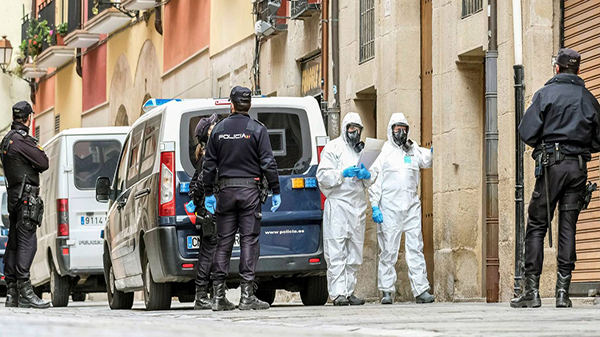
Spain is currently under a state of emergency, which some researchers and members of parliament have questioned as a "covert state of exception".5 and generally accepted without question by the vast majority of citizens in the name of life.
The law regulating states of emergency, exception, and siege states that the duration of the emergency will not exceed 15 days, except “with the express authorization of the Congress of Deputies, which in this case may establish the scope and conditions in force during the extension.” On the other hand, there is talk of the possibility of geolocating citizens via mobile phones in the name of security, guaranteeing their location, although this has not yet received a parliamentary response. In South Korea, this seems to have been successful in controlling the pandemic. It is surprising that Hobbes's ideas remain so relevant. Renouncing liberty for basic security, even a security that guarantees another right beyond life, is less contested today than it was years ago. But we live in post-guarantee democratic societies where the discussion, in the name of the rights it claims to defend, should always take place with the same forcefulness with which those rights are threatened, regardless of the underlying threat. It should not be forgotten that there are countries that do not regulate the intensity of exceptional situations and suspend rights under the sole possibility of a "state of exception".6 with the risks that come with not grading the exceptional circumstances. The uncertainty this tension creates seems to be leaning heavily toward security at this point. This is not surprising. What is unsettling is the lack of discussion on the matter.
Finally, let's consider some aspects of the dilemma between capitalism and a sustainable environment. Until just over a month ago, the escalating trade and technological tensions between China and the United States dominated the economic news. The tariff hikes, the attempt to re-domesticate US production, or at least move it out of China, and, ultimately, the increased trade uncertainty between two powers that seem intent on rewriting a bipolar economy in the technological sphere. However, the urgency of recent events has raised a question that, in January of this year, seemed irrelevant. When Italy and Spain decided to suspend non-essential aspects of their economies—in Spain's case, without clearly defining what constitutes essential—some authors, more literary than economic, began to weigh in.7 They have raised the possibility of capitalist collapse. This is not surprising, given the economic system whose health indicator is production, growth measured by the increase in Gross Domestic Product, and the suspension of production in two of the top 10 economies of the European Union.8 It is to induce a coma in two of the most powerful economies in the Union9 And relatively speaking, the world. The uncertainty this generates is brutal. Managing it is too. Countries like Sweden, the Netherlands, and Germany consider it unfeasible to pay the price of production suspensions, even at the cost of blaming Spain and Italy for a lack of foresight they themselves have also shown.
What this situation presents is unprecedented. It has nothing to do with the speculative crises of 1929 or 2008, nor with the economic crisis associated with World War II, where production was not the problem. What is being done temporarily, with the suspension of production, is to suspend the very essence of capitalism. The longer these economies remain in an artificial coma, the longer the subsequent recovery will take. The opportunities this situation presents range from the most utopian to the dystopian, encompassing both moderate and realistic scenarios.
The ideals can be focused on the unique opportunity this situation offers to question GDP and growth as a cross-cutting, fundamental, and guiding principle of the economy. The environmental movement, ecofeminism, and economists advocating for degrowth have been arguing for years about the long-term unsustainability of the system. Since the publication of the report *The Limits to Growth* in 1972, sponsored by the Club of Rome, the debate on this issue has moved from fringe circles to central positions in the public sphere.
Degrowth is a movement that advocates for a controlled reduction in economic production with the aim of harmonizing the balance between humanity and nature, and among human beings themselves. Its objective is to abandon growth for growth's sake: acreation.
The current situation does not represent a controlled decline; it is an almost total and temporary suspension. Therefore, we cannot analyze its effects from this theoretical perspective, but it does raise the possibility of rethinking theoretical growth and taking a realistic view of this trend. Are we prepared to live in a poorer Europe? Is capitalism the essence of the European Union, or is it a transcendent political project? Will we remain committed to the euro if we lose economic leadership?
The question is how far we are willing to go in betting on an environmentally unsustainable economic system and how much uncertainty, consequently, we are willing to endure in the abyss of the alternative.
Xavier Sampedro10 He argues that the three pandemics of the 20th century neither changed the world nor the economic system. It's difficult to imagine this one doing so, but the questions it raises and the speculations it generates are having an impact on a system already in decline.
Global uncertainty also looms over liberal democratic systems already in decline, characterized primarily by a crisis of representation. The cry of “they don’t represent us,” the slogan of the popular response to the 2008 economic crisis in Spain, aptly summarizes the perceived situation. Perfectly functioning mechanisms incapable of fulfilling their intended purpose. The European Union, in its White Paper on Governance11This model is a commitment to the 21st century, emphasizing interaction among various economic, political, and civic actors to define problems, find solutions, and sustain the institutions that make it possible. We cannot deny the efforts being made in this direction, but neither can we cease to question their progress.
Uncertainty can be managed in different ways. One approach seeks solid, albeit unrealistic, answers that help sustain a large part of society weary of unanswered questions and watching their living standards decline while social inequality rises scandalously. This approach opts for charismatic, absolutist answers, simplistic good-versus-evil narratives, guilty-versus-innocent figures, and gives rise to leaders reminiscent of the first half of the 20th century. In the 21st century, however, these figures will increasingly emerge, under the banner of “non-ideology.” They will be neither left-wing nor right-wing, but rather “of the people,” champions of modernity, and proponents of a positivism impossible in the social sciences, presenting this as something new, as if it didn't belong to the most antiquated Western tradition of strongman rule. They appeal to traditional values such as “sovereignty,” “times of war,” “security,” and, above all, they portray uncertainty as something surmountable and merely anecdotal.
On the other hand, and increasingly as an abstract concept, there is the management of uncertainty, recognizing it as essential to contemporary times. This involves seeking a perpetually precarious balance between the need for security and freedom, daring to seriously question alternatives to an economic system incapable of halting and ceasing to create inequality, and definitively moving beyond the 17th-century concept of sovereignty, understanding that global threats cannot be met with local responses.
Rodrick's trilemma states that one cannot simultaneously choose hyperglobalization, national sovereignty, and democracy, but only two of these elements at a time. The COVID-19 crisis is showing that we intend to choose both capitalist hyperglobalization and national sovereignty simultaneously. In reality, we may be facing the exhaustion of both ways of organizing and understanding the world.
1- PhD in Political Science from the Complutense University of Madrid. Originally published on: Tamaimos.com.
See note:
2-Extracted from: http://www.exteriores.gob.es/RepresentacionesPermanentes/OficinadelasNacionesUnidas/es/quees2/Paginas/Organismos%20Especializados/OMS.aspx
3-Disponible en: https://elpais.com/elpais/2020/04/07/opinion/1586254452_353504.html
4-Ibid.
5-See the article: http://theconversation.com/es-el-estado-de-alarma-en-espana-un-estado-de-excepcion-encubierto-135358 This position is also held by the parliamentary representatives of the VOX and CUP political parties. See: https://elpais.com/espana/2020-04-06/vox-rechaza-la-prorroga-del-estado-de-alarma-y-recurrira-al-constitucional.html https://mundo.sputniknews.com/espana/201709181072441409-espana-cataluna-independencia-cup/
6-For example, El Salvador only recognizes the state of exception, regulated in articles 29, 30 and 31 of its Constitution.
7- For example, Ai Weiwei or Douglas Kennedy. See: https://elpais.com/ideas/2020-04-04/ai-weiwei-el-capitalismo-ha-llegado-a-su-fin.html https://elpais.com/cultura/2020/04/01/babelia/1585756728_283072.html
8-Italy is, according to data from the end of 2019, the eighth largest economy in the world measured by nominal GDP criteria, and Spain ranks thirteenth.
9-Even with the disdain shown by European leaders, the productions of Spain and Italy are crucial in the EU.
10-https://elpais.com/ciencia/2020-04-02/contra-el-optimismo.html
11-https://eur-lex.europa.eu/legal-content/ES/TXT/?uri=LEGISSUM%3Al10109
Bibliography
Beck (1998). The risk society, towards a new modernity. paid Barcelona
Rodrick (2011). The paradox of globalizationAntoni Bosch. Barcelona.
[+] Thinking about the pandemic

If you would like to receive more information about CLACSO's training programs:
[widget id=”custom_html-57″]
to our email lists.

