
Popular revolt, territorial assemblies and popular education

Latin America is experiencing a turbulent period that reminds us of the cyclical processes of history. After the crisis and retreat of the wave of progressive governments, we are entering an era where the rise of fascist and conservative-oriented governments is intertwined with popular rebellions across the continent. From the majestic uprising of the indigenous people in Ecuador with the No to the austerity package! and the sudden Everyone's out of work! from Colombia to the constant Nou pap dom! from Haiti and the No to the coup! Given Bolivia's unexpected turn of events, one might have assumed that Chile, the "oasis" of social peace, would remain unmoved by such social unrest. However, as we now know...Chile has awakened! It has been more than 60 days of fighting that do not appear to have an end in sight.
While street protests and the "front line" have become widely known through mainstream media for their direct confrontation with the police, who from day one have abused their shock troops, systematically repressing and violating human rights, on the other hand, "from above," traditional political parties have sought to negotiate institutional solutions that might appease social demands without listening to the people. These solutions have been tailored to mechanisms that allow them to maintain the positions of power they have held since the incomplete transition to democracy. An example of this was the "Agreement for Peace and a New Constitution in Chile."[1]Likewise, parties with a left-wing discourse have begun to legislate alongside the right-wing government to criminalize protest and social struggle, while from the streets and territories the cry for a parity-based and plurinational Constituent Assembly is heard, which is still far from being a reality.
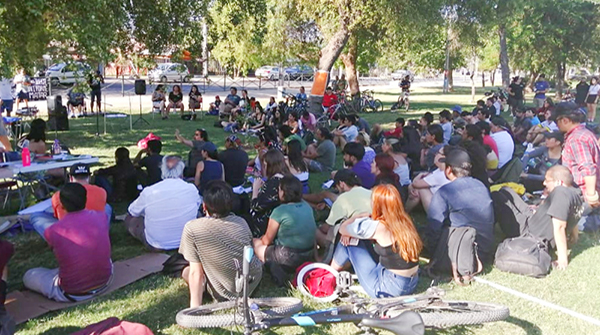
In this socio-political context, which is even more complex and fluctuating than it seems, a process led by Unidad Social has been developing "from below".[2]which has managed to position itself as an actor within this context with an emerging campaign to unite the historical demands of social movements and, on the other hand, a process that, alongside street protests, has provided socio-political support to the people's constituent movement. These are the Self-Convened Territorial Assemblies, which were the first organized movement of direct democracy and reflection that arose in response to the acts of violence perpetrated by the government of Sebastián Piñera. These spaces for territorial organization were convened by the people themselves in the streets, and although their convocation was spontaneous during the first days of the Uprising, they are born from the accumulated experience of years of struggle and learning.[3].
To this day, Territorial Assemblies continue to spring up; in Santiago alone, there are more than 110 registered, and many more throughout the country. Initially, they were a cathartic experience; no one could believe that the military was back in the streets, and precisely under the command of a “democratic” government, which made it all the more disconcerting and unleashed a powerful social awakening. Within days, rumors of shortages gave the assemblies a more proactive and action-oriented purpose. Pot-banging protests, interventions, street blockades, barricades, and marches were the actions organized by the assemblies to defy the curfew and make their discontent with the deployed military visible. In addition, community kitchens were quickly organized to quell the rumors of shortages and bring the community together at a common meeting point. Thus, their actions evolved in response to the struggle and the changing circumstances.
Some of these assemblies were established by political, social, and cultural organizations rooted in each neighborhood, but soon each assembly took its own path without needing these organizations for support. Commissions were created as needed for the context of the uprising and its growth. Beyond the differences in terminology, most of the assemblies have commissions for communications, self-care, popular education, coordination, and mobilization, among others. Through these assemblies, various avenues for communication, counter-information, protest, territorial marches, self-education and discussion workshops, cultural and health activities, and community gatherings have been generated. These activities, among countless others, have reactivated political discussion and the recognition of residents within their territories, rebuilding the social fabric torn apart by the dictatorship and strengthened by the fear, individualism, and distrust imposed by the neoliberal model, which deepened in the subsequent years of transition to democracy.
To date, several assemblies that emerged during the first week of the uprising have been organizing for over two months, and many more have formed recently, demonstrating the vitality and proliferation of these organizations. Furthermore, following the rapid emergence of these assemblies, a space for coordinating them was formed in Santiago during the first days of November. This space, now called the "Coordinadora de Asambleas Territoriales" (Coordinator of Territorial Assemblies), arose from the need to connect, share experiences, and unite struggles, and currently brings together between 30 and 60 territorial assemblies. This coordinating body is characterized by its grassroots, self-organized, autonomous, horizontal, feminist, and democratic nature. Its aim is to coordinate the common proposals and demands arising from local communities, the fight against impunity, and the construction of a dignified life. It also seeks to strengthen the development and autonomy of the assemblies, coordinate mobilizations, unite demands from the local to the national level, and advance towards a People's Constituent Assembly.
In parallel, the “Assembly of Popular and Self-Convened Assemblies” was formed, coordinating various territorial assemblies and grassroots organizations such as ANDHA Chile and other political organizations like the MIR and Workers to Power. Simultaneously, more localized coordinating bodies began to emerge, born from the desire to take more concrete action at the local level, while simultaneously fighting for national demands. These include the Maipú Assembly, which brings together more than 15 smaller assemblies; the Coordinating Body of Territorial Assemblies of the Cordillera Province, which convenes around 20 assemblies in the southeastern part of Greater Santiago; and other smaller coordinating bodies, such as the Santiago Communal Coordinating Body, which coordinates actions among 15 assemblies in downtown Santiago and the Grecia district, promoting direct action and struggle along this major artery of the capital.
One of the fundamental elements developed by the Territorial Assemblies within the framework of this popular uprising has been the creation of self-education initiatives at the local level to keep pace with and influence the ongoing national debate. While initially the urgent task was to formulate proposals and demands from each assembly, the need to understand and discuss the Constitution and the elements that a Constituent Assembly should include subsequently became paramount. It is worth noting that although initially a large number of talks, forums, and discussions focused on the Constitution and the Constituent Assembly, the scope of the discussion has progressively broadened to encompass issues from feminist, human rights, and social rights perspectives, as well as those of sexual minorities, territorial autonomy, and historical constituent processes in Chile and Latin America, among others.
This need and urgency for self-education within the assemblies has led many of them to form permanent commissions related to education, most frequently named "Popular Education" or "Self-Education." Furthermore, by challenging hegemonic education and recognizing the need to construct an alternative practice unavailable in any traditional educational setting, the residents developed proposals that tended to align with certain principles of these practices, which can be explicitly interpreted through the lens of Popular Education. Among other characteristics, new educational and pedagogical relationships are being established among the members of the assemblies, fostering horizontality and power sharing. These relationships define the necessary knowledge for the community, question the societal model underlying educational practices, and incorporate the experiences of educators from within the local community itself. Ultimately, these self-educational initiatives represent the people educating themselves within the community. This organizational structure, which envisions educational self-management to address training gaps in the current context, demonstrates the importance that the Territorial Assemblies assign to education and political training for transforming relations of domination. The people have had to self-organize to resolve an apparent deficiency in training within the educational system, which should be designed to address this issue.
While we understand that the current education system does not seek to empower people to build a dignified life, but rather responds to the neoliberal project promoted by dominant power groups, there is concrete evidence that it is still—and will continue to be—a contested space. An example of this is that social protest erupted from within that very system. It was organized secondary school students, resisting precariousness and criminalization, who lit the fuse of this social explosion, adding another milestone to one of the main actors in resistance over the last two decades and redefining the supposed passive, receptive role of students by rising up as agents of social transformation. No matter how much students are called upon to “study and not engage in politics” or laws like “Safe Classroom” are created.[4] To separate “good students from bad ones”, these have generated spaces for organization, reflection and action from within the educational centers themselves, putting pressure on traditional training and subverting the logics that affirm that the traditional school only generates processes of reproduction of relations of domination.
Similarly, the teaching staff has also generated processes that can be interpreted as liberating, stemming from the "grassroots rebellion"[5] In 2015, the movement went beyond leadership, demanding issues that transcended union and advocacy concerns, questioning curriculum content and the private management practices of the public education system. During these two months of struggle, even Sebastián Piñera's government has acknowledged this reality, attempting to pass a law against "political indoctrination" in schools and kindergartens, following the same lines as Brazil's "Escola sem partido" (Schools Without Parties), thus recognizing a well-known reality. All education is political, and it is a field in which teachers can be agents of social transformation in the political and pedagogical struggle within the education system. In this sense, the precepts of popular education that attribute to education in general, and to political training in particular, the possibility of transformation and overcoming of relations of domination, are not something that has emerged spontaneously from the Territorial Assemblies; it is part of a longer struggle process that has been developing both from within the traditional education system and from self-managed processes outside of it.
Similar experiences can be traced to the cycle of struggles sparked by student mobilizations, where occupations of schools, high schools, and universities developed as a growing repertoire of action from 2006 onward. This raised the possibility of generating incipient practices of educational self-management that were inspired—explicitly or implicitly—by the popular education practices we are witnessing today. These experiences opened the possibility of genuine educational development within the traditional education system, but by self-managing their own pedagogical processes in a context of conflict and struggle.
In the recent past, there have been numerous instances of the formation of Territorial Assemblies, but in general, these have not managed to maintain their strength over time, forming organized or self-managed territories. During the student mobilizations of 2006 and 2011, several self-managed assemblies developed (with smaller numbers of participants) but failed to endure beyond the immediate circumstances. Similarly, territorial assemblies related to socio-environmental conflicts and "sacrifice zones," such as those in Punta Arenas, Chiloé, Freirina, and Quinteros-Puchuncaví, while achieving concrete victories—such as the closure of the meat processing plant in Freirina—saw these embryonic organizations dissolve as the circumstances that had given rise to them subsided. This, then, is one of the main challenges facing the large number of Territorial Assemblies formed recently: ensuring their sustained presence beyond the current situation and conflict.
It is important to emphasize at this point that sustaining these organizations requires confronting the specters of division and dogmatism that haunt leftist organizations, specters that have weakened their strength and paved the way for neoliberal, fundamentalist, or outright fascist advances. This brings us back to the issue of education and the possibilities these Assemblies have to rebel against tradition and imposed education in order to self-manage their educational processes, both for national and territorial struggles and to address the internal problems that have caused rifts in these and other organizations. For the formation and consolidation of Territorial Assemblies as a relevant actor in the struggle for and construction of a just society and a dignified life, it is necessary to continue developing educational practices that allow them to overcome these internal and organizational problems. Popular education could continue to make an important contribution to this, both through its proposals and the diverse experiences of building and connecting with popular movements in Our America.
Considering that during the two months of the Popular Uprising a Popular Constituent (and Destituent) Process has begun, energizing the reconstruction of the social fabric and multiplying the emergence of popular organizations, and assuming that the April Plebiscite resulted in a decision to change the Neoliberal Constitution imposed during the dictatorship, there is a possibility that this Constituent scenario will continue for a couple more years. The prolonged nature of this context presents us with the need, the challenge, and the opportunity to prefigure and collectively construct, from a territorial, popular, feminist, plurinational, and class-based perspective, the kind of society in which we want to live.
The question then remains whether these assemblies want to (or will be able to) sustain themselves throughout the constituent process; whether they can project themselves toward building organized territories beyond simply achieving a constitutional change; and whether their role in the national debate and struggle for a new Constitution will be merely receptive to proposals coming "from above," or whether they will take a step forward by bringing forward proposals "from below." It is worth noting that they could certainly become a leading actor in the constituent process, perhaps by fielding independent candidates or contributing demands to potential constituent delegates, among other options. But they could also continue alongside the self-managed processes that are prefigurative of building a different society in the present. In this way, progress could be made in forming organized territories capable of generating self-managed processes to address their local needs; resisting, influencing, monitoring, and proposing policies and institutions at the community level; and capable of connecting with other assemblies, organizations, and social movements to influence the debate and struggle at the national level.
The challenge then remains, as an organized people and as members of popular organizations that have been fighting and building territory for years, to strengthen the Territorial Assemblies, assist in articulating processes with other types of social organizations and promote educational processes so that the people themselves decide how far this goes so that dignity becomes the norm.
“…Because, sooner rather than later, they too will learn of our constituent power…”
Sebastian Guerrero Lacoste
Master's student in Education, specializing in Curriculum and Educational Community. Community Public School Educator. Member of the Emancipation Movement for a Community and Popular Public Education. Member of the CLACSO Working Group on Popular Education and Critical Pedagogies.
Diego Cabezas Bravo
PhD in American Studies, IDEA/USACH. Professor at UMCE. Community Public School Educator. Member of the Emancipation Movement for a Community and Popular Public Education. CLACSO Working Group on Popular Education and Critical Pedagogies.
[1] This agreement established and negotiated the general terms for the plebiscite to be held in April. It generated considerable controversy due to its closed and limited participation, as the main actor in this conflict—the people—was not involved. For this reason, it became popularly known as the “Constituent Kitchen.”
[2] Unidad Social is a conglomerate of social and trade union organizations that has managed to position itself as an actor within this situation by calling for marches, town hall meetings and demanding a Constituent Assembly.
[3] As happened in Magallanes, Aysén, Calama, Freirina; with Montenegro, Vallenar, Quellón, Chonchi during the early 2010s, where territorial assemblies were formed to coordinate resistance actions and popular construction, from “sacrifice zones”; as high school students did to coordinate during the Student Movement uprising; and as residents have done in the struggle for housing from the 60s to the present.
[4] It is a law enacted at the end of 2018 in response to the various acts of violence that occurred during the previous year in several educational institutions in the Metropolitan Region. For some, it was the legal framework that allowed for an end to school occupations and acts involving violence in general by students. For others, it is merely an authoritarian mechanism for dismantling the student body that does not address the root of the problem and only accelerates the expulsion of students without a thorough investigation of the events that occurred.
[5] Thousands of teachers continued their strike despite the agreement signed between the Teachers' Union leadership and the government. While tensions between the rank and file and the leadership were at their peak, it was estimated that around 200 local branches were on strike.
If you would like to receive more information about CLACSO's training programs:
[widget id=”custom_html-57″]
to our email lists.

