
ISA International Sociology Magazine
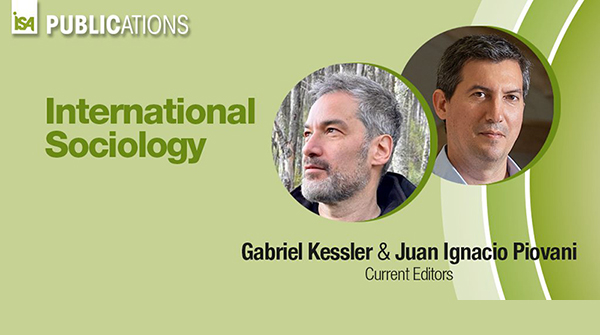

The International Sociological Association announced that Gabriel Kessler and Juan Ignacio Piovani have accepted to be the new Editors of International Sociology, taking over from Marta Soler Gallart.
Dr. Gabriel KESSLER is a researcher and professor at IdIHCS (Institute of Research in Humanities and Social Sciences), CONICET (National Council of Scientific and Technical Research)/ National University of La Plata, and at IDAES (Interdisciplinary School of Higher Social Studies), National University of San Martín, Argentina, and a member of CLACSO Working Groups.
Dr. Juan Ignacio PIOVANI is a researcher and professor at IdIHCS (Institute of Research in Humanities and Social Sciences), CONICET (National Council of Scientific and Technical Research) / National University of La Plata, Argentina, and co-coordinator of the Specialization and University Evaluation Program of the Latin American System of University Evaluation (SILEU) of CLACSO.
What prompted you to become the editors of International Sociology?
GK and JIP: International Sociology is a unique journal due to its diversity and global reach. We felt that publishing the journal in the Global South could be both a great challenge and an achievement for Latin American sociology. We were deeply motivated to continue expanding the global conversation that International Sociology has fostered since its inception. In particular, we were interested in increasing the visibility of agendas, issues, and sociologists from around the world within International Sociology. Along the same lines, two of our motivations were to strengthen ties with colleagues and sociological associations in different countries and to actively participate in the AIS (International Sociology Association).
How would you describe the scope of the magazine?
GK and JIP: As stated on the journal's website, International Sociology is a high-level, peer-reviewed journal that aims to reflect the theoretical and empirical diversity of international sociology. Articles exploring contemporary social challenges and transformations affecting global society, or highlighting how an international perspective can provide new insights that contribute to the development of international sociological theory and knowledge, are especially welcome.
What do you consider to be the main challenges for international sociological publications? How can international sociology address these challenges?
GK and JIP: The main challenge is to account for the diversity of topics, research agendas, and geographies within global sociology. International Sociology should encourage the publication and circulation of articles from different regions that are of interest to an international audience. In doing so, International Sociology could also help alleviate current inequalities in the international circulation of sociological knowledge. To this end, we will establish closer links and promote collaborative work with the national sociological associations that are part of the AIS so that they encourage their members to submit articles. In addition, we will participate in international, regional, and local sociological conferences (and other academic activities) in order to engage more closely with colleagues and develop a better understanding of relevant issues and discussions taking place in various parts of the world.
What would you suggest to improve diversity while maintaining the magazine's quality?
GK and JIP: To improve diversity within International Sociology, we believe that, first and foremost, it is necessary to increase the number of contributions from colleagues in underrepresented regions and on relevant topics that lack sufficient international visibility. Of course, this must be done while maintaining the journal's standards, which implies acknowledging the inequalities that characterize the global academic system. To address this issue, we will establish support and follow-up mechanisms for colleagues who submit original and substantive contributions but experience formal/technical difficulties related to scholarly writing or the use of English. In this regard, we propose, where possible, expanding the options for preprints of articles to be submitted and evaluated in the languages in which the authors are most proficient.
What advice would you give to those who are thinking of submitting an article to the journal?
GK and JIP: First, we suggest that authors who have not yet published in International Sociology familiarize themselves with the journal and its aims, and read the articles already published. Potential authors should also consider how their articles might interest readers in other parts of the world and how they relate to current international sociological dialogues and debates. And we recommend that, in addition to ensuring the content of their articles, they pay attention to writing styles and the formal aspects of international publications.
If you would like to receive more information about CLACSO's training programs:
[widget id=”custom_html-57″]
to our email lists.

