
Challenges and alternatives in the face of the civilizational crisis
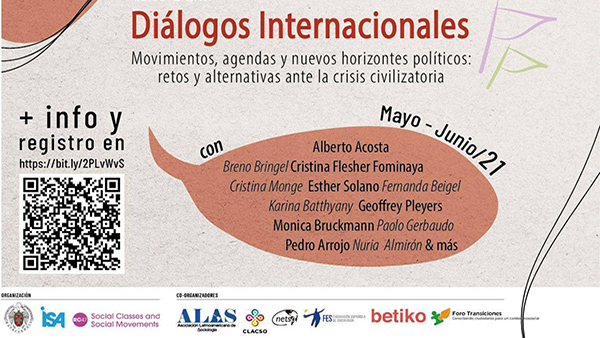

Organized by the Faculty of Political Science and Sociology of the Complutense University of Madrid, Spain, together with CLACSO and other institutions, the “International Dialogues — Movements, agendas and new political horizons: Challenges and alternatives in the face of the civilizational crisis” are taking place in May and June.
The first day, from May 26 to 28, will revolve around “Social movements and mobilizations: assessments, agendas and future horizons”.

This international course aims to foster dialogue between universities, activists, and a broad public interested in (eco)social justice and concerned with building alternative futures. It proposes a shared reflection on the current historical moment based on three central elements for any transformative project: changes in political actors, the main contemporary societal conflicts, and alternative horizons. The urgency of providing intellectual and political responses to the critical juncture we are experiencing is compounded by the need to take stock of the 10 years since the 15M protests and the global indignation, and the 20 years since the World Social Forum. Looking back allows us to critically examine the present and sow the seeds for the future. The invited speakers are prominent researchers and activists committed to democratizing causes and struggles within movements and organizations working across diverse fields, scales, and repertoires.
Organization: Faculty of Political Science and Sociology of the Complutense University of Madrid
Coordination: Innovation and Sustainability Classroom (FCPS-UCM) and International Sociological Association (ISA) Research Committee on Social Classes and Social Movements (RC-47)
Co-organizers: Latin American Sociological Association (ALAS), Latin American Council of Social Sciences (CLACSO), Center for Studies of Social Theory and Latin America (NETSAL) of the IESP-UERJ, Social Movements Research Committee of the Spanish Federation of Sociology (FES), Betiko Foundation and Transitions Forum.
Course Directors: Breno Bringel and Ariel Jerez
Secretary: Lara Sartorio and Xavier Salinas
While the 2008 crisis was primarily defined as a financial crisis, the current one is far deeper, multidimensional, and civilizational in nature. The arrival of the pandemic in 2020 has exacerbated structural inequalities, casting doubt on the sustainability of the current sociopolitical order and the world to come. Neoliberalism is advancing in its most authoritarian and predatory form, while democracy is threatened with suspension by neo-coups and the rise of the far right. Meanwhile, institutional politics—even that which purported to be transformative—is failing to address the aspirations and needs of the social majority. The gaps between social classes and between the state and society are widening. Denialist positions are gaining ground, and the political actors and models that guided many transformative projects in recent decades are being challenged. Furthermore, multiple crises that already existed after 2008 are intensifying, including food, climate, care, energy, geopolitical, and social crises.
Within this critical context, diverse social movements (primarily anti-racist, community-based, environmental, feminist, Indigenous, and youth movements), in both the Global North and South, are assuming a new prominence in redefining our horizons of meaning. To the struggles in defense of the public sphere and of rights and freedoms—now under increasing threat—these movements add a component of defending the commons and constructing “concrete utopias” projected toward ecosocial transitions and redefinitions of our forms of sociability and relationships with culture, nature, and territory. At the same time, they seek to build new forms of complex technopolitical intervention in the face of the growing individualization and digitalization of our societies, in order to broaden representation, participation, and social and political self-organization to enable more sustainable communities.
All of this raises a series of challenges regarding the direction of democracies, the contemporary "social movement form," and the "political party form." What are the most current and innovative reflections from critical thought and the movements themselves on these issues? What assessments can be made of local and global struggles 10 years after the 15M movement and the global indignation protests (2011) and 20 years after the World Social Forum (2001)? How can we generate intergenerational dialogues that allow us to articulate different memories of citizen struggles and diverse worldviews? How are denialism, post-truth, and the feelings of frustration and powerlessness among citizens related? How can we improve our social communication to democratize public debate and foster the ecosocial transitions we need? What is at stake in the struggles to open new horizons of meaning?
Format: The course will consist of three intensive sessions held in May and June. Each session will last three days and will follow the following daily structure: a lecture and a discussion. The program includes approximately 50 hours of presentations by academics, activists, and professionals from various organizations and fields.
Format: Hybrid. In-person for those in Madrid and virtual for everyone else. The in-person venue will be the Faculty of Political Science and Sociology at the Complutense University of Madrid (UCM). We will follow the COVID-19 measures and protocols established by the faculty and health authorities, and if the health situation requires it, the course may be held exclusively online. All sessions will be conducted online via the Zoom platform, the link for which will be provided to registered participants. If you simply wish to attend the course sessions, the entire course will be streamed online on the ALAS and CLACSO YouTube channels. In this case, registration is not required, although as an online viewer you will not be able to interact directly with the speakers.
Registration: There are three types of registration for the course, ALL OF THEM FREE. Choose the one below that best suits your interests and availability and fill out this online registration form by May 23rd, indicating your preferred participation format:
1. Free Participation: It gives you access to the physical room at the UCM if you are in Madrid and the virtual room (Zoom) to be able to participate in the debates.
2. Participation with recognition of 2 ECTS credits. These are free, but only for students enrolled at the UCM. You must select the “UCM Credits” option on the registration form. After completing your registration, you must write to [email protected] (Subject: UCM Credits Course + Last Name) to receive more information about the credit recognition procedure.
3. Participation with Certificate. This is a certificate of participation for all participants, including those without a university degree, issued by the organizing institutions. Attendance at a minimum of 75% of the course sessions is required to receive the certificate at the end of the course. You must register and select the "Certificate" option on the registration form.
If you would like to receive more information about CLACSO's training programs:
[widget id=”custom_html-57″]
to our email lists.

