
Decolonial resistances for socio-environmental justice in Our America: knowledge, territories and images
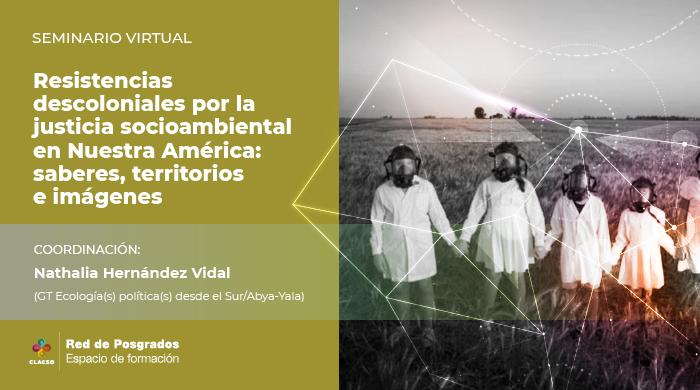
Seminar 2127
ChairCLACSO
Coordination: Nathalia Hernández Vidal (GT Political Ecology(s) from the South/Abya-Yala)
Teaching team: Nathalia Hernández Vidal (GT Political Ecology(s) from the South/Abya-Yala), Mina Kleiche-Dray (Université Denis Diderot, France), Yolanda Wood (University of Havana, Cuba)
Home: 30/06/2021 | Registration: 22/03/2021 to 29/06/2021
Workload: 12 weeks – 90 hours.
In this course, we examine decolonial resistance for socio-environmental justice from the academic and activist production of political ecology in Our America. We focus on giving equal analytical and political importance to understanding the coloniality of nature and to the struggles for the maintenance and creation of other forms of life. The course will be divided into three modules. In the first, we will study the role of knowledge in the struggles for environmental justice, paying critical attention to colonial/modern/capitalist technoscientific regimes of truth and to alternative proposals to these, articulated around the idea of sentient thinking and relational ontologies, among others. In the second, we explore the contributions of peasant, Black, and popular feminisms to the study of socio-environmental conflicts in our continent. Using the concept of intersectionality, we analyze the territorial dimension of extractive domination processes and resistance to them, as well as the ways in which class, gender, and race interact in the formation of the “environment” as a space of political dispute. In the third module, we incorporate the study of narratives and visual resources from the artistic field as a form of decolonial resistance that is closely related to the generation of knowledge and territories explored in modules one and two.
GENERAL PURPOSE
Examine the colonial/modern/capitalist socio-environmental domination models and understand the role of social movements and community resistance not only in oppositional but also generative terms.
SPECIFIC OBJECTIVES
1. To understand the concepts of decolonial resistance and socio-environmental justice from the Political Ecology of Our America.
2. To understand the epistemological, territorial and representational dimensions of decolonial resistances and their contributions to the construction of other (already) possible worlds.
3. To contribute to the construction of knowledge networks and social mobilization in our continent in order to consolidate the production of critical knowledge and socio-environmental actions in terms of socio-environmental justice.
4. To value the impact of the artistic field on territorial and socio-environmental problems as critical stances of memory and decolonial resistance
- The question of knowledge as a central axis of decolonial studies. The emancipation of peoples depends on the emancipation of their knowledge.
- Science, power, and knowledge
- Interculturality, relational ontologies, and practices of decolonizing knowledge
- Plural knowledge to build practical and socially relevant knowledge
- Disputed territories: capitalism, extractivism, and the struggles for the defense of territory
- From “environment” to territory: an intersectional perspective
- Territories, memory and the politics of representation
- Cultural territories and the spirituality of the land: visual resistances from traditional knowledge
- Thinking in images about socio-environmental conflicts: colonial/modern violence and decolonial resistance
- ALIMONDA, HÉCTOR (2011) "The coloniality of nature - An approach to Latin American political ecology", Colonized nature - Political Ecology and Mining in Latin America, Héctor Alimonda (org.), CLACSO- CICCUS, Buenos Aires.
- ALTVATER, ELMAR (2011) “The limits of capitalism. Accumulation, growth and ecological footprint”, Mardulce, Buenos Aires.
- Climate Change and its Impacts in the Greater Caribbean (2020) Jacqueline Laguardia Martínez. (Coordinator) - 1st ed. - Autonomous City of Buenos Aires: CLACSO http://biblioteca.clacso.edu.ar/clacso/gt/20200928053822/Cambio-climatico-impactos.pdf
- CASTRO HERRERA, GUILLERMO “Sociality and Coloniality in the Culture of Nature in Our America” Latin American Political Ecology: Critical Thought, Latin American Difference and Epistemic Rearticulation/ Héctor Alimonda ... [et al.] CLACSO; Buenos Aires. Volume II. pp. 297-302
- CIRO, ESTEFANÍA; BARBOSA, JULIÁN and CIRO, ALEJANDRA (2016) “Oil map of the Amazon and resistance in Caquetá: challenges for peace in the post-conflict.” Extractivisms and post-conflict in Colombia: challenges for territorial peace, A. Ulloa and S. Coronado. Bogotá: National University of Colombia pp. 415–50
- CRUZ, DELMY TANIA and BAYÓN JIMÉNEZ, MANUEL (2019) Bodies, Territories and Feminisms. Latin American compilation of theories, methodologies and political practices. Abya Yala and Institute of Ecological Studies of the Third World.
- ESCOBAR, ARTURO (2003) “Worlds and knowledges of another way. The Latin American modernity/coloniality research program” Tabula Rasa, no. 1, January-December, pp. 51-86
- ESCOBAR, ARTURO (2011) “Political Ecology of Globality and Difference” The Colonized Nature, Héctor Alimonda (coord.). Buenos Aires, CLACSO pp.61-92
- ESCOBAR, ARTURO (2014) “Territories of difference: the political ontology of “rights to territory” Sentipensar con la tierra: nuevas lecturas sobre desarrollo, territorio y diferencia Medellín: Ediciones UNAULA pp. 67-79
- ESCOBAR, ARTURO (2014). Feeling and Thinking with the Land: New Readings on Development, Territory, and Difference. Medellín, Universidad Autónoma Latinoamericana UNAULA
- GUALDRÓN RAMIREZ, MIGUEL (2021). “The archipelago as a dissident territory”. Philosophy Notebooks. Under review.
- HERNÁNDEZ VIDAL, NATHALIA (2021). “The aesthetics of seed care”. Colombian Journal of Sociology. Under review.
- HERNÁNDEZ VIDAL, NATHALIA and GUTIÉRREZ ESCOBA, LAURA (2019) “Epistemic-Political Resistance(s) Against the Privatization of Seeds and Collective Knowledge.” Colombian Journal of Anthropology 55(2) pp. 39–63.
- KLEICCHE-DRAY, MINA; ROUSSEL, LUCILE and JAUMOULLÉ, ALEXANDRA (2020) “NGO, agroecology and local agricultural practices: a case of translation in Mixtec and Zapotec communities in Oaxaca” New Anthropology VOL. XXXIII, NO. 92, JANUARY-JUNE.
- LANDER, EDGARDO (2000) Social Sciences: Colonial and Eurocentric Knowledge. In Edgardo Lander (coord) The Coloniality of Knowledge: Eurocentrism and Social Sciences. Latin American Perspectives, Buenos Aires, Clacso/UNESCO
- MACHADO, ARÁOZ, H (2016) “Political Ecology of Extractive Regimes. From Imperial Reconfigurations and Decolonial Re-existences in Our America”. Bajo el Volcán Journal, vol. 15, No. 23, Benemérita Universidad Autónoma de Puebla, Mexico, Sept.-February, pp. 11-51.
- MARTÍNEZ ALIER, JOAN (2004) The environmentalism of the poor, Icaria, Barcelona.
- MARTÍNEZ ALIER, JOAN (2015) “Political ecology of extractivism and socio-environmental justice” Interdisciplina 3, no. 7 pp. 57-73.
- MERLINSKY, GABRIELA AND SERAFINI, PAULA (2020) “Introduction” Art and Political Ecology Gabriela Merlinski; Paula Serafini. (Compilers) 1st ed. - Autonomous City of Buenos Aires: University of Buenos Aires. Gino Germani Research Institute - UBA, 2020. pp. 11-27
- NAVARRO, MINA LORENA and GUTIÉRREZ, RAQUEL (2019), “Keys to thinking about interdependence from the perspective of ecology and feminisms”, Revista Bajo el Volcán, no. 28.
- RUALES, GABRIELA AND SOFÍA ZARAGOCIN (2019) “Of Genders and Territories: Does the Earth Have a Gender?” Bodies, Territories and Feminisms. Latin American Compilation of Theories, Methodologies and Political Practices. Cruz, Delmy Tania and Bayón Jiménez, Manuel (Compilers), Abya Yala and Institute of Ecological Studies of the Third World. pp. 303-313
- SVAMPA, MARISTELLA (2011) “Thinking about development from Latin America” Latin American Seminar “Rights of Nature and Alternatives to extractivism”, (Voces de Alerta Collective et al.), Buenos Aires. Pp.1 – 25.
- SVAMPA, MARISTELLA. “Thinking about development from Latin America”. Latin American Seminar “Rights of Nature and Alternatives to Extractivism”. Voices of Alert, CLAES, Youth for Equality, and CEPPAS. Buenos Aires, November 2011.
- ULLOA, ASTRID and CORONADO, SERGIO (2016) “Territories, State, Social Actors, Rights and Socio-environmental Conflicts” in “Extractivist Contexts: Contributions to the Post-Agreement.” Extractivism and Post-Conflict in Colombia: Challenges for Territorial Peace, A. Ulloa. National University of Colombia, pp. 23–58
- WALSH, CATHERINE (2007) “Interculturality and coloniality of power. An “other” thought and positioning from the colonial difference” The decolonial turn: reflections for an epistemic diversity beyond global capitalism, Santiago Castro-Gómez and Ramón Grosfoguel (comp.), Bogotá, Siglo del Hombre Editores, pp. 47-62
- WALSH, CATHERINE (2007). “Interculturality, coloniality and education”. Education and Pedagogy Journal, Medellín, University of Antioquia, Faculty of Education, vol. XIX, no. 48, (May-August), pp. 25-35.
- WOOD, YOLANDA Caribbean Islands: nature-art-society (2012) Ed. UH- CLACSO.
|
|
In one payment by 29/06 |
In one payment without discount |
|
CM Plenos |
$75 |
$150 |
|
CM Associates |
$95 |
$190 |
|
No link |
$95 |
$190 |
FAQ
The basic requirements for taking a seminar are:
- Availability of at least 4 hours per week to dedicate to the seminar course.
- Internet access.
- Reasonable handling of communication and computer tools.
- Language proficiency in the language in which the course will be taught. The official languages are Spanish and Portuguese.
If you have a link with a CLACSO Associated Center:
Paying in one payment: USD 150 (includes issuance and shipping costs of the digital certificate).
Paying BEFORE 29/06/2021: USD 75 (includes issuance and shipping costs of the digital certificate).
If you have a link with a Network or Institution Associated with CLACSO:
Paying in one payment: USD 190 (includes issuance and shipping costs of the digital certificate).
Paying BEFORE 29/06/2021: USD 95 (includes issuance and shipping costs of the digital certificate).
If you do NOT have a link with a CLACSO Associated Center:
Paying in one payment: USD 190 (includes issuance and shipping costs of the digital certificate).
Paying BEFORE 29/06/2021: USD 95 (includes issuance and shipping costs of the digital certificate).

