
Resistance in Colombia 2021, continuation of the Andean Spring
Pelao Carvallo[1]
In this year of 2021, marked by an endless pandemic, the Andean Spring continues.[2] And Colombia is part of it. It began in Venezuela in 2017, spreading through Ecuador, Peru, Bolivia, Colombia, and Chile, persisting in different ways in the latter two. Although the rebellion has been redirected in different ways in Bolivia, Peru, and Ecuador, the electoral process is a common thread that, since it doesn't offer a fundamental solution to the crisis, suggests some continuity to these uprisings. The revolutionary process in Chile, part of this spring, has an electoral aspect due to a constitutional process forced by the uprising itself, but the high abstention rate in the elections shows that this path is not, and cannot be, the end of that process.
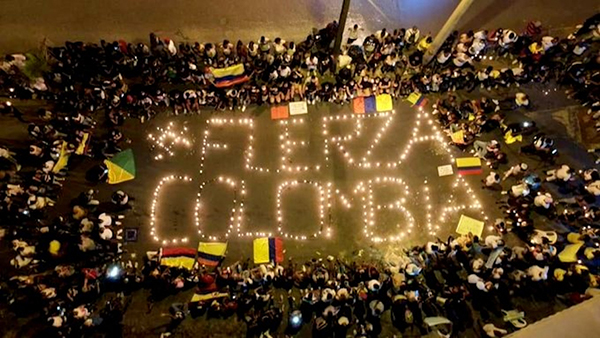
Colombia clearly demonstrates the strength of these mobilizations, which stem from the unforced errors of the ruling elites and their excessive self-confidence: a 30-peso increase in transportation costs in Chile, the removal of subsidies in Ecuador, and an upwardly mobile and punitive tax reform in Colombia. These were unnecessary political acts carried out merely to showcase what the elite could do… but which the people made clear they could not, in the case of Colombia, by successfully getting the reform as proposed canceled. "It's not about 30 pesos, it's about 30 years," they said in Chile, and that gave enormous depth to the social demands of that revolutionary process. The defeat of the Tax Reform (it must be emphasized: it is the defeat of that reform, the defeat of the Duque de Uribe government, the defeat of the Colombian elite) allows for the introduction of other pre-existing demands that had been suppressed by official discourse and its media outlets. The demands for anti-repression, for Indigenous rights, for peace, for human rights, for the environment, for healthcare, against patriarchal abuse, against neoliberal economic abuse, were there before, but they remained marginalized because the voice of the elites monopolized everything. The presence in the streets gave space to these other demands, and the collective voice forced its entry into the mainstream media.
When taking to the streets to demand one cause allows others to take root, it opens spaces that can become a revolutionary process, depending on the weight and effort of military, police, media, and judicial repression. That is the other great defeat of the elite: that the voice of the people seeps in everywhere, especially among the people themselves, who begin to listen to that greater self that is no longer listening to and believing the echo of the elites. In that respect, the situation in Colombia[3] It is similar to certain moments in Ecuador, Venezuela, and Chile. In Ecuador, a truce and electoral process were reached, calming the revolt and its death toll. In Venezuela, repression, hunger, exile for survival, and distrust of the opposition establishment and its fabricated positions slowed the process, but in Chile, the revolutionary process continues in such a way that it has overthrown the Chilean state as it was known during 30 long years of transition.
In October of last year, I had already said that the Andean spring “is a peasant spring, small and family-oriented, which in times of pandemic has been the source of survival and solidarity-based and self-managed food for the communities, towns and cities…” That continues to describe the situation.
What the people of Colombia do and achieve (and they have already achieved many victories) can give more strength and continuity to this Andean spring. Let's hope so.
The objectives of the popular demands in the demonstrations are clear: the demilitarization of the military and police, demonstrating the antimilitarist nature of these struggles. This is also expressed by the fact that the underlying conflict is between two opposing models: individualistic, neoliberal financial capitalism versus community solidarity based on mutual aid. Typically, in our region, these models are not in direct conflict because they are unequally complementary; everything that predatory states and the neoliberal elite cannot plunder, mitigate, or resolve is left in the hands of communities and their practices of mutual aid. The pandemic[4]And before that, the excessive and indolent abuse of power by neoliberal elites has diminished, in everyone's eyes, the effectiveness of those predatory states and elites, and has revealed the full potential of community-based mutual aid, taking on a confrontational character—a confrontation of ways of facing life, shifting from complementarity to displacement. Community-based mutual aid is not as aware of its revolutionary potential for the same reason that capitalism allows it to persist: it is a way of life, and it is only revolutionary for those who do not live it.
The pandemic not only failed to stop the Andean spring[5]Rather, it achieved this displacement: that millions of "neoliberalized" people must resort to mutual aid for mere survival, thus producing confrontation, because it can become a way of life for those who, in practice, subscribe to neoliberalism. All of this is done by making very sharp divisions, which life itself is not; it's all much more intertwined. Therefore, this way of life of community-based mutual aid, these practices, are eminently antimilitarist insofar as their focus is on giving life, caring for life, sustaining life, and celebrating it. That's why the marches use shields, why health teams emerge to treat demonstrators, food groups to sustain the protests, and so on. Because this way of life is unfolding in a revolutionary way for people who, not long ago, lived in the mall and on their smartphones. In other words: the minga is revolutionary when it unfolds in the cities, the communal pot is revolutionary when the middle class resorts to it, looting is revolutionary when adult mothers and not young men loot, street care is revolutionary when it is done for a demonstration as part of that demonstration.
The predatory, extractive state and the neoliberal elites are in check because their mass base is disappearing, transforming into something else. This is why they have no choice but to propose military or militarized solutions, as Moreno did in Ecuador and Piñera in Chile: soldiers in the streets. Duque does nothing different because, unless forced, the military is the ultimate representation of neoliberal and state life, and therefore it is essential that it wins and is portrayed as heroic. The military is, symbolically, the neoliberal state, even before the neoliberal state itself, since it represents unproductive consumption to the point of death; that is what bullets and projectiles are: consumption that consumes itself to the point of death, both one's own and that of others.
Let's not forget that social conflicts are a business opportunity for the military industry and market – BDS knows this well.[6] —as well as the learning and practice of tactics, strategies, and weaponry that feed back into overpowered military complexes like those of Colombia, Chile, and Israel, to name just three examples of mutual military business. There's one thing armies know well: they don't survive desertion and insubordination. When faced with mass desertion and insubordination, not only do the military and militarized forces urgently need to reinvent themselves, but the entire state must reinvent itself. That's what has happened in Chile, for example, and how the revolt has also been an anti-militarist revolt against military participation in repression, against the military police, and against conscription, with the most resounding insubordination.[7] of Chilean history, and with the Chilean armed forces defeated in that, the state is in the process of reinventing itself.
Of course, the revolutionary antimilitarist possibilities of the community-based mutual aid way of life have their limitations: they can be, and have been, co-opted by any form of state, patriarchy, and capital, by this system of domination and violence, that is, by Power.[8]That is why it should not be turned into an institutionalized, state-controlled, or commodified learning process in the sense of the capitalist market.
May 19th 2021
[1] Pelao Carvallo, May 19, 2021. CLACSO Working Group “Collective Memories and Practices of Resistance.” This article stems from notes taken for the webinar “What is happening in Colombia? Global Week of Antimilitarist Contagion,” held from May 17 to 22 of this year. The video of the talk, specifically from a Latin American regional perspective, is available at: https://www.facebook.com/1421886927880165/videos/769828860398521
[2] https://www.clacso.org/la-primavera-andina-florece-en-pandemia/
[3] http://ramalc.org/2021/05/11/colombia-el-desmonte-del-escuadron-movil-anti-disturbios/
[4] https://www.clacso.org/contra-la-revuelta-enfermedad/
[5] https://www.clacso.org/contra-la-revuelta-enfermedad/
[6] https://www.palestinalibre.org/articulo.php?a=67037
[7] https://www.clacso.org/la-revuelta-social-contra-el-servicio-militar/
[8] https://www.clacso.org/anarquismo-en-tiempos-de-punkdemia/
If you would like to receive more information about CLACSO's training programs:
[widget id=”custom_html-57″]
to our email lists.

