
Rethinking territorial planning and management in times of uncertainty

On Wednesday, November 11, the ACIUR XIV International Seminar on Urban and Regional Research "Rethinking the planning and management of the territory in times of uncertainty: processes, scales, actors and governments" will be held, organized by the Colombian Association of Urban and Regional Researchers (ACIUR), with the support of CLACSO and FOLEC.
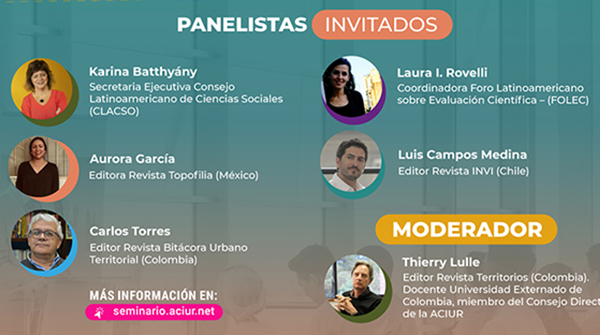
In this context, at 14:00 PM Colombian time (16:00 PM Argentine time), CLACSO Executive Secretary Karina Batthyány will participate in the panel “Sharing or Competing? Reflections for a Debate on the Evaluation of Knowledge Production in Latin American Scientific Publications,” along with Laura I. Rovelli, Coordinator of the Latin American Forum on Scientific Evaluation (FOLEC); Aurora García, Editor of Topofilia Journal (Mexico); Luis Campos Medina, Editor of INVI Journal (Chile); and Carlos Torres, Editor of Bitácora Urbano Territorial Journal (Colombia). The panel will be moderated by Thierry Lulle, Editor of Territorios Journal (Colombia) and member of the ACIUR Board of Directors.
The organizers maintain that the objective of this discussion is to exchange reflections on current processes for evaluating Latin American scientific output, especially that disseminated in scientific publications and journals, and to open a debate on possible future strategies. In a context of designing and implementing rules for evaluating scientific output that are increasingly marked by the so-called impact factor of publications, primarily based on citation measurement, questionable effects have arisen, such as the quantification of evaluations, the predominance of English, and the commodification of the scientific publishing system. This process is even more challenging in the field of social sciences and humanities, whose argumentative and expressive logics are often distinct. Furthermore, this process is directly linked to the reorganization of the evaluation of researchers, research groups, teaching and research institutions, accreditation methods, and the role of the much-feared international rankings. However, faced with the growing pressure of these rules, there is also an emergence of consensus at the national and international levels to question these modalities and seek alternatives.
In this regard, it is worth noting the actions of the Latin American Council of Social Sciences (CLACSO), especially through the Latin American Forum on Scientific Research (FOLEC), which “are based on the right to knowledge, guided by an ethic of social commitment and solidarity, and strengthened by open science to make visible the diversity of knowledge matrices and promote the dialogue of knowledge in Latin America and the Caribbean, and with the rest of the world.” With the participation of representatives from CLACSO, FOLEC, and editors of Latin American scientific journals (INVI from Chile, Topofilia from Mexico, Bitácora and Territorios from Colombia), this discussion aims to share editorial experiences in this context, using the following question as a guide for dialogue and reflection: Sharing or competing? Reflections for a debate on the evaluation of knowledge production in Latin American scientific publications.
If you would like to receive more information about CLACSO's training programs:
[widget id=”custom_html-57″]
to our email lists.

