
“Rethinking the gender order and transforming the allocation of care”
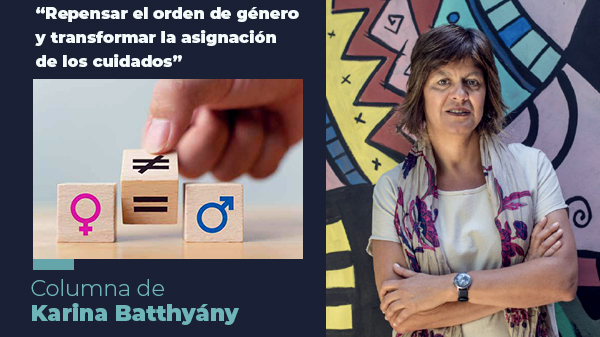
(Transcription of Karina Batthyány's Column)
(in InfoCLACSO – November 3, 2021)
To continue exploring the 34 themes that make up our #CLACSO2022 Conference in June (at UNAM in Mexico), today I propose we address the theme of Care, which was also the reason for my trip to Guadalajara. There, together with CALAS (Center for Legal, Environmental and Social Action), we organized a platform for dialogue on the topic of care. More specifically, we focused on the challenges facing Latin American and Caribbean societies in this area. In addition to CALAS, the organization with which we organized this event, the platform also included the participation of ECLAC (Economic Commission for Latin America and the Caribbean), academics from Latin America and the Caribbean, and representatives from various Latin American governments working on this issue.
Why? Because, as we have said here, gender inequalities are a structural and historical feature in Latin America and the Caribbean that are framed within social inequalities and that also explain or are at the base of the unsustainability of the development model for our region.
Furthermore, as we have already discussed, this COVID-19 pandemic has deepened the structural knots of inequalities, particularly gender inequalities, and highlighted the unjust social organization of care that we have and the need to move towards a change in the development style that puts care and the sustainability of life at the center.
So, that's where we ask ourselves: what exactly are the challenges and opportunities of the care society in this stage that we could begin to call post-pandemic?
First, let's clarify what we mean when we talk about the care society. On the one hand, we're talking about new ways of understanding care and attention for people, particularly those who are dependent; and on the other hand, we're also talking about rethinking and reinventing new ways of organizing society. We're not only talking about a profound shift in how care has historically been perceived and carried out primarily by women—a shift that directly challenges the hierarchical sexual division of labor—but we're also talking about new social models, new economic models that, unlike the current (capitalist) model driven by profit, place care, well-being, and solidarity as their primary premise and raison d'être. In this sense, feminism (particularly critical feminism) has much to say and contribute to these processes.
The characteristics of the Social Organization of Care in Latin America and the Caribbean (which we have covered in some columns last year), basically show us that today care in Latin America is a function of families, within the families of women, that is mainly done in an unpaid way, and that of course access to care and particularly to quality care, is very segmented according to the socioeconomic level of the people.
In general, as I said, care is family-based, unpaid, and when it is paid, it is also provided by women in the form of paid domestic work (domestic workers or household employees, depending on what they are called in each country).
Now, what happened with the pandemic? Furthermore, ECLAC presented some very interesting data during our meeting in Guadalajara: the pandemic increased the burden of unpaid care work for women.
Let's look at some examples from Latin America: in Argentina, according to studies conducted so far, 54% of women reported feeling a greater burden of care work as a result of the pandemic. In Colombia, women dedicate eight hours a day to unpaid work; the COVID-19 situation increased this by an additional hour, from seven to eight during these months of the pandemic. In Chile, women dedicated 19 hours a day to childcare during the pandemic (two hours more than before). And in Uruguay, women dedicated eight hours a day to unpaid care work (an hour and a half more than before the COVID-19 situation). We could continue looking at other Latin American countries, but the conclusion is that there is a greater burden of unpaid work. This brings us back to the discussion, once again, of the Welfare State, of placing the discussion of well-being at the center and building a society of care.
Another piece of information I think is interesting to share with you today (also a product of the analyses carried out by ECLAC) is that if we look at the labor situation of women, there has been a historical setback for women in labor force participation and job quality. Let's take just one example: an 18-year setback in women's participation in the labor market as a result of the pandemic. That is, it's as if we were going back 18 years in terms of the impact on the condition and quality of employment for women. And furthermore, the recovery has been uneven, because we are already seeing that men are returning to labor force participation rates similar to those prior to the pandemic crisis, while in the case of women, there have been these years of decline.
It is therefore very clear that care is an urgent task, and it is not solely the responsibility of women. The pandemic clearly demonstrated the urgency of building this care society if we truly want a more equal, sustainable, and inclusive future. This compels us to rethink the gender order and transform the asymmetrical allocation of care work, which is assigned primarily to women, and to redistribute this unpaid labor not only between men and women, but also among families, the state, the market, and the community.
If we don't address this issue, we certainly won't be able to talk about more equitable, more egalitarian societies in Latin America and the Caribbean.
-Karina, what you're saying is absolutely clear, and it's following a path that allows us to keep moving forward on these fundamental topics. In that sense, I have a feeling that today's program will be connected in a certain way, because Francia Márquez Mina and I were delving into some issues… Before we finish this meeting, I was going to suggest listening to 40 seconds of that conversation, where she alludes to something that I understand is related to what you were just discussing, and then we can talk for a few more minutes, does that sound good?
Agree.
Francia Márquez Mina : I had my first child, and I had to work in the mine throughout my entire pregnancy. For example, today I went to the mine and gave birth to him in the early hours of the next morning. And that's how it is for all of us women… My mother has no fingerprints left on her hands. I realized that when I won the Goldman Environmental Prize, when I went to get her a passport and she could barely travel with me. How many mothers in Colombia, here in Argentina, in Latin America, have lost their fingerprints working in private homes, doing whatever it takes to raise their children?
It refers to those deep-seated and structural gender inequalities in Latin America, in Colombia as she mentions, but throughout the region. These inequalities ultimately reflect the unequal opportunities women face, and particularly demonstrate how the integration of work and reproductive life—between caregiving and paid work—is not possible under current public policies in our region. This is precisely—though not the only—one of the points we want to address when we talk about care societies.
That everyone has the right to carry out these activities without one affecting the other, and without the potential for motherhood that women have (because not all women are mothers) becoming a central obstacle to our participation in the workforce and, ultimately, to gender inequalities. This has been more than demonstrated by her testimony and also by all the research in our region on how these two dimensions are intertwined.
All the indicators we're seeing point to this, to inequalities in general, but with some inequalities in particular, such as gender inequality, where the impact is clearly disproportionate. And one of those issues was also what we addressed in this dialogue platform in Guadalajara. We will, of course, continue working on it, and it will be a central theme—I can already announce this—at our 9th Conference on Social Sciences and Humanities in seven (7) months.
If you would like to receive more information about CLACSO's training programs:
[widget id=”custom_html-57″]
to our email lists.

