
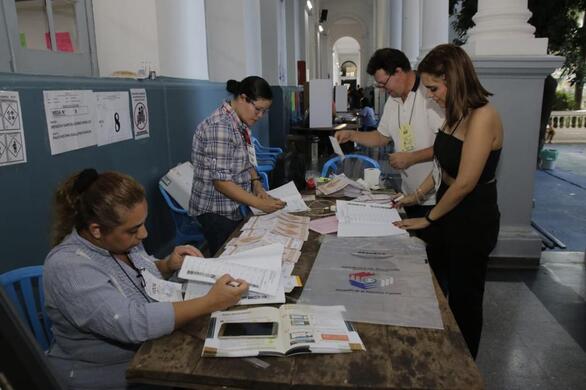
Rendered image of the state of Colorado in Paraguay. The 2023 Paraguayan general elections in post-spectacular times.
Pelao Carvallo*
The results of the Paraguayan general elections of April 30th of this year helped to rehabilitate the image of the Colorado Party, that is, to improve and cleanse its image in this particular post-spectacle society that Paraguay experiences. The most tangible result of the elections is the ratification and deepening of the Colorado Party's dominance: a majority in both houses of Congress, a majority in governorships, and they will be both government and opposition at the same time, as never before. Also in control of the Legislative Branch, the National Republican Association (ANR)-Colorado Party only has to fear its success… and the possible extradition of former president and current Colorado Party president Horacio Cartes [1].
It was a triumph of habit. Abstention, along with null and blank votes, barely reached 30% of the total eligible voters (and votes). It's a lot, but it's nothing, since the Colorado Party's electoral calculations rely on a turnout of up to 70% to secure a victory in an electoral system that doesn't consider a runoff election for the presidency. Therefore, a multi-party race, or a three-party race, favors the majority party. In this case, both things happened simultaneously: many parties competed, and three parties were strong contenders.
The ruling party of the Colorado Party, the ANR, represented by Santiago Peña, former minister under Horacio Cartes, decisively defeated [2] (42.74%) both the center-right opposition bloc led by Efraín Alegre (27,48%), and the populist ex-Colorado faction headed by Payo Cubas (22,91%), as well as the candidacy of Euclides Acevedo (1,36%), former interior minister in the current Colorado government, supported by the culturally conservative wing of the left-wing Frente Guasu (FG) coalition—a candidacy that failed to meet even its own expectations. All nine other presidential candidates combined failed to garner even 3% of the vote.
The habit of complacency has won out. It's not that these elections weren't winnable for any of the opposition parties; the silly calculations that are always made after the elections prove that. But it's difficult to draw favorable conclusions for the opposition regarding these elections, since it's reasonable to assume that Payo, accused by the Efraín supporters of "diverting votes," actually diverted more votes to the Colorado Party than to Efraín [3] , which means the Colorado movement appears divided, yet still emerges victorious.
Decades (and we are slowly approaching a century) of Colorado Party rule have built a particular type of state (the Colorado State [4] ) that has generated a culture that is a custom ritualized in victorious participation in elections. This recent election has been the refinement of that ritual and, by embodying the Colorado State, has resolved with victory all the problems that the Colorado State carries and that the opposition has failed to use to present itself as a solution.
It was, moreover, a triumph of disappointment: while voter turnout was within normal limits, it showed how little enthusiasm the population as a whole had for the promises of change offered by all the candidates (all of them, including the three largest, promised change—even the Colorado Party). Those who supported the most fervent candidate, Payo Cubas, who positioned himself as the antithesis of Efraín and Peña, were mostly from the usual pool of voters. Voting for the same old thing is like not voting for it at all; the triumph of the same old thing is a triumph of disappointment. The enthusiasm, the desire, the excitement for change were lost years ago in Paraguay, and now electoral politics is a practical game of boredom and disillusionment.
It is also a new triumph of fraud, partially exposed by militant protesters, who demonstrated across much of the country for one night and for two and a half weeks in front of the Electoral Court [5] . Unfortunately, despite being common knowledge and political common sense, systematic electoral fraud in Paraguay has not been scientifically studied in even moderate depth [6] . The protesters' claims seem credible and plausible, echoing the population's electoral experience, but because fraud is institutionalized, even perfected with the transition to an electronic voting system, the electoral system appears politically, judicially, and repressively shielded. Evidence of this is that Paraguayan candidate Paraguayo Cubas, who came in third in the presidential election, is currently imprisoned [7] for exercising his right to protest; at least two hundred of his supporters were also arrested [8] . Fraud is a constitutive and normalized part of the electoral system, and the opposition coexists with it without making it a political issue.
The Colorado State has been effectively constructed using one of its mythical pillars: the two-party myth [9] . This myth consists of convincing both the political world and the small analytical elite that Paraguay is a typical democracy, that there are two parties on equal footing that fiercely compete for and divide elected positions (the ANR and the PLRA), and that the executive, legislative, and judicial branches are independent of the Colorado Party. This myth is simplified to the phrase "they are all the same," referring to the two supposedly majority parties. This myth fails to account for the reality that only once, since the 40s, has there been a period of non-Colorado government—that is, 5 years out of a total of more than 70 years. It also fails to account for the fact that the majority of municipal and departmental governments, representatives, and senators have consistently been Colorado, even at times, as will happen in these elections, with an overwhelming majority [10] . That myth proved highly effective in this election, fueling both habit and disillusionment. The "payismo" movement strongly promoted this foundational myth of Colorado State in this election.
This myth also affected the left-wing parliamentary coalition Frente Guasu, a bloc of parties that grew under the wing of Fernando Lugo's government (and subsequent fall) (2008-2012). Two consecutive terms in the Senate (elected nationally), during which it became the third-largest parliamentary representation, led to its electoral irrelevance; the elections reduced its representation to a single senator, Esperanza Martínez [11] . The strongest desire for change was, on this occasion, embraced by the Payista movement. Certainly, the divided support for presidential candidates, both right-wing, did not help the senatorial list presented, which, although united under the FG banner, was not the only one, since Euclides Acevedo's presidential candidacy also included its own senatorial list. The FG list garnered 2.01% of the vote, and the Acevedo list 1.8% (with no one elected). It can be suspected that this division was indeed counterproductive for the FG [12] which, now, will be left without its own bench.
The international press coverage of Efraín Alegre's resounding defeat seems to echo the internal narrative of the Colorado Party, portraying him as a center-left or even left-wing candidate [13] . This completely contradicts the reality of the Paraguayan political landscape. In fact, with the exception of one marginal candidate, none of the leading contenders were left-wing or center-left. It appears to be very advantageous for the international narrative that the left in Paraguay has been "put on the brakes," even if this meant transforming a historically center-right figure like Alegre into a leftist. This reveals a deliberate and convenient ignorance on the part of the Colorado Party regarding the current political situation in Paraguay. Yes, the Paraguayan left suffered a major defeat, but this occurred before the elections when its chances dwindled with the loss of two right-wing candidates (Alegre and Acevedo) [14].
The opposition, both parliamentary and extra-parliamentary, must reconsider its role in legitimizing the Colorado Party and its institutions. The Payista movement's activities against the Paraguayan electoral system demonstrate the scope and limitations of the opposition's uncoordinated actions. They succeeded in exposing the electoral system's nakedness, but the "institutionalist" attitude [15] of a significant portion of the parliamentary opposition facilitated the repressive and stigmatizing work of the Colorado Party. This complicit attitude, this acceptance of the fantastical narrative that Paraguay is a democracy in the traditional sense, that the powers of the Colorado Party are independent (of the ANR party) from the opposition, will allow Paraguayan institutions to continue harming its inhabitants and facilitating drug trafficking and infiltration, as researcher Juan Martens warns [16] . The opposition, whether parliamentary or not, has a future as such if it assumes a truly oppositional role to the Colorado State now, and not the legitimizing sidekick role it has had until now, which makes it irrelevant and domesticated.
Under the Colorado State, Paraguay faces a post-spectacular society in which Debord's [17] distinction between truth and falsehood has been abolished. The world is no longer inverted because, generally, everyone participates in and produces the spectacle. Almost universal access to screens [18] , and the ever-increasing access to cameras that can display what is recorded on those same screens, has allowed a shift from "making others see" to "making oneself seen," as demonstrated by the popular self-portrait that is the selfie [19] . This post-spectacular society is firmly anchored in the Colorado State's imagined narrative of being a democracy like any other because it presents itself, on screens, as a democracy accepted by its peers, with elections of this or that kind… until someone uses those same screens to broadcast their complaints of electoral fraud. Even so, it remains just another moment of the post-spectacle, since it passes, it is just another show, an image to swipe past. The post-spectacular State of Colorado [20] lives in the deconcentration and loss of attention that the speed of forgetting requires to give us space to new empty, elusive, irrelevant, forgettable contents that make us continue to be in the same State that defrauds us.
* Member of the CLACSO Working Group on Collective Memories and Practices of Resistance.
[1] https://es.mercopress.com/2023/04/04/extradicion-de-dirigentes-corruptos-paraguayos-despues-de-las-elecciones
[2] Here are the election results according to the Paraguayan electoral court: https://resultados.tsje.gov.py/publicacion/divulgacion.html
[3] Observations made by this author among Colorado families one week before the elections, in Asunción, the capital of the country.
[4] On the State of Colorado: https://www.clacso.org/wp-content/uploads/2021/11/El-estado-colorado-Paraguay-Pelao-Carvallo.pdf
[5] https://elpais.com/internacional/2023-05-03/furia-callejera-en-paraguay-contra-un-supuesto-fraude-electoral-del-partido-colorado.html
[6] There are minor references to fraud within electoral analyses, here is an example: https://www.scielo.cl/scielo.php?pid=S0718-090X2009000200015&script=sci_arttext
[7] https://www.abc.com.py/politica/2023/05/10/payo-cubas-es-preso-politico-en-plena-epoca-supuestamente-democratica-dice-stilber-valdes/
[8] https://www.abc.com.py/policiales/2023/05/04/disturbios-de-seguidores-de-payo-policia-confirma-mas-de-200-detenidos/
[9] Here I was referring to the prevailing one-party system in Paraguay as monopartidismo https://ea.net.py/blogs/el-monopartidismo-perfecto/
[10] https://elpais.com/internacional/2023-05-01/el-partido-colorado-acumula-todo-el-poder-en-paraguay.html
[11] https://www.adndigital.com.py/frente-guasu-el-gran-derrotado-es-un-golpe-muy-duro-dice-richer/
[12] Election results https://resultados.tsje.gov.py/publicacion/divulgacion.html
[13] An exemplary example is that of the BBC: https://www.bbc.com/mundo/noticias-america-latina-65445095
[14] Right-wing elections in this still optimistic article: https://www.lahaine.org/mundo.php/descoloradizar-paraguay-cerrar-el-ciclo (finally the country has not been decolorized at all)
[15] https://www.lanacion.com.py/politica/2023/05/09/encuentro-nacional-se-despide-de-la-concertacion/
[16] https://enlatitud25.com/news/criminales-del-pcc-estan-aguardando-para-asumir-en-el-congreso-advierten/
[17] Guy Debord, The Society of the Spectacle, available at: http://serbal.pntic.mec.es/~cmunoz11/Societe.pdf
[18] https://es.statista.com/grafico/25181/seleccion-de-datos-sobre-el-mercado-de-los-smartphones/ access to screens
[19] https://www.agendaoculta.com.mx/santa-selfie-que-nos-das-fuerzas-para-soportar-la-pandemia-eterna/
[20] The Venezuelan author and researcher Rafael Uzcategui used the society of the spectacle as a matrix of analysis in his book Venezuela: The Revolution as Spectacle, from 2010, available at: https://archive.org/details/Venezuela_revolucion_como_espectaculo/page/n135/mode/2up

