
Recovery with gender equality and climate justice
CALL FOR RESEARCH FOR YOUNG WOMEN AND MEN RESEARCHERS – ACTIVISTS
Registration closes: December 20, 2021
Fundamentals
While the Latin American region had been showing clear signs of deteriorating political, economic, and social conditions throughout the three-year period from 2018 to 2020, there is no doubt that the COVID-19 pandemic marked an unprecedented turning point for the region and the world in general. The crisis caused by COVID-19 further highlighted the structural contradictions and profound inequalities that have been present in Latin America for years.
With the pandemic, lockdown measures and mobility restrictions (border closures, controls on transportation and trade in goods and services for both domestic and international markets) had a significant impact on increased unemployment, informality, and a drop in household income. The new normal is that of a poorer and more unequal region.
The recovery is marked by extractive economic reactivation initiatives with mining, energy production and agribusiness projects that increase pressure on natural resources and the territories of rural communities, with huge gender gaps, deepening hunger, malnutrition and the climate crisis.
The Food and Agriculture Organization of the United Nations (FAO), the World Food Programme (WFP), and other UN agencies have emphasized the looming food crisis and urged governments in the region to take action to mitigate this scourge.[1]In May 2020, the FAO reported that the Central American Dry Corridor would see an increase in the number of people with severe food insecurity, rising from more than 1,6 million to nearly 3 million; it also noted that an additional 10 million people could be pushed into poverty and hunger in 11 countries of the region.
In this regard, it is worth mentioning the role of rural, peasant, and indigenous women "as key agents for the development of effective response strategies to combat hunger and poverty, even though they are the ones with the least access to land ownership, capital, education, and health," according to UN Women.[2]Additionally, with the pandemic, women have taken on the increased burden of caregiving and domestic tasks, due to school closures, preventive isolation, and the need for emotional support from other family members.[3].
Regarding housing and habitat, according to the United NationsThe proportion of people without adequate housing in Latin America amounts to 40% of the region's population[4]The countries with the highest deficits include Nicaragua (78%), Bolivia (75%), and Guatemala (67%). These figures also mask a significant gap that still exists between geographic areas: in rural areas, the qualitative deficit is often much higher than in cities, due to the prevalence of deficiencies in access to quality basic and public services.
The relevance of studying habitat production processes in terms of their potential to sustainably guarantee adequate housing and other rights becomes even more apparent after understanding the violations of the right to housing that have occurred during the pandemic. According to a global study conducted by We Effect, UrbaMonde, and the Co-Habitat Network[5]49% of participants had difficulty affording their housing, 43% lost more than half of their income, 40% of those living in irregular tenure received eviction threats, as did 10% of people in private rental and 2.8% of people in individual ownership.
This research concludes that people living in collective or socially managed and produced housing have a significant advantage in terms of safety and habitability compared to those in irregular housing situations, borrowed or rented accommodation, and standard individual ownership. In the context of the pandemic, these models have offered greater protection against evictions, foreclosures, or forced relocations, even if tenants have experienced income losses. The study also confirmed that community housing models, including cooperatives, are more likely to foster collective activities that reduce domestic workloads, especially for women, thereby preventing isolation, loneliness, stress, and depression.
For all the reasons stated above, We Effect in Latin America and the Latin American Council of Social Sciences (CLACSO) are launching this call for proposals from young women and men in all their diversity to contribute evidence, analysis, and proposals on the relationship between the right to food and a sustainable habitat, focusing on rural women from peasant, Indigenous, or Afro-descendant communities. The call is open to mixed teams comprised of young researchers and activists. Furthermore, proposals must address, in a cross-cutting manner, the socioeconomic recovery from COVID-19, from a climate justice and gender justice perspective.
Some suggested topics for applications in the Right to Food:
- Gender gaps in the right to food in rural and peri-urban areas.
- Models of social and solidarity economy from the perspective of feminist economics for socio-economic recovery with gender equality.
- Cooperative models with gender equality to alleviate hunger and malnutrition.
- Gender inequality and care in rural areas from the perspective of the right to food.
- Land grabbing, indigenous communities and the right to food. The situation of women defenders of territories and common goods.
- SDGs: Right to food, climate justice and gender justice, readings from rurality for their fulfillment.
Some suggested topics for for applications in Sustainable Habitat:
- Sustainable experiences and alternatives for managing and producing housing and habitat in rural and peri-urban areas.
- The right to a sustainable habitat for (a) dignified permanence in the territories and (b) preventing forced migration.
- Socially produced housing and habitat as a means to resolve the care crisis.
- Cooperative housing models in rural areas: lessons learned and scalability in public policy.
- Food sovereignty, climate justice and habitat: possible relationships and tensions.
- Rethinking rural housing and habitat in public policy: contributions from a rights-based approach.
Competition Rules
- Applicants must be researchers with accredited ties to CLACSO Member Centers, which they will demonstrate with a sworn statement included in the application form. If awarded the scholarship, they must submit a letter of support signed by the highest authority of the center.
- Submissions from collectively authored teams of up to three (3) members will be accepted. Each team must include women in all their diversity, as well as at least one activist.
- Each team must be made up of a mixed group: trained researchers, that is, those with a master's degree, doctorate or equivalent and proven academic track record, and/or researchers in training, that is, those who are pursuing master's or doctoral studies or have a degree; and at least one activist from an organization, collective or movement linked to rural women from peasant, indigenous or Afro-descendant communities on issues of the right to food and sustainable habitat.
- One of the researchers must be selected as the person responsible for registering the project. He or she will open the registration form in the system and register the other team members within it.
- Each researcher or research team may only participate with one proposal in this call.
- If the scholarship is awarded and travel is necessary, the winners will be responsible for covering the costs themselves.
Up to six (6) group scholarships will be awarded.
The amount of the scholarships awarded will consist of:
- $6.000 for each selected research team.
Proposals with a regional or multi-country emphasis will be valued, although proposals for single-country studies may be accepted, with priority, but not exclusive, given to Honduras, El Salvador, Guatemala, Bolivia and Colombia.
Four (4) of the scholarships will be assigned to proposals on topics related to the right to food and two (2) to proposals related to topics on sustainable habitat.
The proposed research will be carried out over a maximum period of 6 (six) months. The scholarships will be paid in installments via bank transfers made to the name of the principal investigator.
The winners will work with the support of tutors assigned by CLACSO who will follow the process of their research and results.
The authors will transfer the original publication rights of their works, given that CLACSO adheres to and defends the principles of open science and open access to knowledge, so that the resulting work is easy to find, accessible, interoperable, and reusable. Subsequently, these works may be published in any other medium, always citing the grant received. Grant recipients must inform CLACSO of the subsequent publication of works resulting from the grant work.
CLACSO and We Effect will publish the final products in print and/or digital media, giving them wide publicity and dissemination through the means they deem appropriate.
- The member centers to which the applicants are linked must not have any outstanding debts in the payment of membership fees with CLACSO corresponding to the year 2020, due on June 30 of the same year.
- Completed research projects will not be accepted. Proposals may be linked to ongoing research processes, but the final works must be original and unpublished products and developed within the period established by the call for proposals.
- Members of the Steering Committee or officials of the Executive Secretariat of CLACSO, or of We Effect, may not participate.
- Proposals from researchers who are currently recipients of research grants, fellowships, or research projects organized by CLACSO will not be accepted. Applications from researchers who have previously received a CLACSO research grant will be accepted, provided that the recipient has fulfilled all obligations in a timely manner.
- Texts and products must be written in Spanish.
- In the first stage, the submitted proposals will be reviewed for their formal and administrative aspects to ensure their compliance with the competition rules. Proposals that do not meet the established requirements will be rejected.
- Applications that pass to the next stage will be evaluated by an International Committee composed of experts who will assess the quality and relevance of the proposals, which will be submitted under a pseudonym.
- The Call may be declared void or a smaller number of scholarship recipients may be selected, if the proposals submitted do not meet the required quality and consistency.
- Situations not covered in this document will be resolved by the convening institution.
- The ruling will be final.
- The research projects will develop their work plan between March 1, 2022 and August 30, 2022. This plan will be implemented under the facilitation of tutors assigned by CLACSO.
- The progress and final reports submitted by the scholarship recipients will be reviewed by the tutors.
- In their final version, the research papers submitted as a result should be between 12.000 and 15.000 words in length (excluding appendices and bibliography), written in Times New Roman 12-point font, single-spaced. This is an approximate guideline, and CLACSO and We Effect reserve the right to make adjustments or exceptions if deemed necessary.
- The structure of the text will be free, respecting the conventions of presentation of an academic text, the editorial standards of CLACSO, as well as APA and inclusive language.
- Each team must submit an Executive Summary with the research results by September 15, 2022. The structure of this summary will be communicated in due course.
- The final research texts must be written in Spanish.
It is mandatory that the submission be made through the online registration system provided by CLACSO. Printed submissions and submissions sent by email will not be accepted. It is recommended to access the online system to review the registration form.
- Access the CLACSO website clacso.orgThe online registration system will be available from November 8, 2021 to December 20, 2021.
- Register in the CLACSO Single Registration System (SUIC). The generated username and password will be required each time you wish to access the system to consult, modify, add, or submit information for this or any other CLACSO activity. Applicants submitting collective proposals must designate one of the authors as responsible for registration. This same person will receive the corresponding monetary award if the proposal is selected by the Jury.
- Identify the proposal by indicating its title and the pseudonym(s) of the applicant(s). Applications with pseudonyms that correspond to the applicant's first and/or last name will not be accepted. Once the corresponding fields are completed, the system will enable the upload of the following data.
- They must complete the registration form sworn declaration indicating the applicants' affiliation with a Member Center belonging to the CLACSO network. Consult the database of member centers at: clacso.org.ar/clacso/centros_miembros_clacso/inicio.php.
- Complete the form personal and academic data and attach the curriculum vitae in free format; the digital copy of the identity document, passport or ID card; the digital copy of the highest academic degree obtained (or proof of degree in process) and the photograph.
- The proposal must be uploaded to the form that appears once the personal and academic data has been completed.
- Once registration is closed, the system will produce an electronic certificate of receipt that will serve as proof.
Registration closes: December 20, 2021 (23:59 PM Argentina time)
Winners will be announced in February 2022.
Project implementation: March 1, 2022 to August 30, 2022.
Presentation of the executive summary of results: September 15, 2022.
Final report submission: August 30, 2022.
The results will be published on the CLACSO and We Effect websites. The winners will be contacted by email.
Queries: [email protected]
[1] Food Security under the COVID-19 Pandemic.
[2] Rural, indigenous and Afro-descendant women: Key agents for effective post-pandemic recovery strategies.
[3] Care in Latin America and the Caribbean in times of Covid-19. Towards integrated systems to strengthen the response and recovery.
[5] Global study: Socially produced and managed housing in the context of COVID-19.
OPINION – Recovery with gender equality and climate justice
Call for research teams
RESEARCH CALL FOR YOUNG WOMEN AND MEN RESEARCHERS – ACTIVISTS
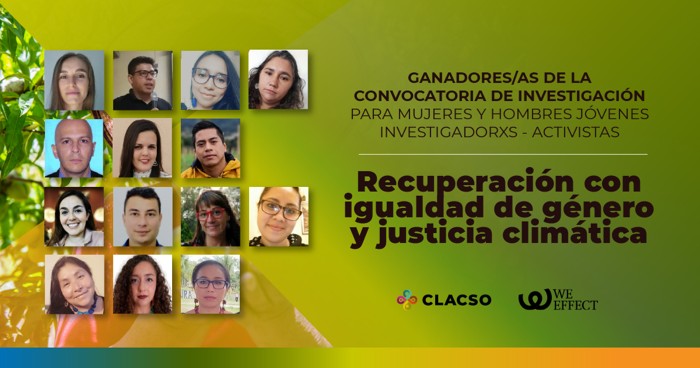
The Latin American Council of Social Sciences (CLACSO) and WE EFFECT, a Swedish cooperation organization committed to the right to food and sustainable habitat in Latin America, announce the results of the research call “Recovery with gender equality and climate justice”.
First, we would like to thank the entire research and activist community for their positive response to this call for proposals. 31 The applications were technically reviewed and then evaluated by the International Committee of Experts. This Committee considered the quality, relevance, and coherence of the projects, in accordance with the call for proposals.
The evaluation process was carried out by an International Committee composed of 14 expert evaluators of 11 countries: Bertha Zapeta, Dámaris Ruiz, Ever Guillén, Sara Avilez, Natalia Quiñonez, Manuel Dammert-Guardia, Felipe Milanez, Mina Lorena Navarro Trujillo, Denisse Roca-Servat, Eliud Torres Velázquez, Gabriela Merlinsky, Valentina Perrotta, María Cristina Cravino, Pablo Vitale.
In accordance with the above, and based on the evaluations carried out, the payroll of the 6 projects The selected list is as follows:
|
Researchers/Activists |
CLACSO Member Center |
Central Country |
Social organization |
Title of the project |
|
David Solís Aguilar, Alberto Gutierrez |
Center for Research in Culture and Development. CICDE/UNED |
Costa Rica |
Indigenous leaders of the Malelu and Ixil people |
Agencies for the food spaces of the defenders of the Ixil (Guatemala) and Maleku (Costa Rica) territories. |
|
Luz Dary Ruiz Botero, Natalia Sánchez Corrales, Carmen Alicia Acevedo Mariaca, |
University Institution College. Colegio Mayor de Antioquia. IUCMA/COLMAYOR |
Colombia |
Association of Everlasting Peasant Women |
Feminist peasant economies in recovery with gender equality and climate justice: An approach from Colombia |
|
Elizabeth Lopez Canelas, Fulvia Cartagena |
Center for Labor and Agrarian Development Studies – CEDLA |
Bolivia |
Central Indigenous Tacana Women |
A commitment to life: resilience mechanisms of the Central Indigenous Tacana Women (CIMTA) in the face of extractive expansion and the dispossession of their habitat |
|
Silvia Moreno, Daniela Pessolano, Ninfa Carrizo, Gisela Tintilay |
Secretariat of Research and Scientific Publication – Faculty of Political and Social Sciences – National University of Cuyo – SIPUC/FCPyS – UNCUYO |
Argentina |
Union of Land Workers (UTT) – Regional II of Mendoza (located in Fray Luís Beltrán) |
Horticultural families in the green belt of Mendoza: migration, (re)production and community care in the pandemic and post-pandemic context |
|
Edna Margarita Meneses Clavijo, Juan Carlos Zuluaga Díaz, Norma Esperanza Cordero Lara |
Faculty of Legal and Social Sciences – University of Caldas – JURIDICASYSOC/UCALDAS |
Colombia |
Organization of Indigenous Peoples of the Colombian Amazon - OPIAC |
Good living of indigenous women in the Colombian Amazon: A comparative study of poverty conditions among indigenous women in the department of Guainía who live in urban and rural reserve areas. |
|
Dinora Centes, Néstor Omar Wright Fernández, Héctor Moisés Aspuac Quel, Ana Noemy Mux Ramos |
Institute of Political and Social Research – School of Political Science – University of San Carlos of Guatemala – IIPS/USAC |
Guatemala |
Oxlajuj N'oj Foundation |
Community practices of food sovereignty in the community of Rancho Alegre, Sumpango Sacatepéquez. |
This ruling is irrevocable and cannot be appealed.
Buenos Aires, March 3, 2022
If you would like to receive more information about CLACSO's training programs:
[widget id=”custom_html-57″]
to our email lists.

