
Recognition of Marta Casaús Arzú
By: Marisa G. Ruiz Trejo *
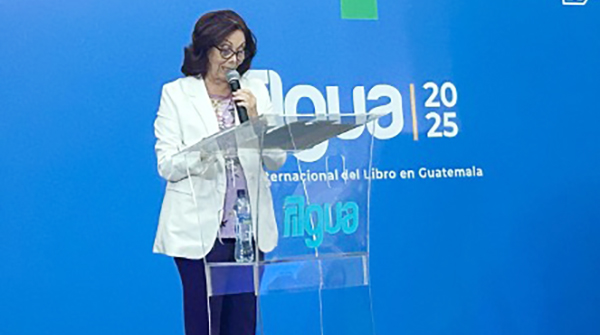
The Guatemala International Book Fair (FILGUA 2025) was the setting for a well-deserved tribute to Marta Elena Casaús Arzú, a Guatemalan critical thinker whose work has marked a milestone in studies on structural racism, power, memory, and nationhood in Central and Latin America. In honor of this well-deserved tribute, FILGUA, held from July 1 to 13, 2025, at the Foro Majadas in Guatemala City, became a space for profound dialogue on topics historically relegated to the margins: structural racism, the wounds of genocide, violence against women, and everyday discrimination. Beyond the tribute itself, the fair transformed into a collective platform for critical thought, bringing together academics, students, policymakers, artists, and activists, marking a turning point in the reaffirmation of committed and transformative Latin American thought.
This recognition of Marta Casaús Arzú aligns with numerous regional initiatives seeking to highlight the transformative role of women in critical social sciences. Among these, our research project, “Critical Thinkers and the Crises of Academic Freedom in Chiapas and Central America,” stands out. This project, funded by the CLACSO-CLAA Grant for Strengthening Comparative Research and Critical Thinking within the Framework of Academic Freedom in the Americas [1] , is coordinated by me at the Autonomous University of Chiapas, in collaboration with Ana Lucía Ramazzini (FLACSO, Guatemala) and Tania Mata Parducci (Center for the Arts for Peace of El Salvador). Its objective is to reconstruct genealogies of critical thinkers in Latin America and denounce the growing threats to freedom of thought in the region.
The legacy of Marta Casaús Arzú vindicates the central role of women in the production of Latin American critical thought. Recognizing her work also means acknowledging the urgent need to shift the center of knowledge toward historically silenced voices and affirming that thinking from a place of commitment remains a powerful form of resistance.
Marta Elena Casaús Arzú has trained generations of researchers and is an indispensable figure in the field of Latin American critical social sciences. Her work combines methodological rigor with an ethic of intellectual commitment, demonstrating that academic research can and should also function as an act of dissent, public service, and political action.
Intergenerational dialogues in honor of a committed thinker
On July 4 and 5, the reflection days “Memory, Nation and Racism” took place, bringing together prominent voices from the academic and intellectual field, committed to the recovery of historical memory, the democratic construction of the nation and the denunciation of structural racism.
One of the most significant sessions on July 4th was “The Other Faces of Racism,” which featured Mayan intellectuals such as Victoria Tubin Sotz, Delfina Mux Caná, Lina Barrios, and Bertha Zapeta, whose contributions highlighted the persistence of epistemic and structural racism from situated perspectives. Similarly, the panel “Racisms, Discriminations, and Inequalities,” moderated by Yolanda Aguilar, included Glenda Ixtabalan, Fernando Us, and María Elisa Velázquez.
On July 5th, a selection of Marta Casaús Arzú's key works was presented, focusing on the links between racism, genocide, and nationhood. Researchers Raxche' Rodríguez Guaján, Demetrio Cojtí, Luis Alberto Padilla, and Jorge Ramón González Ponciano participated in this event, analyzing the enduring relevance and critical depth of her intellectual output. Simultaneously, the panel "Art and Memory," coordinated by researcher Patricia Arroyo Calderón (UCLA), brought together artists and cultural managers such as Mayarí de León, Miguel Ángel Oxlaj Cúmez, Carlos Fredy Ochoa, and Edgar Sajcabún. Mayarí de León, daughter of the disappeared writer Luis de Lión, emphasized the power of art as a vehicle for resistance and living memory, highlighting the work of the Luis de Lión cultural project in San Juan del Obispo.
The main event of the tribute took place on July 10th and brought together prominent figures from the academic and cultural spheres, as well as family members of the honoree (Andrés, Tatiana, Alejandra, and María Hurtado de Mendoza). Distinguished researchers such as María Teresa Giraldez, Patricia Arroyo Calderón, Irma Alicia Velásquez Nimatuj, Rolando Castillo, Raúl Figueroa Sarti, and Diana López de Sánchez, director of FILGUA, were also present. This event constituted not only an individual recognition but also a collective affirmation of epistemic justice toward a thinker committed to social transformation.
Throughout the fair, there were moments of encounter, dialogue, and renewed commitment to critical thinking. Colleagues, alumni, and researchers linked to the social sciences and critical humanities of Latin America participated, including Patricia Arroyo Calderón, Georgina Hernández Rivas, Gloria Graterol, Juan Manuel Ledezma, and myself, who joined in recognizing a figure who has been a teacher, guide, and intellectual reference point for several generations.
FILGUA 2025 was not just a celebration of the book, but a collective action of memory and resistance, which highlighted the value of a life dedicated to denouncing structural racism, reclaiming historical memory and defending a social science committed to the dignity of peoples.
The power of critical thinking and the threat to academic freedom
Marta Elena Casaús Arzú's career transcends conventional tributes due to its academic rigor, ethical commitment, and political courage. Since the 1980s, her work has bridged history and memory, research and action, making fundamental contributions to critical thinking about dominant elites and racism, such as the emblematic book Guatemala: Lineage and Racism (1992) or the monumental Diagnosis of Racism in Guatemala: Interdisciplinary and Participatory Research for a Comprehensive Policy for Coexistence and the Elimination of Racism , in six volumes, aimed at transforming structures of exclusion through public policies.
In a regional context marked by violence, dispossession, and censorship of academic freedom, her figure represents an active defense of justice and memory, as evidenced by her expert testimony in emblematic legal proceedings such as the Sepur Zarco case against state agents for domestic slavery, rape, and sexual violence against Q'eqchi' women , and the genocide trial against Efraín Ríos Montt. In this scenario, many dissenting voices have been silenced, persecuted, tortured, imprisoned, forced into exile, and even murdered, which has posed serious threats to the critical production of thought and the academic freedom of diverse women.
Throughout her academic life, Marta Casaús has dedicated her voice, time, and knowledge to serving those who have been historically silenced. Driven by a radical ethic of commitment, she has worked alongside Indigenous communities and women survivors of sexual violence, relentlessly confronting the mechanisms of impunity and oblivion. Her legacy is not merely theoretical: it is profoundly political and ethical.
The recognition of Marta Casaús Arzú is also an affirmation of the place women have occupied in the production of critical thought in Central and Latin America. It acknowledges that their voices are not marginal, but central, and that their epistemic production constitutes a fundamental corpus for rethinking the present and building more just futures.
The profoundly political and ethical legacy of Marta Casaús Arzú vindicates the central role of Central American women in the production of critical thought in Latin America. Recognizing her work also means acknowledging the urgent need to shift the center of knowledge toward historically silenced voices, and affirming that thinking from a place of commitment remains a powerful form of resistance.
[1] https://cafa-claa.org/es/becas/mexico-pensadoras-criticas-y-las-crisis-de-libertad-academica-en-chiapas-y-centroamerica/
* Mexican anthropologist, researcher, journalist, and feminist activist
If you would like to receive more information about CLACSO's training programs:
[widget id=”custom_html-57″]
to our email lists.

