
Race and racism in Caribbean critical thought
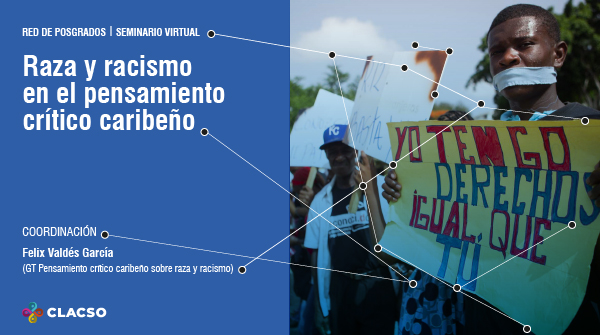
Seminar 2038
Chair: CLACSO
Coordination: Felix A. Valdés García (University of Havana, Cuba)
Teaching team: Aristinete Bernardes Oliveira Neto (University of Brasilia, Brazil), Yohanka León del Río (University of Havana, Cuba), José Antonio Matos Arévalos (Institute of Philosophy, Havana, Cuba), Camila Valdés León (University of Havana, Cuba)
Home: 17 / 09 / 2020 | Registration: 20/04/2020 al 16/09/2020
Workload: 12 weeks – 90 hours.
The study of Caribbean thought has sparked interest, motivated by questioning the very foundations of knowledge and the dominant Western traditional episteme, as well as by the significance of historical events in the region or the threatening environmental vulnerability.
Concerns about coloniality, race, discrimination based on color, gender and epistemics; the questioning of the assumptions on which knowledge has been based and, consequently, hegemonic power, have made visible the critical accumulation expressed by Caribbean thinkers.
Genocide and the concealment of indigenous roots; ecocide or devastation of the natural environment; races (indigenous and black); slavery, dependence and independence from colonial domination, the total emancipatory revolution, agricultural plantations and the development of peripheral capitalism, the critique of narrated history and the sciences used to support national projects, language, culture, and religion, all reappear time and again in academic circles and social activism, permeated by the critique and practical action developed by Caribbean thinkers and actors.
The course focuses on a current issue: skin color, race, and anti-Black racism in the Caribbean. This has allowed intellectuals in the region to move from denunciation and the phenomenology of the phenomenon to theory, philosophy, and epistemic change. The debate has fostered a theoretical and conceptual rupture that extends beyond skin color and biology, offering a reversal of Western modernity and revealing connections, concepts, theoretical tools, practical policies, and narrative modes that go beyond the topic itself. Critical intellectuals have defended the equality of human races, coined concepts such as indigenism, bobarism, mulatto identity, transculturation, Negritude, alienation by color, mimesis of the colonized, creolization, creolite, and epistemic racism. They have inverted traditional narratives, unveiled silenced events, and made visible alternative ways of understanding religion, culture, language, the arts, and philosophy in the Antilles. The purpose of the course is to distinguish the work of Caribbean thinkers on race and its theoretical-philosophical transcendence throughout history, from Las Casas, T. Louverture to the present day.
- Europe's encounter with the Other in the Caribbean islands
- Haiti: Race and Revolution
- Haiti: Race and Revolution in the Long 20th Century
- Between Negritude, Mulatto Identity, and Transculturation
- Fernando Ortiz and The Deception of Races
- Negritude – a concept for universal thought. The critical work of Aimé Césaire
- From Blackness to Decolonization: The Work of Frantz Fanon
- From Marcus Garvey to Walter Rodney: The Transcendence of Black Power in the Anglophone Caribbean
- From E. Glissant's Antillean discourse to In Praise of Creolity
- Caribbean women and insular feminism. Black feminism
- “Algeria Removes the Veil” (Sociology of a Revolution or Year V of the Algerian Revolution) Rupert Lewis, Marcus Garvey: Anti-Colonialist Champion. (Fragments).
- Aimé Césaire, “Discourse on Negritude. Negritude, Ethnicity and Afro-American Cultures.” Taken from Discourse on Colonialism, Akal, 2007. (Available in the Anthology of Contemporary Caribbean Critical Thought. West Indies, French Antilles and Dutch Antilles)
- Aimé Césaire. Discourse on Colonialism. Madrid: Akal, 2007.
- Alissa Trotz. Gender, Generation and Memory: Remembering a FutureCaribbean.
- Antenor Firmin. The Equality of Human Races. Havana, Social Sciences Publishing House, 2010. (Excerpts)
- Brian Meeks, “CY Thomas, the Authoritarian State and Revolutionary Democracy.” From Radical Caribbean: From Black Power to Abu Baker. Kingston: Press University of the West Indies, 1996. [English].
- Claude Moïse and Emile Ollivier “A heavy burden”, taken from Repenser Haïti. Grandeur et misères d'un mouvement démocratique (Montréal: Éditions du CIDIHCA) pp. 192-229, available in Spanish in Anthology of Contemporary Haitian Social Thought, CLACSO, 2018
- Constitution of Toussaint Louverture (1801) and Jean Jacques Dessalines (1805).
- Édouard Glissant. The Antillean Discourse, 2010 (fragments). In: Anthology of Contemporary Caribbean Critical Thought: West Indies, French Antilles and Dutch Antilles. Coordinator: Felix Valdés García. Buenos Aires: CLACSO, Argentina, 2017.
- Epiphany of mulatez. History and poetry. Compilation and prologue José A. Matos Arévalos. Fernando Ortiz Foundation Editorial. 2015. (Fragment)
- Fernando Ortiz against race and racism. Compilation by Jesús Guanche and José Matos. Editorial Ciencias Sociales. 2013.
- Fernando Ortiz. The Deception of Races. Havana, Social Sciences. Excerpts
- Frantz Fanon. The Wretched of the Earth (1961). Havana: Ediciones Venceremos 1965. (Fragments).
- Frantz Fanon. Black Skin, White Masks. (Fragments).
- GUILLÉN, Nicolás. Fragments of Poetic Works 1920-1958, Volume I, 1972 (“Prologue to Sóngoro cosongo”, pp. 113-114, “Negro Bembón”, “Mulata”, “Si tú Supiera…”, “La canción del bongó”, “Canto Negro”, pp. 103-105, 116-118, 122-123.
- Jacques Stephane Alexis, essay “Prolegomena to a wonderful Haitian realism”, (1956, Paris, Premier Congrès des Écrivains et Artistes Noirs).
- Jean Bernabé, Patrick Chamoiseau, and Raphaël Confiant, In Praise of Creolity, Havana: Casa de las Américas, 2014 (Fragments). In: Anthology of Contemporary Caribbean Critical Thought: West Indies, French Antilles, and Dutch Antilles. Coordinator: Felix Valdés García. Buenos Aires: CLACSO, Argentina, 2017.
- José Martí. Our America (Critical Edition)
- The Black Jacobins, CLR James, Casa de las Américas Publishing Fund.
- Michel Rolph-Trouillot, “The Haitian Revolution as a non-event”, Anthology of Contemporary Haitian Social Thought, CLACSO, 2018
- Ortiz, Fernando. “On the social phenomenon of 'transculturation' and its importance in Cuba', Cuban Counterpoint of Tobacco and Sugar, Editorial de Ciencias Sociales, 1983, pp. 86-90.
- Ortiz, Fernando. “The xylophonic key of Cuban music”, The instruments of Afro-Cuban music: The anatomical instruments and the percussive sticks. Volume I, Publications of the Directorate of Culture of the Ministry of Education, 1952, (fragments).
- Ortiz, Fernando. Epiphany of Mulatto Identity: History and Poetry, Fernando Ortiz Foundation, 2015. (Fragments).
- Quijano, A. (1991). "Coloniality and modernity/rationality." Indigenous Peru Vol. 13 (No. 29): 11-29; and, What about races. Venezuelan Journal of Economics and Social Sciences 2000, Vol. 6 No. 1 (Jan.-Apr.), 37-45
- René Depestre “Homo Papadocus”, Casa Magazine, no. 96, May-June, 1976, pp. 84-91.
- René Depestre. Good morning and goodbye to blackness, Havana, Casa de las Américas Publishing Fund, 1980. (Chapter 2. Available in the Anthology of contemporary Haitian critical thought).
- Rhoda Reddock. Feminism, Nationalism and the Early Women's Movement in the English-Speaking Caribbean (With Special Reference to Jamaica and Trinidad and Tobago).
- Suzy Castor, “Part IV. The accommodation of the neocolonial apparatus”, The North American occupation…, Fondo Editorial Casa de las Américas, 1981, pp. 105-126.
- Violet Eudine Barriteau. “Contributions of Black feminism to feminist thought: a Caribbean perspective.”
- Walter Rodney, “Black Power – Its relevance to the West Indies” [in English]. Taken from The Groundings with My Brothers. London, 1990. [There is a Spanish version in the Anthology of Critical Thought]
If you have a link with a CLACSO Associated Center:
- Paying in one payment: USD 95 (includes issuance and shipping costs of the digital certificate).
- Paying in one payment: USD 140 (includes issuance and shipping costs of the digital certificate).
- Paying in one payment BEFORE 25/08/2020: USD 150 (includes issuance and shipping costs of the digital certificate).
- Paying in one payment: USD 190 (includes issuance and shipping costs of the digital certificate).
FAQ
The basic requirements for taking a seminar are:
- Availability of at least 4 hours per week to dedicate to the seminar course.
- Internet access.
- Reasonable handling of communication and computer tools.
- Language proficiency in the language in which the course will be taught. The official languages are Spanish and Portuguese.
If you have a link with a CLACSO Associated Center:
- Paying in one payment: USD 95 (includes issuance and shipping costs of the digital certificate).
- Paying in one payment: USD 140 (includes issuance and shipping costs of the digital certificate).
- Paying in one payment BEFORE 25/08/2020: USD 150 (includes issuance and shipping costs of the digital certificate).
- Paying in one payment: USD 190 (includes issuance and shipping costs of the digital certificate).

